
Research of salivary glands
Ultrasound of the salivary glands is a diagnostic imaging procedure used to examine the salivary glands. It helps in assessing the size, structure, and any abnormalities or pathologies such as stones, cysts, or tumors within the glands.
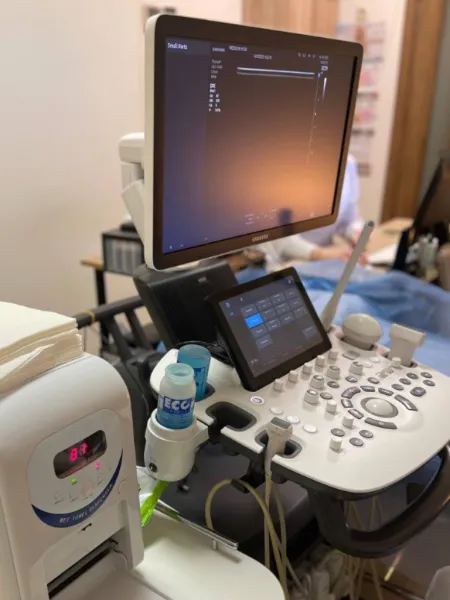
Ultrasound examination of the salivary glands is a non-invasive, safe, and highly informative diagnostic method that allows for the assessment of the condition of the parotid, submandibular, and sublingual glands. With the help of ultrasound, a doctor can detect inflammatory processes, tumors, cysts, stones, and other pathologies at an early stage without the need for complex procedures or radiation exposure.
When is an ultrasound of the salivary glands prescribed?
This examination is conducted both in the presence of complaints and for preventive purposes. The main indications for ultrasound include:
- Enlargement or tenderness of the salivary gland
- Swelling, hardening, or facial asymmetry
- Dry mouth, impaired salivation
- Suspected inflammation (sialadenitis) or duct obstruction
- Diagnosis of stones (sialolithiasis)
- Post-operative and trauma monitoring
- Monitoring of tumors and cysts
What does an ultrasound of the salivary glands show?
Ultrasound diagnostics allow the doctor to:
- Assess the size, structure, and shape of the salivary glands
- Detect inflammatory processes and determine their nature
- Identify the presence of stones, cysts, or tumors
- Determine the degree of duct obstruction and impaired saliva flow
- Evaluate blood flow and the presence of pathological vessels
Advantages of ultrasound of the salivary glands:
✅ Complete safety — no radiation exposure, the examination can be performed on children and pregnant women
✅ Painlessness and comfort — the procedure does not cause discomfort
✅ High accuracy — allows for the detection of even minor structural changes
✅ Accessibility and speed — takes 10–15 minutes and requires no preparation
How the procedure is conducted:
The patient is positioned lying down or sitting. A special gel is applied to the area of examination, after which the doctor moves the transducer over the skin in the area of the parotid, submandibular, and sublingual glands. The procedure is completely painless, requires no preparation, and can be performed multiple times.
💡 Ultrasound of the salivary glands is a simple, safe, and accurate way to detect salivary gland diseases at an early stage. Timely diagnosis helps to avoid complications and start treatment as early as possible.
When is an ultrasound of the salivary glands prescribed?
This examination is conducted both in the presence of complaints and for preventive purposes. The main indications for ultrasound include:
- Enlargement or tenderness of the salivary gland
- Swelling, hardening, or facial asymmetry
- Dry mouth, impaired salivation
- Suspected inflammation (sialadenitis) or duct obstruction
- Diagnosis of stones (sialolithiasis)
- Post-operative and trauma monitoring
- Monitoring of tumors and cysts
What does an ultrasound of the salivary glands show?
Ultrasound diagnostics allow the doctor to:
- Assess the size, structure, and shape of the salivary glands
- Detect inflammatory processes and determine their nature
- Identify the presence of stones, cysts, or tumors
- Determine the degree of duct obstruction and impaired saliva flow
- Evaluate blood flow and the presence of pathological vessels
Advantages of ultrasound of the salivary glands:
✅ Complete safety — no radiation exposure, the examination can be performed on children and pregnant women
✅ Painlessness and comfort — the procedure does not cause discomfort
✅ High accuracy — allows for the detection of even minor structural changes
✅ Accessibility and speed — takes 10–15 minutes and requires no preparation
How the procedure is conducted:
The patient is positioned lying down or sitting. A special gel is applied to the area of examination, after which the doctor moves the transducer over the skin in the area of the parotid, submandibular, and sublingual glands. The procedure is completely painless, requires no preparation, and can be performed multiple times.
💡 Ultrasound of the salivary glands is a simple, safe, and accurate way to detect salivary gland diseases at an early stage. Timely diagnosis helps to avoid complications and start treatment as early as possible.


