
Ultrasound Doppler (USDG) of the lower limb vessels
Doppler ultrasound of the lower limb vessels — diagnostics of the veins and arteries of the legs.
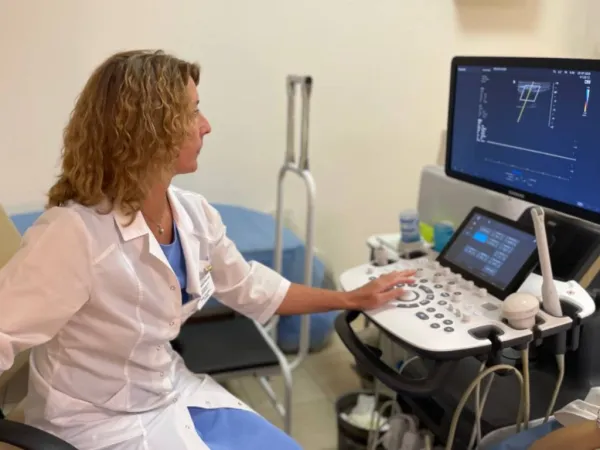
Ultrasound Dopplerography (USDG) of the lower limb vessels is a modern non-invasive diagnostic method that allows for the assessment of the condition of the arteries and veins in the legs, determining the speed and direction of blood flow, identifying vascular disorders at an early stage, and preventing the development of serious complications.
The examination is completely safe, painless, and does not require complex preparation. It can be performed at any age—from young people with a hereditary predisposition to elderly patients with chronic vascular diseases.
What Dopplerography of the leg vessels shows
During the examination, the doctor evaluates:
🩸 The condition of the venous system—venous patency, valve function, presence of varicose veins, reflux (reverse blood flow), thrombosis, or phlebitis.
🫀 Arterial blood flow—speed and direction of blood flow, presence of narrowing (stenosis), atherosclerotic plaques, thrombosis, or occlusions.
🔬 The condition of deep and superficial veins—their structure, diameter, wall elasticity, and possible changes in chronic venous insufficiency are determined.
📈 Tissue blood supply—assessed to determine if enough blood is reaching the muscles and skin, which is especially important in diabetes, ischemia, and metabolic disorders.
When to have an ultrasound Doppler of the lower limb vessels
The examination is recommended for the following symptoms:
heaviness, swelling, a feeling of fullness, or pain in the legs;
appearance of a vascular network, varicose nodes, or trophic skin changes;
cramps, numbness, or coldness of the feet and calves;
skin color changes (pallor, cyanosis);
appearance of wounds that do not heal for a long time;
suspicion of thrombosis or chronic venous insufficiency.
USDG is also indicated for people at risk:
– with a sedentary lifestyle or constant leg strain;
– with excess weight;
– smokers;
– with diabetes, hypertension, or atherosclerosis;
– before surgical operations on vessels or varicose veins.
Advantages of Dopplerography of the leg vessels
✅ Painless and safe examination
✅ No radiation exposure
✅ Ability to detect vascular pathologies early
✅ High accuracy and informativeness
✅ Can be used to monitor treatment effectiveness
How the procedure is conducted
The patient lies down. The doctor applies a special gel and uses an ultrasound sensor to sequentially examine the leg vessels—from the groin area to the feet. The procedure takes 20–30 minutes, and the results are provided immediately after the examination.
Why it is important to undergo Dopplerography regularly
Diseases of the lower limb vessels are among the most common and insidious: they often develop unnoticed and progress for a long time without pronounced symptoms. Early diagnosis using ultrasound Dopplerography allows for timely treatment, preventing the formation of blood clots, trophic ulcers, chronic venous insufficiency, and even gangrene.
📍Schedule a Dopplerography of the lower limb vessels at our clinic—and learn about the condition of your vessels today!
The examination is completely safe, painless, and does not require complex preparation. It can be performed at any age—from young people with a hereditary predisposition to elderly patients with chronic vascular diseases.
What Dopplerography of the leg vessels shows
During the examination, the doctor evaluates:
🩸 The condition of the venous system—venous patency, valve function, presence of varicose veins, reflux (reverse blood flow), thrombosis, or phlebitis.
🫀 Arterial blood flow—speed and direction of blood flow, presence of narrowing (stenosis), atherosclerotic plaques, thrombosis, or occlusions.
🔬 The condition of deep and superficial veins—their structure, diameter, wall elasticity, and possible changes in chronic venous insufficiency are determined.
📈 Tissue blood supply—assessed to determine if enough blood is reaching the muscles and skin, which is especially important in diabetes, ischemia, and metabolic disorders.
When to have an ultrasound Doppler of the lower limb vessels
The examination is recommended for the following symptoms:
heaviness, swelling, a feeling of fullness, or pain in the legs;
appearance of a vascular network, varicose nodes, or trophic skin changes;
cramps, numbness, or coldness of the feet and calves;
skin color changes (pallor, cyanosis);
appearance of wounds that do not heal for a long time;
suspicion of thrombosis or chronic venous insufficiency.
USDG is also indicated for people at risk:
– with a sedentary lifestyle or constant leg strain;
– with excess weight;
– smokers;
– with diabetes, hypertension, or atherosclerosis;
– before surgical operations on vessels or varicose veins.
Advantages of Dopplerography of the leg vessels
✅ Painless and safe examination
✅ No radiation exposure
✅ Ability to detect vascular pathologies early
✅ High accuracy and informativeness
✅ Can be used to monitor treatment effectiveness
How the procedure is conducted
The patient lies down. The doctor applies a special gel and uses an ultrasound sensor to sequentially examine the leg vessels—from the groin area to the feet. The procedure takes 20–30 minutes, and the results are provided immediately after the examination.
Why it is important to undergo Dopplerography regularly
Diseases of the lower limb vessels are among the most common and insidious: they often develop unnoticed and progress for a long time without pronounced symptoms. Early diagnosis using ultrasound Dopplerography allows for timely treatment, preventing the formation of blood clots, trophic ulcers, chronic venous insufficiency, and even gangrene.
📍Schedule a Dopplerography of the lower limb vessels at our clinic—and learn about the condition of your vessels today!


