
Trepan-biopsy of the breast under ultrasound guidance
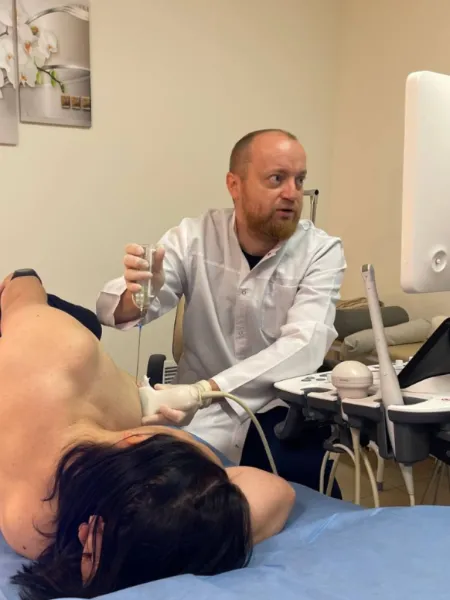
Ultrasound-guided core needle biopsy of the breast is a method of obtaining breast tissue for laboratory examination using a core needle, with the procedure being performed under ultrasound guidance. This allows the physician to accurately direct the needle to the desired location, even if the tumor or lesion is small or not easily palpable. Ultrasound helps in accurately and safely obtaining samples from suspicious areas of the breast.
Indications for ultrasound-guided core needle biopsy:
• Presence of nodules or tumors that are not visible on mammography but can be well visualized on ultrasound.
• Suspicion of malignant changes in the breast.
• Need to clarify the diagnosis after a standard needle aspiration or other examinations.
• Monitoring and examination of tissues in cases of ambiguous results from previous tests.
Purpose of the procedure:
Core needle biopsy allows for the precise determination of the nature of the lesion—whether benign or malignant. The procedure helps avoid unnecessary surgeries and provides doctors with the necessary information to prescribe the most appropriate treatment if needed.
Duration of the procedure:
The procedure usually takes 20–30 minutes. It is performed under local anesthesia, making it quite comfortable for the patient. After the biopsy, the patient may feel some discomfort at the puncture site, but generally, a return to normal activities is possible almost immediately.
Indications for ultrasound-guided core needle biopsy:
• Presence of nodules or tumors that are not visible on mammography but can be well visualized on ultrasound.
• Suspicion of malignant changes in the breast.
• Need to clarify the diagnosis after a standard needle aspiration or other examinations.
• Monitoring and examination of tissues in cases of ambiguous results from previous tests.
Purpose of the procedure:
Core needle biopsy allows for the precise determination of the nature of the lesion—whether benign or malignant. The procedure helps avoid unnecessary surgeries and provides doctors with the necessary information to prescribe the most appropriate treatment if needed.
Duration of the procedure:
The procedure usually takes 20–30 minutes. It is performed under local anesthesia, making it quite comfortable for the patient. After the biopsy, the patient may feel some discomfort at the puncture site, but generally, a return to normal activities is possible almost immediately.


