

In Brief
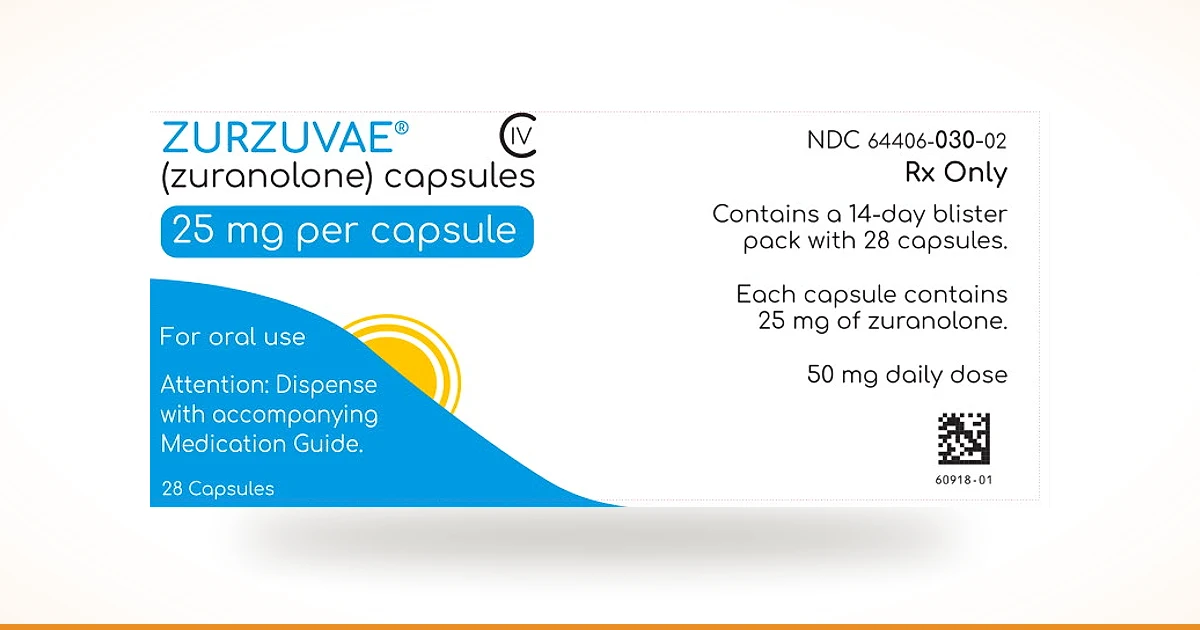
What it is. Zuranolone (brand name Zurzuvae) is a tablet for postpartum depression. The course runs 14 days, then dosing stops.
Why it matters. It is not an antidepressant in the usual sense: it acts not through serotonin but by replacing a neurosteroid that collapsed after birth. Separation from placebo is visible by day three.
Who it is for. Women with postpartum depression. Not depression in general — there is no approval for major depressive disorder outside the postpartum period.
What Collapses After Birth
Progesterone has a metabolite: allopregnanolone. It is a neurosteroid — a substance produced partly in the brain itself and acting directly on how the brain works. Its job is to strengthen GABA, the main inhibitory system of the nervous system. In plain terms, it turns excitation down.
Through pregnancy its level rises many-fold, and the brain gradually adjusts to that high background: receptor sensitivity shifts and the system settles into a new equilibrium.
After birth the level falls within hours. In most women the receptors readjust. In some they do not, and the inhibitory system is left destabilised. That is the biological trigger of postpartum depression — on top of sleeplessness, workload and everything else a newborn brings.
Why an Ordinary Antidepressant Is Slow Here
Standard antidepressants work through the serotonin system. They do not replace a deficit directly; they change the conditions the brain then adapts to over weeks. Hence the familiar two to four weeks before an effect appears.
For a woman with a newborn that is a very long time. Depression in this period does not strike her alone: bonding with the child suffers, and so does the whole family.
Zuranolone is built on a different logic: return the missing piece rather than retune the system. It reproduces the action of allopregnanolone, strengthening GABA receptors — including the extrasynaptic ones that set overall inhibitory tone.
| Antidepressants (SSRIs) | Zuranolone | |
|---|---|---|
| Target | Serotonin system | GABA receptors via a neurosteroid |
| Time to effect | Weeks | Days (separation from day 3) |
| Duration of dosing | Months | 14 days |
| Indication in postpartum depression | Yes (general) | Yes (specific) |
| Indication in ordinary depression | Yes | No |
What the Trials Showed
▸ SKYLARK (Am J Psychiatry, 2023) — 196 patients with postpartum depression. By day 15 the HAM-D score had fallen by 15.6 points versus 11.6 on placebo (difference −4.0; 95% CI −6.3 to −1.7). Separation was recorded as early as day 3 and held at days 28 and 45. The most frequent adverse events were somnolence, dizziness and sedation. No loss of consciousness, withdrawal symptoms or increase in suicidal ideation was observed [1].
▸ ROBIN (JAMA Psychiatry, 2021) — 153 patients. By day 15, −17.8 versus −13.6 points (difference −4.2; p=0.003), with differences holding from day 3 through day 45. The odds of response rose roughly 2.6-fold and of remission about 2.5-fold [2].
Note the placebo arms: −11.6 and −13.6 points. That is a lot. In depression the placebo effect and natural improvement are always large, so the drug's own figure means nothing on its own — only the difference counts, and it came to about 4 points.
How It Is Taken
| Parameter | Detail |
|---|---|
| Formulation | Capsules |
| When | In the evening, with a fatty meal |
| Course | 14 days, then stop |
| Driving | Prohibited for at least 12 hours after a dose |
| Status | Controlled substance |
| Follow-up | Clinical assessment during the course |
Evening dosing is not a convention but a way of placing the peak of sedation inside the night.
Constraints to Know Before Starting
▸ Sedation. Somnolence and dizziness are the most frequent effects. The boxed warning says it plainly: the ability to drive is impaired, and the woman may not realise how much.
▸ Care of the baby. Across the two weeks someone must be available to take night care. This is agreed before starting, not improvised along the way.
▸ Breastfeeding. Data on passage into milk exist but are limited; the decision is individual.
▸ Controlled substance. Hence the specific prescribing and dispensing arrangements.
What Cannot Be Claimed Yet
▸ That it works in depression outside the postpartum period — that application was declined by the FDA.
▸ That it is better than antidepressants: no head-to-head trials against SSRIs have been run, only indirect comparisons, which do not substitute for that conclusion.
▸ What happens after day 45 — the trials did not follow patients that far.
▸ That it replaces therapy and support: the drug takes the edge off, but it solves neither sleeplessness, nor isolation, nor the absence of help at home.
Who It Is Not For
▸ Women with depression outside the postpartum period, under the current indication.
▸ Anyone who will be alone with the baby for two weeks: sedation makes that unsafe.
▸ Anyone counting on driving as usual.
▸ As a substitute for monitoring: severe postpartum depression with suicidal thoughts needs immediate help, not a wait for a tablet to work.
Bottom Line
▸ A physiological mechanism: the drug reproduces the allopregnanolone that collapsed after birth and, through GABA, gives the inhibitory system its footing back.
▸ Speed: separation from placebo is visible from the third day, not after a month.
▸ A 14-day course, not months of dosing; in the trials the effect held to day 45.
▸ The price of that speed — sedation, a driving ban and the need for a helper during the course.
▸ Strictly one indication: postpartum depression. Neither the data nor the regulator allowed extending it to depression at large.
The condition can be discussed at a consultation; the drug can be ordered here.
References
1. Deligiannidis KM, et al. Zuranolone for the Treatment of Postpartum Depression. Am J Psychiatry. 2023;180(9):668–675. PMID 37491938
2. Deligiannidis KM, et al. Effect of Zuranolone vs Placebo in Postpartum Depression: A Randomized Clinical Trial. JAMA Psychiatry. 2021;78(9):951–959. PMID 34190962
3. Deligiannidis KM, et al. Zuranolone Concentrations in the Breast Milk of Healthy, Lactating Individuals: Results From a Phase 1 Open-Label Study. J Clin Psychopharmacol. 2024;44(4):337–344. PMID 38739007
4. ZURZUVAE (zuranolone) — US Prescribing Information, Sage Therapeutics and Biogen.


