

Key points
A cold may pass faster. In a 2024 Cochrane review, zinc started during a cold that was already under way may have shortened it by 2.4 days on average; the certainty of the evidence is low (Nault D Cochrane Database Syst Rev 2024. PMID 38719213).
Fewer infections in older people. In one study, 50 healthy people aged 55–87 took 45 mg of zinc a day for a year (this is above the upper limits); they had fewer infections than on placebo (Prasad AS Am J Clin Nutr 2007. PMID 17344507).
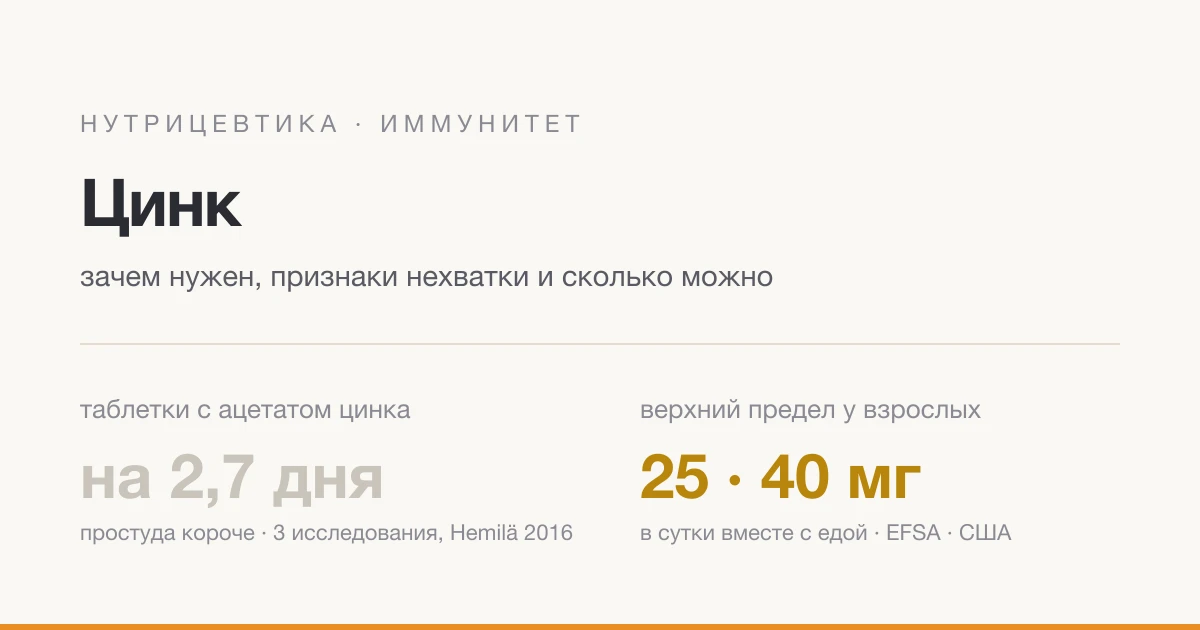
Zinc lozenges. In a pooled analysis of three trials (199 patients), zinc acetate lozenges shortened colds by 2.7 days, with an average cold lasting 7 days; the effect did not depend on allergy, smoking, age or sex (Hemilä H Br J Clin Pharmacol 2016. PMID 27378206).
Ways to top up. Vegetarians have less zinc on average. The review authors suggest considering zinc-fortified foods or small doses of supplements — for vegetarians with a low intake or with zinc near the lower end of normal (Foster M J Sci Food Agric 2013. PMID 23595983).
More is not better. Excess zinc may suppress copper absorption (Stiles LI Clin Exp Med 2024. PMID 38367035); anemia and nerve damage due to copper deficiency have been described (Willis MS Am J Clin Pathol 2005. PMID 15762288).
Why the body needs zinc
Zinc is part of more than 200 enzymes. It is needed for immunity, cell division, skin and wound healing, and for the metabolism of sex hormones and thyroid hormones, growth hormone and insulin (Burgerstein, Handbuch Nährstoffe 2015, p. 106–107).
The body cannot store zinc in any significant amount, so it has to come regularly with food (Stiles LI Clin Exp Med 2024. PMID 38367035). Sources include, for example, meat, seafood, eggs and cheese; zinc from animal foods is absorbed better (Burgerstein, Handbuch Nährstoffe 2015, p. 109).
Who is more often short of zinc
Vegetarians and vegans. In a review of 26 studies, serum zinc in vegetarians was on average 0.93 µmol/L (about 6 µg/dL) lower than in people who eat meat. The difference is larger in women and vegans (Foster M J Sci Food Agric 2013. PMID 23595983).
Older people. In older people, plasma zinc can be lower than in younger adults (Prasad AS Am J Clin Nutr 2007. PMID 17344507); part of the difference may be explained by inflammation, which also lowers plasma zinc (King JC J Nutr 2016. PMID 26962190).
Gut diseases and medicines. Acquired deficiency usually shows up in adulthood; one of the risk factors is poor absorption in the gut, and deficiency can also be caused by diuretics and by angiotensin receptor blockers — blood pressure medicines (Stiles LI Clin Exp Med 2024. PMID 38367035). The handbook adds cortisone, non-steroidal anti-inflammatory drugs (NSAIDs) and penicillamine (Burgerstein, Handbuch Nährstoffe 2015, p. 111).
A diet that hinders absorption. Zinc absorption is reduced by phytates from grains and legumes, by calcium and by casein — a milk protein (Stiles LI Clin Exp Med 2024. PMID 38367035), as well as by phosphorus and fiber (Burgerstein, Handbuch Nährstoffe 2015, p. 108).
How to suspect a deficiency
The handbook lists these signs: hair loss, weaker taste and smell, slow wound healing (Burgerstein, Handbuch Nährstoffe 2015, p. 108). All of them also happen for other reasons — for example, hair also falls out when iron is low: Ferritin and hair: how much iron you need.
Testing is tricky: zinc in plasma or serum changes after meals, over the course of the day, with inflammation and with some medicines, and experts do not recommend zinc in hair, nails or urine for assessment. That is why the test is interpreted together with diet and risk factors (King JC J Nutr 2016. PMID 26962190).
What supplements showed
Colds. In the Cochrane review, lozenges were the form given most often, and the studies differed a lot (Nault D Cochrane Database Syst Rev 2024. PMID 38719213).
Acne. For 3 months, 332 patients received 30 mg of zinc or the antibiotic minocycline. Zinc did worse: success — inflammatory lesions falling by more than two thirds — was seen in 31.2% vs 63.4%; there was no placebo group (Dreno B Dermatology 2001. PMID 11586012).
What the studies showed
| What was tested | Who took part | Result |
|---|---|---|
| Zinc for a cold that has started, Cochrane review, 2024 | 8 studies, 972 people | Cold shorter by 2.4 days on average; low certainty |
| Zinc to prevent colds, same review | 9 studies, 1449 people | No reduction in risk was shown; low certainty |
| Zinc acetate lozenges, 2016 | 3 studies, 199 patients | Cold shorter by 2.7 days, with an average cold lasting 7 days |
| 45 mg of zinc a day for a year, 2007 | 50 healthy people aged 55–87 | Fewer infections than on placebo; dose above the upper limits |
| 30 mg of zinc vs minocycline, 3 months, 2001 | 332 patients with inflammatory acne | Zinc did worse: success in 31.2% vs 63.4%; no placebo |
| Zinc by mouth for leg ulcers, Cochrane review, 2014 | 6 small studies, 183 people | Faster healing was not shown |
| Excess zinc, case report, 2005 | 3 patients | Copper deficiency: anemia, neutropenia, neuropathy in two |
Not everything is equally proven: no effect was shown for preventing colds (low certainty) or for healing leg ulcers (Nault D Cochrane Database Syst Rev 2024. PMID 38719213; Wilkinson EA Cochrane Database Syst Rev 2014. PMID 25202988).
How much is safe
According to a review, the intake reference estimated by the World Health Organization (WHO) is 6.7–15 mg of zinc a day (Schoofs H Molecules 2024. PMID 38999082); the handbook gives 15 mg (Burgerstein, Handbuch Nährstoffe 2015, p. 154). The upper limit for adults, in total with food, is 25 mg a day according to the European Food Safety Authority (EFSA) and 40 mg in the US (Schoofs H Molecules 2024. PMID 38999082); limits for children are lower.
For acne, the handbook gives its authors’ doses of 60–90 mg a day (Burgerstein, Handbuch Nährstoffe 2015, p. 110) — these are regimens from the 1980s, and current guidelines are more cautious. It describes harm to immunity only above 150 mg a day (Burgerstein, Handbuch Nährstoffe 2015, p. 111), but intake above the recommended level may cause anemia, neutropenia and copper deficiency (Schoofs H Molecules 2024. PMID 38999082), and today’s limits are 4–6 times lower.
Zinc, copper and iron
Zinc and copper push each other out (Burgerstein, Handbuch Nährstoffe 2015, p. 136), and excess zinc may suppress the absorption of copper and iron — hence copper deficiency and anemia (Stiles LI Clin Exp Med 2024. PMID 38367035).
Copper deficiency is easy to miss. In a report of three cases there were anemia and neutropenia — low neutrophils, the cells that protect against bacteria — and in two patients neuropathy (nerve damage), which worsened for 8 and 18 months until the cause was suspected from the bone marrow (Willis MS Am J Clin Pathol 2005. PMID 15762288).
With more than 25 mg a day for longer than 6 weeks, a deficiency of copper, manganese, calcium and iron is possible (Burgerstein, Handbuch Nährstoffe 2015, p. 112). If you take zinc together with iron or calcium, it is better to discuss the regimen with a doctor.
Who should be more careful
- People who take more than 25 mg of zinc a day for longer than 6 weeks: a doctor may check copper and iron (Burgerstein, Handbuch Nährstoffe 2015, p. 112).
- People who develop numbness, anemia or low white blood cells on a blood test during long-term zinc use: tell your doctor about the zinc right away (Willis MS Am J Clin Pathol 2005. PMID 15762288).
- People taking the antibiotics ciprofloxacin or doxycycline, or risedronate for osteoporosis: zinc taken by mouth may reduce their absorption (Stiles LI Clin Exp Med 2024. PMID 38367035).
- People treating a cold with zinc: non-serious side effects (in the review these included, for example, an unpleasant taste and stomach upset) are probably about a third more common than on placebo (Nault D Cochrane Database Syst Rev 2024. PMID 38719213).
Bottom line
Vegetarians have less zinc on average, older people can have lower plasma zinc, and gut diseases and some medicines make a deficiency more likely. Supplements may shorten a cold; for acne, zinc did worse than an antibiotic. The upper limit for adults, in total with food, is 25 mg a day by the European estimate and 40 mg in the US, lower for children; excess may lead to copper deficiency. Whether you need zinc, and at what dose, can be worked out at a consultation.
This material is for information only and does not replace a doctor’s consultation. The zinc dose and the need to monitor copper are decided by a doctor.


