

Key points
Most vitamins and minerals can be taken together; for a few pairs there are simple rules.
| Where it applies | How it helps | What human studies showed |
|---|---|---|
| Levothyroxine and calcium, iron, magnesium | calcium and iron salts are spaced 3–4 hours apart from it; magnesium sensibly the same way | magnesium interferes less: in 15 healthy volunteers, magnesium aspartate lowered thyroxine absorption by 12% (significant), citrate by 7% (not significant) (Attinger MC Clin Transl Sci 2025. PMID 41221788) |
| Tetracyclines, fluoroquinolones and minerals | the antacid 4 hours before the antibiotic or 2 hours after | — |
| Warfarin and vitamin K | instead of giving up leafy greens — a roughly constant amount of vitamin K in the diet | in a review of 11 studies, restricting vitamin K in food apparently did not improve treatment (Violi F Medicine (Baltimore) 2016. PMID 26962786) |
| Calcium and iron | with normal iron stores, spacing them apart is, according to the available data, not necessary | in 11 adults with normal iron stores, half a year of 1200 mg of calcium a day did not change haemoglobin or ferritin (Minihane AM Am J Clin Nutr 1998. PMID 9665102); in a meta-analysis haemoglobin did not fall (Abioye AI J Nutr 2021. PMID 33758936) |
| Iron and vitamin C | vitamin C with iron is optional | in 440 adults with iron deficiency anaemia, haemoglobin rose over 2 weeks by 18.4 g/L without vitamin C and by 20.0 g/L with it; the difference was within the preset margin of 10 g/L (Li N JAMA Netw Open 2020. PMID 33136134) |
| Iron and coffee | coffee an hour before a meal | in people with normal iron stores, coffee an hour before a meal did not lower iron absorption from it (Morck TA Am J Clin Nutr 1983. PMID 6402915) |
| Vitamin D and food | with a meal that contains fat | in 50 older people, after a single dose the peak blood level of vitamin D3 was 32% higher with a breakfast containing fat than with a fat-free one (Dawson-Hughes B J Acad Nutr Diet 2015. PMID 25441954) |
| High-dose zinc and copper | more than 25 mg of zinc a day for longer than 6 weeks — monitor copper | in a review of 37 cases of copper deficiency caused by zinc (from roughly 50 mg a day), after zinc was stopped and copper given, the blood usually recovered, while nerve problems recovered more slowly and not always fully (Dutta A Biol Trace Elem Res 2026. PMID 42087025) |
What really matters
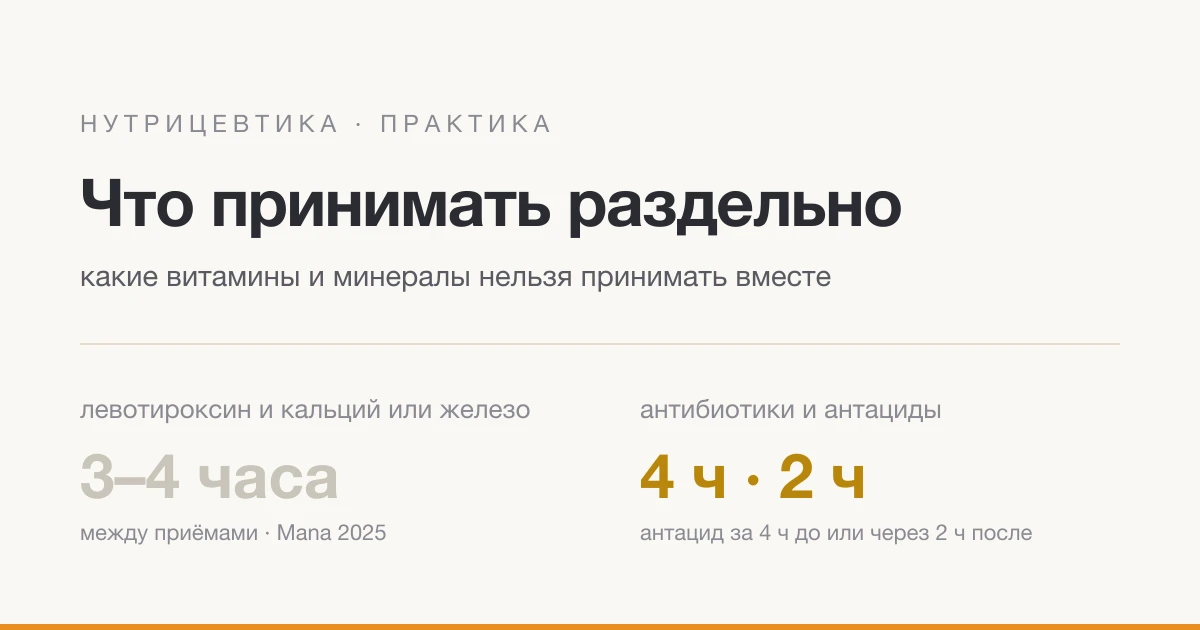
Thyroid pills. Levothyroxine is absorbed less well together with calcium and iron salts; a review advises spacing them 3–4 hours apart (Mana DL Medicina (B Aires) 2025. PMID 41109285). Magnesium interferes less (Attinger MC Clin Transl Sci 2025. PMID 41221788). More in the article Iron and thyroid pills.
Two groups of antibiotics. Tetracyclines (for example, doxycycline) and fluoroquinolones (for example, ciprofloxacin) bind to metal ions from antacids (chelation) and are absorbed less well. A review advises taking the antacid 4 hours before the antibiotic or 2 hours after (Ogawa R Drugs 2011. PMID 21942976); for mineral supplements this interval is carried over from antacids. The exact timing differs for each antibiotic, so check the package leaflet.
High-dose zinc and copper. The handbook advises monitoring copper as soon as you take more than 25 mg of zinc a day for longer than 6 weeks (Burgerstein, Handbuch Nährstoffe 2015, p. 112, 136). A systematic review collected 37 cases of copper deficiency caused by zinc at doses from roughly 50 to more than 1500 mg a day. Almost all of them had anaemia; after zinc was stopped and copper given, the blood usually recovered, while nerve problems recovered more slowly and not always fully (Dutta A Biol Trace Elem Res 2026. PMID 42087025). On reasonable doses — in the article Zinc: why you need it and how much is safe.
Warfarin and vitamin K. The authors of a systematic review (2 interventional and 9 observational studies) advise keeping vitamin K intake roughly constant: restricting vitamin K in food apparently does not improve treatment, and an effect may be noticeable only at intakes above 150 µg a day (Violi F Medicine (Baltimore) 2016. PMID 26962786).
What matters less than it seems
Calcium and iron. In 11 adults with normal iron stores, half a year of taking 1200 mg of calcium a day did not change haemoglobin or ferritin (iron stores), although in 14 volunteers 400 mg of calcium with each meal lowered iron absorption over a day from 15.8% to 4.7% (Minihane AM Am J Clin Nutr 1998. PMID 9665102). In a meta-analysis haemoglobin did not fall, although the more calcium, the lower the ferritin, and iron absorption in short experiments was lower by an average of 5.6 percentage points (Abioye AI J Nutr 2021. PMID 33758936).
Vitamin C and iron. The handbook states that vitamin C markedly increases iron uptake (Burgerstein, Handbuch Nährstoffe 2015, p. 89, 114–115). But in a randomised trial, 440 adults with iron deficiency anaemia (97% women) took one 100 mg ferrous succinate tablet (this is the weight of the salt; it contains less iron) three times a day — with 200 mg of vitamin C or without. Over 2 weeks haemoglobin rose by 20.0 g/L (2.00 g/dL) and 18.4 g/L (1.84 g/dL): the difference fell within the preset margin of 10 g/L (1 g/dL) (Li N JAMA Netw Open 2020. PMID 33136134).
Coffee and tea with iron. Coffee an hour before a meal did not lower iron absorption from it, while coffee an hour after the meal interfered as much as coffee drunk with it. A cup of coffee lowered iron absorption from a hamburger meal by 39%, and tea by 64% (Morck TA Am J Clin Nutr 1983. PMID 6402915). Tannins in tea and coffee reduce iron uptake (Burgerstein, Handbuch Nährstoffe 2015, p. 113).
Fat-soluble vitamins and food. With a single dose of 50,000 IU (1,250 µg) of vitamin D3, a breakfast with fat gave a 32% higher peak blood level than a fat-free one (Dawson-Hughes B J Acad Nutr Diet 2015. PMID 25441954). More in the article Vitamin D in winter.
What to space apart, and by how many hours
- Levothyroxine and calcium, iron — 3–4 hours (Mana DL Medicina (B Aires) 2025. PMID 41109285); magnesium interferes less (Attinger MC Clin Transl Sci 2025. PMID 41221788), and it is sensibly spaced apart the same way.
- Tetracyclines, fluoroquinolones and antacids — the antacid 4 hours before or 2 hours after the antibiotic (Ogawa R Drugs 2011. PMID 21942976); the exact timing differs for each antibiotic, so check the package leaflet.
- Iron and coffee — coffee an hour before a meal (Morck TA Am J Clin Nutr 1983. PMID 6402915).
- Calcium and iron — with normal iron stores, spacing them apart is, according to the available data, not necessary (Abioye AI J Nutr 2021. PMID 33758936).
Who should see a doctor first
- People taking levothyroxine: if you start or stop calcium, iron or magnesium, tell your endocrinologist.
- People being treated with tetracyclines or fluoroquinolones: check the interval with minerals with your doctor.
- People taking more than 25 mg of zinc a day for longer than 6 weeks: discuss copper monitoring with your doctor; the review has no data for doses of 25–50 mg.
- People taking warfarin: do not start or stop vitamin K supplements without your doctor.
- People taking anticoagulants: start high doses of vitamin C only after talking to your doctor — the handbook warns that they weaken the effect of these medicines (Burgerstein, Handbuch Nährstoffe 2015, p. 91).
Bottom line
Most vitamins and minerals can be taken together. A few pairs have simple rules: levothyroxine and two groups of antibiotics are spaced apart from minerals, copper is monitored on high doses of zinc, and on warfarin vitamin K intake is kept roughly constant. You can put together a regimen that suits your medicines at a consultation.
Source: Which vitamins and minerals should not be taken together: what is proven and what to space apart — universum.earth. Dr. Pereligyn.


