

The main point
Each oil has its own role in the kitchen. Olive oil is good in salad and on bread, rapeseed and sunflower oil help with cooking, flaxseed oil gives plant omega-3 (ALA, alpha-linolenic acid), and butter and ghee give flavour in a small portion. What is best shown: when butter is replaced with a vegetable oil, "bad" cholesterol (LDL, low-density lipoprotein) becomes lower. Below are tables of what is in each oil, comparisons and kitchen tips, and the studies at the end. There is a separate article on foods for cholesterol: five foods against bad cholesterol.
| Oil | Main substances | Per 1 tablespoon | Why it is good |
|---|---|---|---|
| Olive | oleic acid, vitamin E; extra virgin also has polyphenols | 119 kcal; oleic acid 9.6 g; vitamin E 1.9 mg | Flavour for salad and bread; lower "bad" cholesterol instead of butter |
| Rapeseed (canola) | oleic and linoleic acids, ALA | 124 kcal; saturated fat 1.0 g; ALA 1.3 g; vitamin E 2.5 mg | Little saturated fat; lower "bad" cholesterol instead of butter |
| Sunflower | linoleic acid (omega-6), vitamin E | 120 kcal; linoleic acid 8.9 g; vitamin E 5.6 mg | Lots of vitamin E; lower "bad" cholesterol instead of butter |
| Flaxseed | ALA (plant omega-3) | 120 kcal; ALA 7.3 g | The most plant omega-3 |
| Butter | saturated fat, butyric acid, cholesterol | 102 kcal; saturated fat 7.2 g; butyric acid 0.46 g; cholesterol 31 mg | Flavour in a small portion |
| Ghee (data for anhydrous milk fat) | saturated fat, cholesterol | 112 kcal; saturated fat 7.9 g; cholesterol 33 mg | Rich flavour in a small portion |
| Coconut | lauric acid | 121 kcal; lauric acid 5.7 g; saturated fat 11.2 g | Tropical flavour; lower "bad" cholesterol instead of butter |
| Palm | palmitic and oleic acids | 120 kcal; palmitic acid 5.9 g; oleic acid 5.0 g | Better than trans fats for "good" cholesterol |
| Rice bran | oleic and linoleic acids, vitamin E | 120 kcal; oleic acid 5.3 g; vitamin E 4.4 mg | Lower "bad" cholesterol in short trials |
| Sesame | linoleic and oleic acids | 120 kcal; linoleic acid 5.6 g; oleic acid 5.3 g | Aroma; no different from rapeseed for cholesterol |
| Avocado | oleic acid | 124 kcal; oleic acid 9.5 g | In a salad it helps absorb carotenoids |
| What replaces what | What it gives |
|---|---|
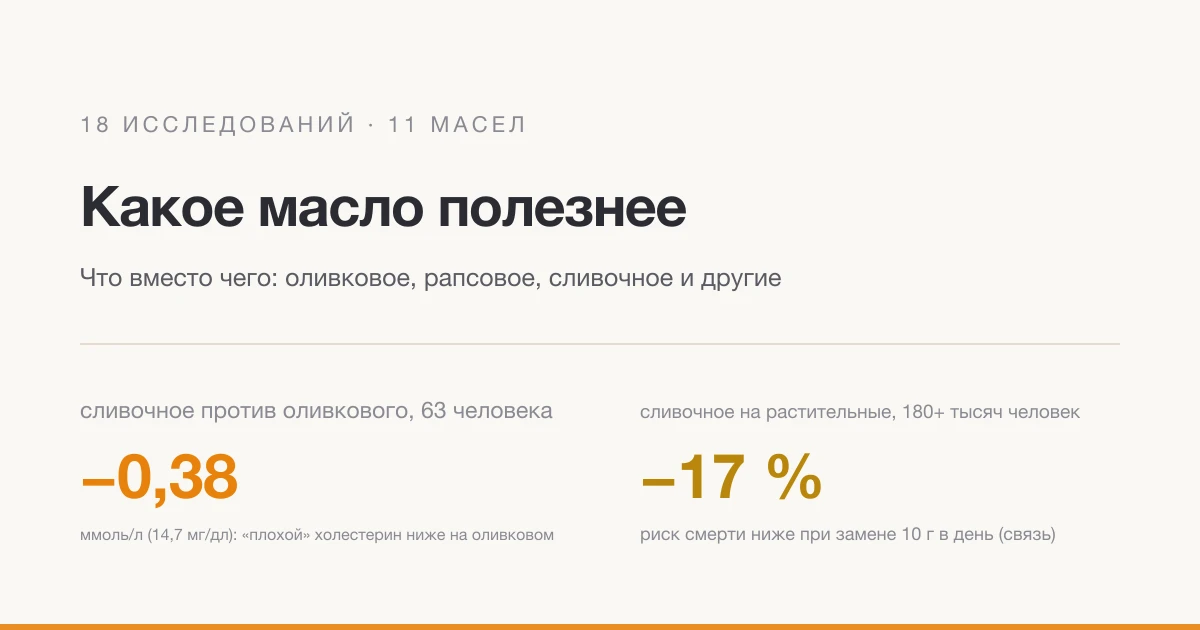
| Butter with olive oil, 50 g a day, 4 weeks | "Bad" cholesterol lower by 0.38 mmol/L (14.7 mg/dL); 63 people in two groups |
| Butter with vegetable oils (9 of 10 studied) | "Bad" cholesterol lower by 0.23–0.42 mmol/L (8.9–16.2 mg/dL); 54 trials, 2,065 people in the whole analysis |
| Butter with vegetable oils, 10 g a day (estimate from observations) | Linked to a 17% lower risk of death from any cause; more than 180 thousand people |
| Margarine, butter or mayonnaise with olive oil, 10 g a day (estimate from observations) | Linked to a 13%, 14% and 19% lower risk of death from any cause, respectively; 92,383 people |
| Milk fat with rapeseed oil, 3 weeks, all food provided | "Bad" cholesterol lower by 17% from baseline, 4.76 → 3.95 mmol/L (184 → 153 mg/dL); 20 people |
| Ghee with rapeseed oil in fatty liver disease, 12 weeks | Triglycerides fell by 0.45 mmol/L (39.7 mg/dL), on ghee they rose by 0.16 mmol/L (14.6 mg/dL); together with a 4.3 kg weight loss; 110 people |
Olive oil
Olive oil is the base of Mediterranean cooking. A tablespoon (13.5 g) has 9.6 g of oleic acid and 1.9 mg of vitamin E, and extra virgin oil also has polyphenols. It suits salad dressings, warm vegetables and beans, and bread instead of butter. A guide: 1–2 tablespoons a day instead of another fat; more in olive oil every day.
The PREDIMED trial included 7,447 people aged 55–80 at high risk of heart disease; among those who ate a Mediterranean diet with extra virgin olive oil, heart attacks, strokes and deaths from vascular causes over 4.8 years were less frequent: 3.8% vs 4.4% in the group advised to eat less fat, a 31% lower risk (Estruch R N Engl J Med 2018. PMID 29897866). The whole diet was tested; with nuts the result was similar.
In observations of 92,383 people (36,856 deaths), more than 7 g of olive oil a day, a little over half a tablespoon, is linked to a 19% lower risk of death from any cause compared with people who did not eat the oil or ate it rarely (Guasch-Ferré M J Am Coll Cardiol 2022. PMID 35027106). In type 2 diabetes, in 22 trials (1,428 people) HbA1c (the sugar level over the past months) was 0.27 percentage points lower than on the control diets (Schwingshackl L Nutr Diabetes 2017. PMID 28394365).
Rapeseed oil (canola)
Rapeseed oil is neutral in taste and has the least saturated fat of the oils in the table: 1.0 g per tablespoon. It suits salads and baking. In 20 people with raised blood fats who were given all their food for three weeks, "bad" cholesterol on rapeseed oil fell by 17% from baseline, from 4.76 to 3.95 mmol/L (from 184 to 153 mg/dL), and on milk fat (butter, cream, cheese) it did not fall; triglycerides fell by 20%, and lipoprotein(a) rose by 6% on average (Iggman D J Intern Med 2011. PMID 21466598).
Sunflower oil
Sunflower oil is rich in vitamin E: 5.6 mg per tablespoon in the usual type, plus 8.9 g of linoleic acid (omega-6). High-oleic sunflower oil is different: 11.6 g of oleic acid. It suits dressings and frying. In 10 trials, a higher intake of omega-6 fats lowered total cholesterol by 0.33 mmol/L (12.8 mg/dL; 4,280 people), and total mortality did not change (10 trials, 4,506 people; Hooper L Cochrane 2018. PMID 30488422). In an old trial from the 1960s and 70s (9,423 people), replacing saturated fats with corn oil rich in linoleic acid lowered total cholesterol by 13.8% vs 1.0% in the control group, and mortality did not become lower (Ramsden CE BMJ 2016. PMID 27071971).
Flaxseed oil
Flaxseed oil is the main source of plant omega-3: 7.3 g of ALA per tablespoon. It is taken cold: in salad, porridge, cottage cheese. A teaspoon has about 2.4 g of ALA. More on omega-3: how much EPA and DHA you need.
In five trials lasting a year or more (19,327 people), extra ALA did not change total mortality, and heart rhythm disorders were 27% fewer (2 trials, 4,912 people; Abdelhamid AS Cochrane 2020. PMID 32114706). In observations (15 cohorts, 745,122 people), a high ALA intake is linked to a 10% lower risk of death from any cause (Naghshi S BMJ 2021. PMID 34645650). Flaxseed oil did not lower cholesterol compared with other vegetable oils (Yang C Nutr Metab 2021. PMID 34635132).
Butter
Butter gives flavour and familiar pleasure. A tablespoon (14.2 g) has 7.2 g of saturated fat, 0.46 g of butyric acid and 31 mg of cholesterol. It suits a thin layer on bread, in porridge, and in baking now and then. In observational studies, each tablespoon a day was linked to a 1% higher risk of death from any cause (379,763 people), no link with heart and vessel disease (175,612 people) and a 4% lower risk of type 2 diabetes (201,628 people; Pimpin L PLoS One 2016. PMID 27355649). The highest intake, about 13 g a day, is linked to a 15% higher risk of death from any cause than in people who hardly ate butter (Zhang Y JAMA Intern Med 2025. PMID 40048719; more than 180 thousand people, 50,932 deaths).
Ghee
Ghee is clarified butter without water and proteins, with a rich flavour. By the data for anhydrous milk fat, a tablespoon has 7.9 g of saturated fat and 33 mg of cholesterol. In 30 healthy people who ate ghee for 4 weeks instead of refined olive oil, apoB (the protein of "bad" cholesterol particles) was 0.09 g/L (9 mg/dL) higher, and non-HDL cholesterol (all cholesterol except the "good" kind, HDL, high-density lipoprotein) was 0.53 mmol/L (20.5 mg/dL) higher; for "bad" cholesterol the difference did not reach significance (Mohammadi Hosseinabadi S Br J Nutr 2022. PMID 34794522).
Coconut oil
Coconut oil has a tropical flavour: 5.7 g of lauric acid and 11.2 g of saturated fat per tablespoon. It suits Asian dishes and desserts. In a 4-week trial (91 people) at 50 g a day, about 3.5 tablespoons, "bad" cholesterol on coconut oil was 0.42 mmol/L (16.2 mg/dL) lower than on butter, and no different from olive oil; "good" cholesterol (HDL) was 0.18 mmol/L (7.0 mg/dL) higher than on butter. Weight, blood pressure and fasting sugar did not differ (Khaw KT BMJ Open 2018. PMID 29511019).
Palm oil
Palm oil: 5.9 g of palmitic acid and 5.0 g of oleic acid per tablespoon. Compared with trans fats it is better: "good" cholesterol is 0.09 mmol/L (3.5 mg/dL) higher, "bad" did not differ (9 studies). Against oils low in saturated fat, "bad" cholesterol on palm oil is 0.24 mmol/L (9.3 mg/dL) higher (26 studies), against olive oil the difference did not reach significance (4 studies), and palm oil does not differ from animal fat (2 studies; Sun Y J Nutr 2015. PMID 25995283).
Rice bran, sesame and avocado oils
Rice bran oil has 5.3 g of oleic acid, 4.5 g of linoleic acid and 4.4 mg of vitamin E per tablespoon. In short trials (4–8 weeks), "bad" cholesterol was lower than in the control group by 0.20 mmol/L (7.6 mg/dL) in 8 trials (Pourrajab B Crit Rev Food Sci Nutr 2022. PMID 33715544) and by 0.38 mmol/L (14.6 mg/dL) in 4 trials (Park SY Nutrients 2024. PMID 39796546).
Sesame oil is aromatic: 5.6 g of linoleic acid and 5.3 g of oleic acid per tablespoon. In people with type 2 diabetes (92–95 people, 9 weeks on each oil), sesame and rapeseed oil did not differ in cholesterol and blood pressure (Amiri M Eur J Nutr 2022. PMID 35596008).
Avocado oil: 9.5 g of oleic acid per tablespoon. If 24 g of avocado oil is added to a salad, the salad's carotenoids (alpha- and beta-carotene, lutein) are absorbed better, as they are with 150 g of the fruit (11 people in each, single test meals; Unlu NZ J Nutr 2005. PMID 15735074).
Comparisons: what instead of what
Butter and olive oil. Besides the Khaw trial, in 32 men on 30 mL of olive oil or 30 g of butter over 2 weeks, "bad" cholesterol on olive oil was 0.17 mmol/L (6.45 mg/dL) lower, and systolic blood pressure over the day was 4.3 mmHg lower (Liang F Nutr Health 2025. PMID 37461824). In a double-blind trial in 47 healthy people, a moderate portion of butter (4.5% of dietary energy, 5 weeks) raised total and "bad" cholesterol more than olive oil (Engel S Am J Clin Nutr 2015. PMID 26135349).
Butter and vegetable oils. Instead of butter (10% of energy), safflower oil lowered "bad" cholesterol by 0.42 mmol/L (16.2 mg/dL), rapeseed by 0.36 (13.9 mg/dL), sunflower by 0.34 (13.1 mg/dL), olive by 0.25 (9.7 mg/dL); lard did not differ from butter (Schwingshackl L J Lipid Res 2018. PMID 30006369; 54 trials, 2,065 people in the whole analysis). In cohorts, replacing 10 g of butter a day with vegetable oils is linked to a 17% lower risk of death from any cause; for heart and vessel disease it is 6% lower, but this did not reach significance (more than 180 thousand people; Zhang Y JAMA Intern Med 2025. PMID 40048719). Another cohort, 2,459 people, showed otherwise: among those who ate more than 5 g of butter a day, type 2 diabetes was 31% less frequent than among those who did not eat it (Zhou X Eur J Clin Nutr 2025. PMID 40404978).
Rapeseed, olive and sunflower. Rapeseed versus olive oil in a network analysis: "bad" cholesterol lower by 0.11 mmol/L (4.3 mg/dL), a difference that did not reach significance; in a review of 13 trials, lower by 0.16 mmol/L (6.1 mg/dL; Pourrajab B Crit Rev Food Sci Nutr 2023. PMID 35866510). Sunflower versus olive oil is lower only slightly, by 0.09 mmol/L (3.5 mg/dL). Rapeseed and sunflower oil gave the same result in a direct comparison: in 13 trials (for cholesterol 11 trials, 656 people; Vafa F J Health Popul Nutr 2026. PMID 43015922) and in a trial of 84 people over 12 weeks (Nicol K Eur J Nutr 2022. PMID 35381848).
Coconut. In the Khaw trial (section above), for "bad" cholesterol it did better than butter and matched olive oil. Against non-tropical vegetable oils, "bad" cholesterol is 0.27 mmol/L (10.5 mg/dL) higher in 16 trials (Neelakantan N Circulation 2020. PMID 31928080); in a review of 7 trials the difference did not reach significance (Duarte AC Lipids Health Dis 2022. PMID 36045407).
Ghee. Against olive oil in 30 people, non-HDL cholesterol was 0.53 mmol/L (20.5 mg/dL) higher. In 110 people with fatty liver disease over 12 weeks, on rapeseed oil instead of ghee triglycerides fell by 0.45 mmol/L (39.7 mg/dL) while rising by 0.16 mmol/L (14.6 mg/dL) on ghee, and "bad" cholesterol fell by 0.19 mmol/L (7.5 mg/dL) while rising by 0.16 mmol/L (6.25 mg/dL), together with a 4.3 kg weight loss (Maleki Sedgi F Br J Nutr 2024. PMID 38501177).
What to fry with
In a Spanish cohort of 40,757 people (11 years, 606 cases of coronary heart disease), eating a lot of fried food was not linked to the disease, and frying in olive oil and in sunflower oil did not differ (Guallar-Castillón P BMJ 2012. PMID 22275385). In a review of 17 studies, in people who ate more fried food, serious heart and vessel disease was 28% more frequent (Qin P Heart 2021. PMID 33468573). Practical advice: fry over moderate heat, do not reuse the oil, keep fried food for "sometimes", and stew and bake vegetables and fish.
Bread and butter: how to make a sandwich healthier
The first step: a thin layer. A teaspoon of olive oil is about 40 kcal, and the main thing here is the swap: olive or rapeseed oil on bread instead of butter. The second step: whole grain bread instead of white.
How to build an "oil shelf" for the week
A simple plan: extra virgin olive oil for salads, vegetables and bread (1–2 tablespoons a day); rapeseed or sunflower oil for cooking and baking; a small bottle of flaxseed oil for porridge or salad, a teaspoon at a time; butter or ghee when you want exactly that flavour; coconut oil for Asian dishes. Oil works as a swap, not an add-on: a tablespoon of vegetable oil is 119–124 kcal, butter 102 kcal, so a new oil is put in place of butter, mayonnaise or margarine, not next to them. A practical guide: 2–3 tablespoons of oils a day, counting cooking.
Who should see a doctor first
See a doctor first, and change your diet after: with high "bad" cholesterol, after a heart attack or stroke, with diabetes, with gallbladder and pancreas disease, with early heart attacks in close relatives. The doctor will fit the diet to your tests.
What the studies showed
| What was compared | Who and how many | Result | Source |
|---|---|---|---|
| Olive oil and butter, 50 g a day, 4 weeks | 63 people in two groups | "Bad" cholesterol on olive oil lower by 0.38 mmol/L (14.7 mg/dL) | Khaw KT BMJ Open 2018. PMID 29511019 |
| 10 vegetable oils instead of butter, 10% of energy | 54 trials, 2,065 people in the whole analysis | With 9 of 10 oils, "bad" cholesterol lower by 0.23–0.42 mmol/L (8.9–16.2 mg/dL) | Schwingshackl L J Lipid Res 2018. PMID 30006369 |
| Butter, for every 14 g a day | Mortality: 379,763 people; heart and vessels: 175,612 people | Risk of death from any cause 1% higher (association); no link with heart and vessel disease (hazard ratio 1.00) | Pimpin L PLoS One 2016. PMID 27355649 |
| Replacing 10 g of butter a day with vegetable oils | More than 180 thousand people, 50,932 deaths | Linked to a 17% lower risk of death from any cause; from heart and vessel disease 6%, the difference did not reach significance | Zhang Y JAMA Intern Med 2025. PMID 40048719 |
| Olive oil, more than 7 g a day | 92,383 people, 36,856 deaths; 4,751 dementia-related deaths | Linked to a 19% lower risk of death from any cause, and 28% lower for dementia-related death | Guasch-Ferré M J Am Coll Cardiol 2022. PMID 35027106; Tessier AJ JAMA Netw Open 2024. PMID 38709531 |
| Mediterranean diet with extra virgin oil and advice to eat less fat | 7,447 people aged 55–80, 4.8 years | Heart attack, stroke or cardiovascular death: 3.8% vs 4.4% | Estruch R N Engl J Med 2018. PMID 29897866 |
| Olive oil in type 2 diabetes | 22 trials, 1,428 people | HbA1c lower by 0.27 percentage points | Schwingshackl L Nutr Diabetes 2017. PMID 28394365 |
| Rapeseed oil and milk fat, 3 weeks | 20 people with raised blood fats | "Bad" cholesterol lower by 17% from baseline | Iggman D J Intern Med 2011. PMID 21466598 |
| Rapeseed and sunflower | 13 trials (cholesterol: 11 trials, 656 people); 84 people, 12 weeks | No difference | Vafa F J Health Popul Nutr 2026. PMID 43015922; Nicol K Eur J Nutr 2022. PMID 35381848 |
| Omega-6 fats (linoleic acid) | 10 trials, 4,506 people (mortality); 10 trials, 4,280 people (cholesterol) | Total cholesterol lower by 0.33 mmol/L (12.8 mg/dL); total mortality unchanged (hazard ratio 1.00) | Hooper L Cochrane 2018. PMID 30488422 |
| ALA (plant omega-3) | Trials: 5, 19,327 people; observations: 15 cohorts, 745,122 people | Mortality in trials unchanged, in observations 10% lower; cancer mortality 6% higher (10 cohorts, 849,711 people) | Abdelhamid AS Cochrane 2020. PMID 32114706; Naghshi S BMJ 2021. PMID 34645650 |
| Coconut and non-tropical vegetable oils | 16 trials | "Bad" cholesterol higher by 0.27 mmol/L (10.5 mg/dL) | Neelakantan N Circulation 2020. PMID 31928080 |
| Ghee and olive oil; rapeseed and ghee | 30 healthy people, 4 weeks; 110 people, 12 weeks | Ghee: non-HDL cholesterol higher by 0.53 mmol/L (20.5 mg/dL); rapeseed: triglycerides fell by 0.45 mmol/L (39.7 mg/dL) | Mohammadi Hosseinabadi S Br J Nutr 2022. PMID 34794522; Maleki Sedgi F Br J Nutr 2024. PMID 38501177 |
| Fried food and heart disease | 40,757 people, 606 cases, 11 years | Top quarter vs bottom: no link (hazard ratio 1.08) | Guallar-Castillón P BMJ 2012. PMID 22275385 |
Summary
A good "oil shelf" is built on swaps: olive oil for salads and bread, rapeseed or sunflower oil for cooking, a teaspoon of flaxseed oil in porridge, and butter, ghee and coconut oil for flavour in small portions. In trials, it was the replacement of butter with vegetable oils that lowered "bad" cholesterol. If you have raised cholesterol, diabetes or a past heart attack, discuss your diet at a consultation.
Source: Which oil is healthiest: cooking oils compared — universum.earth. Dr. Pereligyn.


