

The main point
The thyroid works like an orchestra, and TSH (thyroid-stimulating hormone from the pituitary gland) is its conductor. But eight more signals prompt the conductor: TRH (thyrotropin-releasing hormone) from the hypothalamus, cortisol, fasting and leptin, hCG in pregnancy, estrogens, sleep, growth hormone and insulin. The benefit is practical: the test depends on the time of the blood draw, sleep, food and the stage of pregnancy, and it can be taken so that it shows the thyroid and not a sleepless night. Reference ranges: normal TSH in adults and when to see a doctor.
| Signal | Where it comes from | What it does to the thyroid | What it means for the test |
|---|---|---|---|
| TRH (thyrotropin-releasing hormone) | hypothalamus | tells the pituitary to release TSH | in severe illness the command weakens, so TSH is read together with free T4 |
| Cortisol | adrenal glands | slows TSH production and its night-time rise | with high cortisol, TSH alone cannot be used to judge |
| Fasting and leptin | fat tissue, nutrition | during fasting TSH and T3 fall; leptin softens the fall in TSH | do not take the test while fasting or on a strict no-carb diet |
| hCG | placenta | works as a weak TSH: the higher the hCG, the higher the free T4 and the lower the TSH | in pregnancy, TSH is judged by the stage |
| Estrogens | ovaries, pregnancy, hormone therapy | raise TBG and total T4; free T4 in healthy people does not change | with high estrogens, look at free T4, not total |
| Sleep and night rhythm | brain | most TSH pulses fall at night | take the test in the morning after normal sleep, at the same time when repeated |
| Growth hormone | pituitary | speeds up the conversion of T4 to T3 outside the thyroid | in children treated with growth hormone, free T4 is lower and T3 higher |
| Insulin | pancreas | linked with larger thyroid volume and nodules | with insulin resistance, a thyroid ultrasound makes sense |
How the axis works
The hypothalamus (a part of the brain) makes TRH, thyrotropin-releasing hormone. It tells the pituitary to release TSH. TSH reaches the thyroid, and the thyroid releases T4 (the main hormone of the gland) and a little T3 (the active form). The body gets most of its T3 by converting T4 in the tissues. When there are enough hormones, the pituitary lowers TSH: this is feedback, like a thermostat.
The thermostat takes signals not only from the thyroid itself: stress, food, sleep and pregnancy all act on it. That is why one person's TSH differs from day to day, and it is not always about the thyroid. About stress in general: stress and the thyroid, three levels.
TRH: the command from above
TRH sits at the very top of the chain: how much TSH the pituitary releases depends on it. In a special test, TRH is given intravenously to check how the pituitary responds. During fasting and with raised cortisol, the TSH response to TRH was lower (Samuels MH J Clin Endocrinol Metab 1997. PMID 9360528, 8 healthy people).
TRH in the human brain was studied after death, in people with severe illness. The more TRH there was in the hypothalamus, the higher the T3 (association r = 0.66) and TSH (association r = 0.64) in the blood. No such association was found with total T4 (Fliers E J Clin Endocrinol Metab 1997. PMID 9398708).
Takeaway: in a severely ill person, a normal TSH does not always mean the axis is fine, which is why the doctor looks at it together with free T4. Which tests to take: thyroid tests.
Cortisol: stress and TSH
Cortisol, a hormone of the adrenal glands, rises with exertion and fasting. In 8 healthy people, cortisol was raised artificially, through an infusion, by 32% of baseline, as it rose in each of them during fasting. TSH over a day became 51% lower than baseline (65% with fasting). Cortisol stayed within the normal range. The TSH response to TRH and total T3 fell to a similar degree (Samuels MH J Clin Endocrinol Metab 1997. PMID 9360528). This is a laboratory experiment, not ordinary stress.
The reverse also worked: in 25 patients with normal thyroid function whose own cortisol was lowered artificially, TSH rose from 1.6 to 3.1 mU/L (µIU/mL) (Re RN J Clin Endocrinol Metab 1976. PMID 820709).
In Cushing syndrome, cortisol is very high. Of 61 patients with no thyroid treatment, 32 (52%) had central hypothyroidism: free T4 at the lower limit of normal or below, and TSH not raised. In another group, 55 patients with Cushing syndrome, there was no usual night-time rise in TSH: 1.00 by day and 1.08 mU/L (µIU/mL) at night. After cure the rise returned: about 8 months later, 1.30 by day and 2.17 mU/L (µIU/mL) at night. In those followed for longer, the lowered free T4 and T3 returned to normal 6–12 months after cure (Shekhar S J Clin Endocrinol Metab 2021. PMID 33236107).
Practical meaning: with high cortisol, the thyroid cannot be judged by TSH alone; free T4 is needed too.
Fasting and leptin
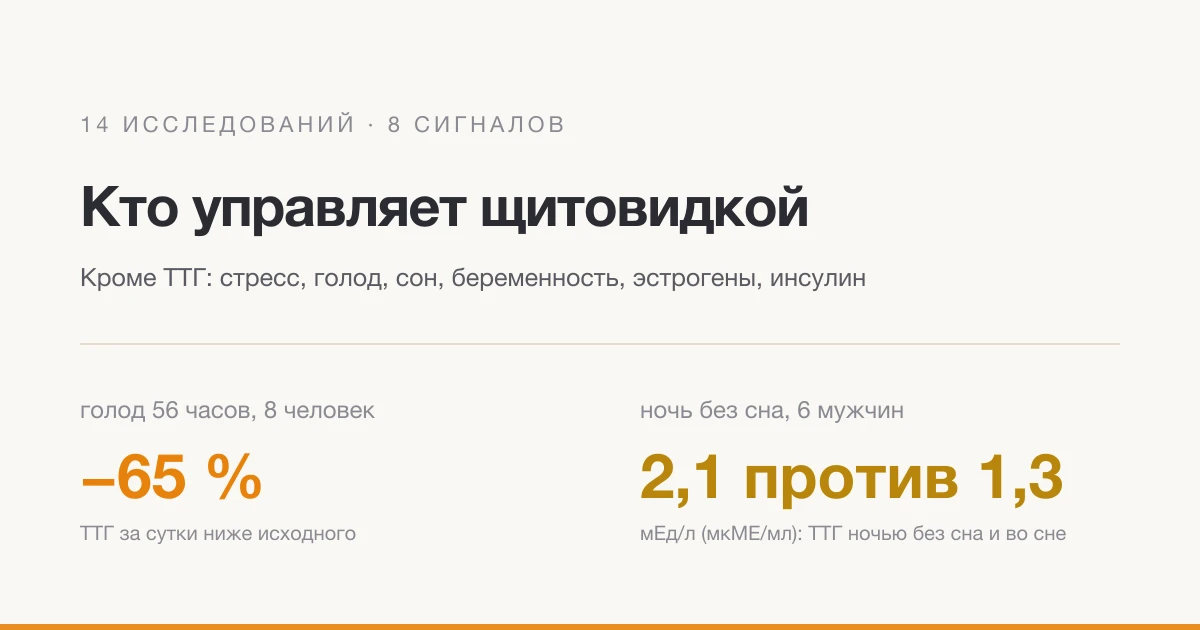
When there is little food, the body saves energy, and the thyroid slows down too. In 8 healthy people after 56 hours of fasting, TSH over a day was 65% lower than baseline (Samuels MH J Clin Endocrinol Metab 1997. PMID 9360528). In another experiment, 6 healthy men fasted for 72 hours: T3 fell by about 30%, reverse T3 (the inactive form) rose by a similar amount, total T4 did not change, and daily TSH production fell by more than 70% (Chan JL J Clin Invest 2003. PMID 12727933).
When the fasting participants were also given leptin, a hormone of fat tissue, the fall in TSH production was noticeably smaller, so leptin helped to keep TSH secretion. It did not affect the fall in T3 (same study, 6 people).
In people with obesity, complete fasting lowered T3 by 53%, and an 800 kcal diet with no carbohydrates by 47%. The same calories with at least 50 g of carbohydrates a day did not change T3 significantly (Spaulding SW J Clin Endocrinol Metab 1976. PMID 1249190). In 9 people with obesity, 4 weeks of fasting sharply lowered T3; in the same study, after 5 days of eating T3 returned to baseline (Vagenakis AG J Clin Endocrinol Metab 1975. PMID 1150863).
Low T3 during fasting looks like an adaptation that passes with food. It is better not to take the test while fasting or on a strict no-carb diet: the result will be about the diet.
hCG: the pregnancy hormone
hCG (human chorionic gonadotropin) is made by the placenta, and its structure is a little like TSH. So in the first half of pregnancy it nudges the thyroid, and TSH from the pituitary becomes lower. In a study of 606 healthy pregnant women, a high hCG was linked with a lower TSH and an enlarged thyroid. hCG acted mainly in the first half of pregnancy, and the rise in TSH came mainly in the second (Glinoer D J Clin Endocrinol Metab 1990. PMID 2116437).
This is strongest in severe vomiting in pregnancy, when hCG is especially high. TSH was suppressed in 60% of 57 women with vomiting and in 9% of 57 comparison women at the same stage. The association of hCG with free T4 was r = 0.45, and with TSH r = −0.48 (Goodwin TM J Clin Endocrinol Metab 1992. PMID 1430095).
In two cohorts, 7,587 pregnant women, in women without TPO antibodies (thyroid peroxidase antibodies) hCG was linked with a rise in free T4 and a fall in TSH. In women with TPO antibodies there was no such association: the thyroid responded to hCG more weakly (Korevaar TI J Clin Endocrinol Metab 2017. PMID 27754809). Ranges by trimester: TSH reference ranges in pregnancy.
Estrogens
The main thing estrogens change in the test is the carrier protein. They raise TBG (thyroxine-binding globulin), and there is more total T4 in the blood because it is bound to the protein. Free T4, the part that acts on the tissues, does not increase in a healthy person.
This was tested in 11 postmenopausal women with a healthy thyroid who started oral estrogens. After 12 weeks total T4 rose from 103 to 134 nmol/L (from 8.0 to 10.4 µg/dL), TBG from 20.3 to 31.3 mg/L, and free T4 and TSH did not change. In 25 women with hypothyroidism who were already receiving treatment, the picture was different: free T4 fell from 22 to 18 pmol/L (from 1.7 to 1.4 ng/dL), and TSH rose from 0.9 to 3.2 mU/L (µIU/mL) (Arafah BM N Engl J Med 2001. PMID 11396440). So for those already receiving treatment for hypothyroidism, TSH is worth checking about 12 weeks after starting estrogens, and the doctor will choose the treatment.
Practical meaning: when estrogen levels are high, for example in pregnancy or hormone therapy, total T4 cannot be used to judge, and free T4 is needed. The study was in postmenopausal women on oral estrogens; it does not speak about other hormonal pills.
Sleep and night rhythm
TSH is released not evenly but in pulses. In 26 healthy people, an average of 9.9 to 11.4 pulses a day were counted (by two counting programs), and more than half of the pulses fell between 20:00 and 04:00 (Brabant G J Clin Endocrinol Metab 1990. PMID 2105332).
Sleep holds back the night-time pulse, so a sleepless night strengthens it. In 6 healthy men, average TSH on a night without sleep was 2.1 ± 1.3 mU/L (µIU/mL) versus 1.3 ± 0.5 mU/L (µIU/mL) on a night of sleep (same study). An experiment in 4 men, 64 hours without sleep, gave a similar picture: the daily TSH peak without sleep was longer, later and higher (Parker DC J Clin Endocrinol Metab 1987. PMID 3782430).
Chronic sleep loss acts the other way. In 11 young men, after 6 nights of 4 hours in bed, TSH was lower than after 6 nights of 12 hours (Spiegel K Lancet 1999. PMID 10543671). A sleepless night raises night-time TSH, a week of short sleep lowers it, and the advice is one: take the test after normal sleep.
The time of day changes the reference range itself. In data from 465,593 TSH tests and 112,994 free T4 tests of people without thyroid disease, the upper limit of normal TSH rises with age from 6.45 to 7.55 mU/L (µIU/mL), mainly because of a higher night-time rise. The TSH range depends on the hour of the blood draw; the free T4 range does not (Ehrenkranz J Thyroid 2015. PMID 26061389).
Growth hormone
Growth hormone changes the test through the conversion of T4 to T3. This is seen in 20 children with proven growth hormone deficiency, examined on treatment and without it. Free T4 on treatment was lower, 14.3 versus 17.0 pmol/L (1.11 versus 1.32 ng/dL, a group of 12 children), and T3 was higher, 2.4 versus 1.8 nmol/L (156 versus 117 ng/dL). TSH did not change: 2.6 versus 3.2 mU/L (µIU/mL), the difference was not significant (Portes ES Clin Endocrinol 2000. PMID 10931099).
The authors explain the shift by faster conversion of T4 to T3 outside the gland, and write that the treatment itself does not cause hypothyroidism. In a child on growth hormone treatment, free T4 is worth checking, and a lower value is not necessarily a disease. More about the conversion of hormones: T4 to T3 conversion and deiodinases.
Insulin
With insulin, this is about an association, not a cause. In a study of 111 women with normal thyroid function, in 17 women with insulin resistance (IR: cells respond less well to insulin) and normal weight, thyroid volume was 16.2 mL, versus 12.1 mL in 31 comparison women. Nodules were found in about 6 in 10 versus 16.1% (Rezzonico J Thyroid 2008. PMID 18346005).
A bigger picture comes from a review of 13 studies. In metabolic syndrome, of which IR is one feature, thyroid nodules were more common: odds ratio 1.88 (1.42–2.50), and in people with metabolic syndrome nodules were found in 45% overall (Zhang C Front Endocrinol 2021. PMID 34603208). Practical advice: with IR and metabolic syndrome, it makes sense to discuss a thyroid ultrasound with a doctor.
How to take the TSH test so the result is honest
- In the morning, at the same time when repeated. TSH has a night-time rise, and the reference range depends on the hour of the blood draw.
- After normal sleep. Do not take it after a sleepless night, a night shift or a week of short sleep, and if that happened, tell the doctor.
- Not fasting and not on a strict no-carb diet. Fasting lowers TSH and T3. An ordinary night without food before the test does not contradict these data.
- With high estrogens, look at free T4. Total T4 and TBG rise without a real change in thyroid function. If treatment for hypothyroidism has already been prescribed, TSH is checked about 12 weeks after estrogens are started.
- In pregnancy, judge the result by the stage. A low TSH in the first half is often explained by hCG.
- With high cortisol, look at free T4 too. The thyroid cannot be judged by TSH alone.
- With insulin resistance, think about a thyroid ultrasound. This is the author's advice, not a conclusion from a study.
Who should see a doctor first
See a doctor first if there is:
- pregnancy or planning one;
- marked weakness, palpitations or a sharp change in weight with no clear reason;
- thyroid nodules on ultrasound;
- TSH outside the laboratory range on a repeat test;
- a history of adrenal or pituitary disease.
The doctor will choose the examination and treatment.
What the studies showed
| What was studied | Who and how many | Result | Source |
|---|---|---|---|
| TRH in the brain and blood hormones | people who died with severe illness | TRH linked with T3 (r = 0.66) and TSH (r = 0.64) | Fliers E J Clin Endocrinol Metab 1997. PMID 9398708 |
| Fasting and cortisol, TSH over a day | 8 healthy people | fasting: 65% lower; cortisol by infusion: 51% | Samuels MH J Clin Endocrinol Metab 1997. PMID 9360528 |
| Cushing syndrome | 61 patients | central hypothyroidism in 52%; normal 6–12 months after cure | Shekhar S J Clin Endocrinol Metab 2021. PMID 33236107 |
| 72-hour fast and leptin | 6 men | T3 lower by about 30%; leptin softened the fall in TSH but not in T3 | Chan JL J Clin Invest 2003. PMID 12727933 |
| hCG and TSH | 606 pregnant women | high hCG linked with low TSH in the first half | Glinoer D J Clin Endocrinol Metab 1990. PMID 2116437 |
| hCG and TPO antibodies | 7,587 pregnant women | hCG linked with T4 without antibodies, not with antibodies | Korevaar TI J Clin Endocrinol Metab 2017. PMID 27754809 |
| Vomiting in pregnancy | 57 and 57 women | TSH suppressed in 60% versus 9% | Goodwin TM J Clin Endocrinol Metab 1992. PMID 1430095 |
| Oral estrogens | 11 postmenopausal women | total T4 103 versus 134 nmol/L (8.0 versus 10.4 µg/dL); free T4 and TSH unchanged | Arafah BM N Engl J Med 2001. PMID 11396440 |
| Night-time TSH pulses, sleep | 26 people; 6 men without sleep | night without sleep: 2.1 versus 1.3 mU/L (µIU/mL) | Brabant G J Clin Endocrinol Metab 1990. PMID 2105332 |
| Sleep loss, 4 hours a night | 11 men | TSH lower than after 12 hours of sleep | Spiegel K Lancet 1999. PMID 10543671 |
| Time of day, TSH range | 465,593 TSH tests | TSH range depends on the hour, free T4 range does not | Ehrenkranz J Thyroid 2015. PMID 26061389 |
| Growth hormone in children | 20 children (calculation for a group of 12) | free T4 17.0 without treatment, 14.3 pmol/L on treatment (1.32 and 1.11 ng/dL), TSH unchanged | Portes ES Clin Endocrinol 2000. PMID 10931099 |
| IR and the thyroid | 111 women; groups of 17 and 31 | nodules in about 6 in 10 versus 16.1% (association) | Rezzonico J Thyroid 2008. PMID 18346005 |
| Metabolic syndrome and nodules | 13 studies | odds ratio 1.88 (1.42–2.50) | Zhang C Front Endocrinol 2021. PMID 34603208 |
Summary
TSH does not live on its own: it is moved by TRH, cortisol, food, hCG, sleep and other signals. Knowing this turns a test from a random number into a clear answer: morning, normal sleep, not fasting, by stage in pregnancy, free T4 with high estrogens. If a result is unclear or how you feel does not match the numbers, it can be worked through at a consultation.
Source: What controls the thyroid besides TSH: 8 signals — universum.earth. Dr. Pereligyn.


