

Key points
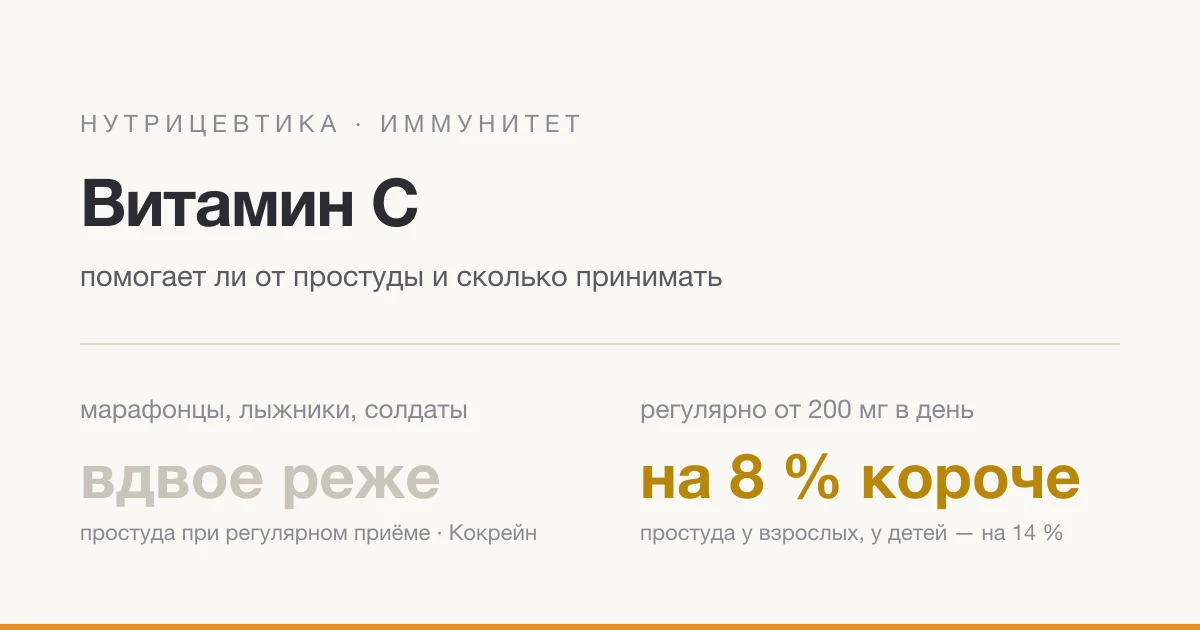
A cold passes a little faster. With regular intake of 200 mg a day or more, a cold lasted 8% shorter in adults and 14% shorter in children, and was milder (Hemilä H Cochrane Database Syst Rev 2013. PMID 23440782).
Under heavy exertion — half as often. In marathon runners, skiers and soldiers on subarctic exercises, regular vitamin C lowered the risk of a cold roughly by half (Hemilä H Cochrane Database Syst Rev 2013. PMID 23440782).
Helps you absorb iron. Vitamin C is a strong enhancer of iron absorption from plant foods; the European Food Safety Authority (EFSA) has recognised a cause-and-effect relationship (Lynch SR Ann N Y Acad Sci 1980. PMID 6940487; EFSA NDA Panel EFSA J 2014. PMID 42125126).
Food provides the amount you need. In 15 young men with low vitamin C levels, one gold kiwifruit a day was enough to raise the blood level to a healthy one (Carr AC J Nutr Sci 2012. PMID 25191543).
More does not mean better. The authors of a pharmacokinetic study in 7 volunteers considered doses above 400 mg a day to have no clear benefit (Levine M Proc Natl Acad Sci U S A 1996. PMID 8623000), and in men a total vitamin C intake of 500–999 mg a day was associated with a 29% higher risk of stones, and 1000 mg or more with a 43% higher risk, than an intake below 90 mg (Ferraro PM Am J Kidney Dis 2016. PMID 26463139).
Why the body needs vitamin C
Vitamin C (ascorbic acid) is needed to make collagen — the protein of skin, blood vessels and bones — and carnitine, which helps cells get energy from fats. It takes part in forming noradrenaline and serotonin, works as an antioxidant and protects vitamin E and folic acid from oxidation (Burgerstein, Handbuch Nährstoffe 2015, p. 84–86).
Vitamin C and the common cold
Regularly, for prevention. In a Cochrane review, among ordinary people (10,708 participants), taking 200 mg a day or more barely lowered the risk of catching a cold (relative risk 0.97). But a cold lasted 8% less in adults and 14% less in children, 18% less in children at 1–2 g a day, and was milder (Hemilä H Cochrane Database Syst Rev 2013. PMID 23440782).
With heavy physical exertion. In 598 marathon runners, skiers and soldiers, regular intake lowered the risk of a cold roughly by half: relative risk 0.48. The review authors believe vitamin C may be useful during short periods of heavy exertion (Hemilä H Cochrane Database Syst Rev 2013. PMID 23440782).
Starting at the first symptoms. In 7 comparisons (3249 cold episodes), vitamin C started during the illness showed no consistent effect on duration or severity; there are few such studies (Hemilä H Cochrane Database Syst Rev 2013. PMID 23440782). The handbook says that higher doses are used for severe infections (Burgerstein, Handbuch Nährstoffe 2015, p. 88).
Vitamin C and iron
Iron from meat and fish (heme iron) is absorbed well, iron from plant foods (non-heme iron) less well. Here vitamin C is a strong enhancer, and it also weakens the inhibiting effect of tea and calcium (Lynch SR Ann N Y Acad Sci 1980. PMID 6940487). The handbook says that vitamin C considerably increases iron absorption (Burgerstein, Handbuch Nährstoffe 2015, p. 85, 89, 114).
Together with food. For example, vegetables or berries on the same plate as porridge or legumes. Across the whole diet the effect is much weaker than within a single meal: in 12 people on diets with 51 and with 247 mg of vitamin C a day, iron absorption did not differ noticeably (Cook JD Am J Clin Nutr 2001. PMID 11124756).
With iron tablets. In an open-label equivalence study, 440 adults with iron-deficiency anemia, nearly all of them women, took iron every 8 hours: some with 200 mg of vitamin C with each tablet (600 mg a day), others without it. The rise in hemoglobin and ferritin was comparable (Li N JAMA Netw Open 2020. PMID 33136134). The handbook advises adding vitamin C to iron (Burgerstein, Handbuch Nährstoffe 2015, p. 115), but according to these data it is not essential.
How much you need and where to get it
Reference values. The handbook cites 100 mg a day (Germany, Austria, Switzerland) and 90 mg for men, 75 mg for women (USA) (Burgerstein, Handbuch Nährstoffe 2015, p. 87). A review for the 2023 Nordic Nutrition Recommendations suggests 140 mg a day for people weighing 100 kg or more, and 40 mg more for smokers (Lykkesfeldt J Food Nutr Res 2023. PMID 38187788).
Examples from food. One gold kiwifruit a day was enough to raise the blood level above 50 µmol/L (0.88 mg/dL), and with two the excess was already lost in the urine (Carr AC J Nutr Sci 2012. PMID 25191543). Fruit and vegetables provide about 200 mg a day (Levine M Proc Natl Acad Sci U S A 1996. PMID 8623000): sweet peppers, citrus fruit, berries, cabbage, broccoli.
A large dose is split. According to the handbook, more than 90% is absorbed at up to 300 mg, but less than 30% at a single 1500 mg dose (Burgerstein, Handbuch Nährstoffe 2015, p. 88).
What the studies showed
| What was tested | Who took part | Result |
|---|---|---|
| Regularly, 200 mg a day or more, Cochrane 2013 | 10,708 people from the general population | Risk of getting sick barely lowered (0.97) |
| The same under heavy exertion | 598 marathon runners, skiers, soldiers | Risk of a cold roughly halved (0.48) |
| Duration of a cold with regular intake | 9745 cold episodes | Adults: −8%, children: −14% |
| Starting at the first symptoms | 3249 cold episodes | No consistent effect shown |
| Iron with vitamin C (200 mg every 8 hours) and without, 2020 | 440 adults with anemia, nearly all women | Rise in hemoglobin and ferritin comparable |
| Vitamin C and kidney stones, 2016 | 156,735 women and 40,536 men, about 11 years | Men: 500–999 mg — risk +29%, 1000 mg or more — +43% (association); in women no association found |
| 1000 mg twice a day for 6 days, 2005 | 48 people with and without past stones | Urinary oxalate and the calculated stone risk index rose in 40% |
Not everything is equally proven: taking it from the start of a cold has been studied little (Hemilä H Cochrane Database Syst Rev 2013. PMID 23440782), and the data on stones come from an observational study — this is an association, not a proven cause (Ferraro PM Am J Kidney Dis 2016. PMID 26463139).
How much is safe
The tolerable upper intake level in the USA is 2000 mg a day (Institute of Medicine 2000). The European agency EFSA has not set an upper level for vitamin C (EFSA, Tolerable Upper Intake Levels for Vitamins and Minerals 2006). Signs of excess, according to the handbook, are nausea, bloating and diarrhea (Burgerstein, Handbuch Nährstoffe 2015, p. 91).
Kidney stones in men. In an observational study of 156,735 women and 40,536 men (about 11 years), in men a total vitamin C intake of 500–999 mg a day was associated with a 29% higher risk of stones, and 1000 mg or more with a 43% higher risk, than an intake below 90 mg. No association was found for vitamin C from food, but few people got more than 700 mg from food; with supplements of 1000 mg a day or more the risk was 19% higher than without supplements. In women no association was found (Ferraro PM Am J Kidney Dis 2016. PMID 26463139).
Oxalate. Part of vitamin C is converted into oxalate, the basis of the most common stones. In 48 people with and without past stones, after 6 days of 1000 mg twice a day, urinary oxalate and the calculated stone risk index rose in 40% (Massey LK J Nutr 2005. PMID 15987848).
Doses proposed in the handbook. Pauling’s own proposed doses (1986) are many times higher than current reference values (Burgerstein, Handbuch Nährstoffe 2015, p. 87); the handbook’s own antioxidant table gives 0.5–2 g (Burgerstein, Handbuch Nährstoffe 2015, p. 154). Current guidelines are more cautious (Institute of Medicine 2000), and the authors of a pharmacokinetic study in 7 volunteers considered doses above 400 mg a day to have no clear benefit (Levine M Proc Natl Acad Sci U S A 1996. PMID 8623000).
Who should be more careful
- People who have already had kidney stones: at 1000 mg twice a day urinary oxalate rose in 40% of participants (Massey LK J Nutr 2005. PMID 15987848); in men, high intake is associated with stones (Ferraro PM Am J Kidney Dis 2016. PMID 26463139).
- People with iron overload, for example in haemochromatosis: vitamin C enhances iron absorption (Lynch SR Ann N Y Acad Sci 1980. PMID 6940487). More in the article on haemochromatosis.
- People who take anticoagulants: according to the handbook, high doses of vitamin C may weaken their effect (Burgerstein, Handbuch Nährstoffe 2015, p. 91).
- People who let vitamin C dissolve in the mouth or take it as a powder: the acid erodes tooth enamel, and the handbook advises rinsing the mouth (Burgerstein, Handbuch Nährstoffe 2015, p. 88).
Bottom line
Vitamin C is needed for collagen and iron absorption, and fruit and vegetables usually provide enough of it. Regular intake makes a cold slightly shorter, and during short periods of heavy exertion it halves the risk of getting sick. In men, large doses are associated with kidney stones. You can choose a dose that takes iron, kidneys and medications into account at a consultation.
This material is for information only and does not replace a doctor’s consultation. The dose of vitamin C and the need for tests are determined by a doctor.


