

Key points
Vitamin A is needed for vision, skin and immunity, and its main source is a varied diet; the table shows how it helps and what human studies showed.
| Where it applies | How it helps | What human studies showed |
|---|---|---|
| Vision, skin, immunity | part of the visual pigment of the retina; supports the skin, mucous membranes and immunity (Burgerstein, Handbuch Nährstoffe 2015, p. 56–58) | — |
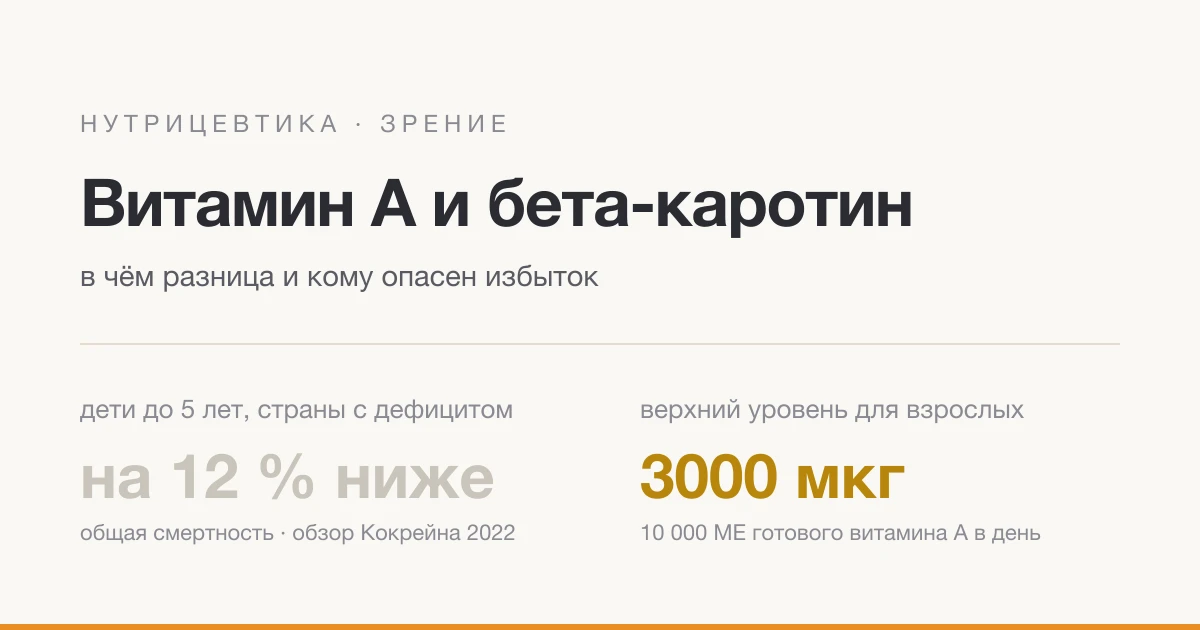
| Children in countries with deficiency | regular doses of vitamin A for children aged 6 months to 5 years | in a Cochrane review (47 studies, about 1.2 million children), overall mortality was 12% lower and night blindness about three times less common (Imdad A Cochrane Database Syst Rev 2022. PMID 35294044) |
| The requirement from food | the requirement — 900 µg RAE (3,000 IU) a day for men and 700 µg RAE (2,300 IU) for women — is made up of retinol from animal foods and beta-carotene from vegetables and fruit (Burgerstein, Handbuch Nährstoffe 2015, p. 61; Institute of Medicine 2001) | — |
| Vegetables and fruit | the body turns beta-carotene from food into vitamin A as needed, so it gives no excess; carotenoids do not cause birth defects (Burgerstein, Handbuch Nährstoffe 2015, p. 62, 64) | in male smokers who ate the most vegetables and fruit, the risk of lung cancer was 27% lower (association; this is about food, not beta-carotene pills) (Holick CN Am J Epidemiol 2002. PMID 12226001) |
How it helps
Retinol and beta-carotene: what is the difference
Retinol is preformed vitamin A. It is found in liver, fish oil, eggs, butter, cheese and supplements. It is active straight away and is stored in the liver; it is its excess that is dangerous.
Beta-carotene is provitamin A. The body turns the orange pigment of carrots, pumpkin and spinach into vitamin A when needed; a very large amount of carrots may turn the skin yellow, but it does not cause vitamin A poisoning (Burgerstein, Handbuch Nährstoffe 2015, p. 62).
Who may be short of it
Vitamin A deficiency is above all a problem of low- and middle-income countries, where 190 million children under 5 have it; regular doses there cut the rate of night blindness almost threefold (Imdad A Cochrane Database Syst Rev 2022. PMID 35294044). In other countries, more attention is warranted with alcohol misuse and long-term use of some cholesterol-lowering drugs and laxatives: they reduce the absorption or stores of vitamin A (Burgerstein, Handbuch Nährstoffe 2015, p. 58). The protein that releases vitamin A from the liver's stores depends on zinc (Burgerstein, Handbuch Nährstoffe 2015, p. 55–56) — more in the article Zinc: why you need it, signs of deficiency and how much is safe.
How much you need
The daily requirement. 900 µg RAE (retinol activity equivalents), or 3,000 international units (IU) as retinol, a day for men and 700 µg RAE (2,300 IU) for women (Burgerstein, Handbuch Nährstoffe 2015, p. 61; Institute of Medicine 2001); it is made up of retinol from animal foods and beta-carotene from vegetables and fruit.
How it is counted. 1 µg of retinol = 3.33 IU (Burgerstein, Handbuch Nährstoffe 2015, p. 56); the upper level applies only to preformed vitamin A. In RAE, 1 µg of retinol is equated to 12 µg of beta-carotene from food or 2 µg from a supplement in oil (Institute of Medicine 2001); the handbook converts using the old 6:1 ratio (Burgerstein, Handbuch Nährstoffe 2015, p. 56), and in human studies with an isotope label it ranged from 3.6:1 to 28:1 (Tang G Am J Clin Nutr 2010. PMID 20200262).
Pregnancy: the main risk of excess
Retinoids — synthetic relatives of vitamin A — cause birth defects, and high doses of preformed vitamin A apparently do too. In a study of 22,748 pregnant women, with supplements of more than 10,000 IU (3,000 µg) a day, defects of the tissues from which the face and head develop occurred 4.8 times more often than at 5,000 IU (1,500 µg) or less (observation, association); the risk is concentrated in the first 7 weeks, when women often do not yet know they are pregnant; by the authors' estimate, the defect was linked to the supplement in about 1 child in 57 (Rothman KJ N Engl J Med 1995. PMID 7477116).
How much is safe. For adults, including pregnant women, no more than 3,000 µg (10,000 IU) of preformed vitamin A a day from all sources (Institute of Medicine 2001). In women after menopause, a link with fractures is seen from as little as 2,000 µg (6,700 IU) (Feskanich D JAMA 2002. PMID 11754708). The handbook is stricter for pregnancy: when planning and during pregnancy — up to 8,000 IU (2,400 µg) a day in total, and no liver in the first trimester (Burgerstein, Handbuch Nährstoffe 2015, p. 61, 64).
Liver. In a survey of women in the Netherlands, among those who ate liver on one of the two recording days, 60% exceeded 3,000 µg (10,000 IU) and 23% exceeded 7,500 µg (25,000 IU). The authors considered a multivitamin with no more than 1,200 µg (4,000 IU) safe for pregnant women and those planning pregnancy, provided liver is not eaten at all and liver products are limited to one serving a day (van den Berg H Eur J Obstet Gynecol Reprod Biol 1996. PMID 8735753).
Beta-carotene and smoking
The ATBC and CARET trials. The ATBC trial (alpha-tocopherol, beta-carotene) involved 29,133 male smokers: on 20 mg of beta-carotene a day for 5–8 years, lung cancer occurred 18% more often and mortality was 8% higher. The CARET trial (beta-carotene and retinol efficacy) involved 18,314 smokers, former smokers and people who worked with asbestos: on 30 mg of beta-carotene together with 7,500 µg (25,000 IU) of retinol, lung cancer occurred 28% more often and mortality was 17% higher (Alpha-Tocopherol, Beta Carotene Cancer Prevention Study Group N Engl J Med 1994. PMID 8127329; Omenn GS N Engl J Med 1996. PMID 8602180).
Pooled analysis. In 9 trials, no effect of beta-carotene on the overall risk of cancer was found, but at 20–30 mg a day lung cancer occurred 20% more often in smokers and people who worked with asbestos (Druesne-Pecollo N Int J Cancer 2010. PMID 19876916). The handbook also warns smokers against high doses of synthetic beta-carotene (Burgerstein, Handbuch Nährstoffe 2015, p. 65).
Food is a different matter. In the same Finnish group, men who ate the most vegetables and fruit had a 27% lower risk of lung cancer; this is an association, not proof (Holick CN Am J Epidemiol 2002. PMID 12226001).
Vitamin A and bones
Retinol from food and supplements. In 72,337 women after menopause followed for 18 years, at 2,000 µg of retinol (6,700 IU) a day or more the risk of hip fracture was 1.89 times higher than at less than 500 µg (1,700 IU); no significant link between beta-carotene and the risk was found (Feskanich D JAMA 2002. PMID 11754708).
Who should be more careful
- Pregnant women and those planning pregnancy: keep track of the total preformed vitamin A and avoid liver (van den Berg H Eur J Obstet Gynecol Reprod Biol 1996. PMID 8735753). Isotretinoin for acne and other retinoids cause birth defects (Rothman KJ N Engl J Med 1995. PMID 7477116) — discuss them with a doctor in advance.
- Smokers and people who worked with asbestos: harm has been shown at 20–30 mg of beta-carotene a day, and the safety of lower supplement doses in smokers has not been established (Druesne-Pecollo N Int J Cancer 2010. PMID 19876916); check the beta-carotene dose on the label of multivitamins and “eye and skin” formulas. Food was not tested in the trials; in smokers, vegetables and fruit were not linked to a higher risk — the risk was lower (association) (Holick CN Am J Epidemiol 2002. PMID 12226001).
- Women after menopause and people with osteoporosis: do not stack retinol from supplements and liver (Feskanich D JAMA 2002. PMID 11754708).
- People taking several supplements: retinol is found in multivitamins, cod liver oil and skin and hair products, and the doses add up.
Bottom line
Vitamin A is essential for vision, skin and immunity, and its main source is a varied diet. Caution applies to high-dose supplements: preformed vitamin A in pregnancy and for bones, beta-carotene pills for smokers. Whether you need supplements, and at what dose, can be discussed at a consultation.
Source: Vitamin A and beta-carotene: the difference and who is at risk from excess — universum.earth. Dr. Pereligyn.


