

In Brief
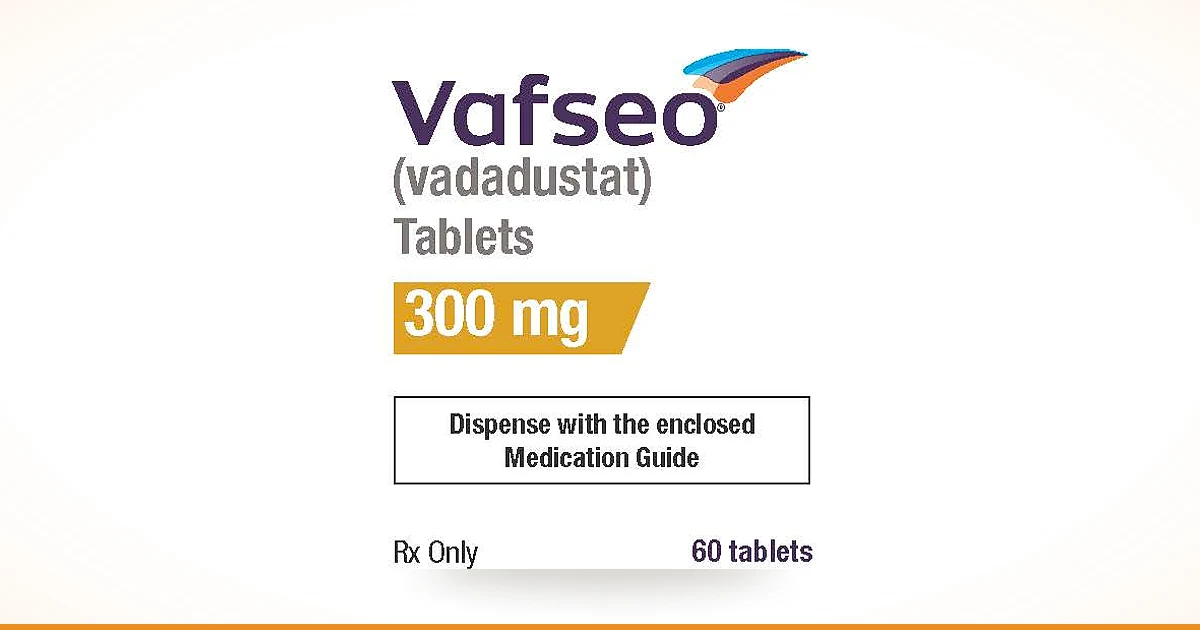
What it is. Vadadustat (brand name Vafseo) is an oral treatment for anaemia of chronic kidney disease — a HIF prolyl hydroxylase inhibitor.
Why it matters. It does not deliver erythropoietin from outside; it makes the body produce its own. FDA approval came in March 2024.
Who it is for. Adults on dialysis for at least three months — and that narrow indication is not a formality but a direct consequence of the trial results.
Why Haemoglobin Falls in Kidney Disease
The kidneys are not only a filter. They produce erythropoietin, the hormone that tells the bone marrow to make red cells. As the kidneys fail the instruction stops arriving, and anaemia follows: fatigue, breathlessness, poor exercise tolerance.
For decades the answer was direct — inject the missing hormone. It works, but it requires injections, cold storage and careful dose titration.
How Vadadustat Works
The body has a built-in oxygen sensor: the HIF factor. When oxygen is plentiful a dedicated enzyme continuously degrades it. When oxygen is scarce — at altitude, for instance — the enzyme slows, HIF accumulates and switches on a programme: more erythropoietin, better iron handling, more active blood formation.
Vadadustat blocks that enzyme. The body behaves as if it had gone up a mountain, though the person has gone nowhere. From there it is the patient's own physiology doing the work, not an externally supplied hormone.
An important consequence: not only erythropoietin production switches on but the accompanying tuning of iron metabolism — the mechanism sits closer to the natural one than an injection of the finished hormone does.
The Core Story: Two Trials, Two Different Answers
The development programme was built honestly: the same molecule was tested in two large trials — dialysis patients separately, pre-dialysis patients separately. In both cases the comparator was darbepoetin alfa, the standard injection, not placebo.
▸ INNO2VATE (NEJM, 2021) — 3,923 patients on dialysis. A major cardiovascular event occurred in 18.2% on vadadustat versus 19.3% on the injection; hazard ratio 0.96 (95% CI 0.83–1.11). Non-inferiority was met on both safety and haemoglobin [1].
▸ PRO2TECT (NEJM, 2021) — 3,476 patients not on dialysis. On haemoglobin the drug was again no worse than the injection. But the hazard ratio for cardiovascular events came out at 1.17 (95% CI 1.01–1.36) against a pre-specified margin of 1.25 — the margin was missed [2].
| INNO2VATE (dialysis) | PRO2TECT (non-dialysis) | |
|---|---|---|
| Patients | 3,923 | 3,476 |
| Comparator | Darbepoetin alfa | Darbepoetin alfa |
| Haemoglobin: non-inferior | Yes | Yes |
| Cardiovascular safety: non-inferior | Yes (HR 0.96) | No (HR 1.17, margin 1.25) |
| Regulatory outcome | Indication granted | No indication |
What That Actually Means
The phrase missed the margin needs precision, because it is easy to misread.
It was agreed in advance that the drug would count as equivalent if the upper bound of the confidence interval stayed below 1.25. It came out at 1.36. This means a higher risk could not be ruled out — not that harm was proven. The distinction is fundamental, but in such a situation the regulator acts conservatively: it approves where the evidence held and declines where it did not.
Hence the unusually narrow wording of the indication: dialysis for at least three months. Not kidney disease, not anaemia in CKD — precisely the population in which the positive trial was run.
Where It Sits Among Its Relatives
| Drug | United States | Elsewhere |
|---|---|---|
| Vadadustat (Vafseo) | Approved, dialysis only | Approved in Japan, EU |
| Daprodustat (Jesduvroq) | Approved, dialysis only | Approved in Japan |
| Roxadustat (Evrenzo) | FDA refused | Approved in Japan, China, EU |
The pattern is visible: the US regulator accepted the class, but admitted only those molecules and those populations where the cardiovascular safety data were convincing. The class mechanism and the roxadustat story are covered in a separate guide.
The Practical Side
| Parameter | Detail |
|---|---|
| Formulation | Tablets |
| Who | Adults on dialysis ≥ 3 months |
| Storage | Ordinary; no cold chain |
| Monitoring | Haemoglobin, ferritin, transferrin saturation |
| Iron | Usually required — stimulation without raw material is pointless |
A separate word on the goal of treatment: haemoglobin in kidney disease is not pushed to the level of a healthy person. Attempts at full normalisation produced more cardiovascular events in earlier trials, and that is a property of the entire class of agents stimulating blood formation. The target range is deliberately modest, and the nephrologist sets it.
What Cannot Be Claimed Yet
▸ That the drug is safer than injections — in the dialysis population it is equivalent, not better.
▸ That it can be used before dialysis — that is precisely what the trial failed to support.
▸ That the class members are interchangeable: roxadustat, daprodustat and vadadustat have different trial results and different regulatory fates; the mechanism is shared, but conclusions do not transfer.
▸ Long-term data beyond the trial horizons are limited.
Who It Is Not For
▸ Patients with kidney disease not yet on dialysis, under the current US indication.
▸ Anyone whose iron stores are not replenished: iron first, stimulation second.
▸ Anyone expecting a normal haemoglobin: the goal of therapy is different and deliberately more modest.
Bottom Line
▸ Mechanism: mimicking oxygen shortage switches on the body's own erythropoietin production instead of injecting the hormone.
▸ Dialysis patients: equivalent to the standard injection on both haemoglobin and cardiovascular events.
▸ Non-dialysis patients: haemoglobin rises just as well, but safety could not be demonstrated — hence no indication.
▸ The shape of the approval mirrors the shape of the evidence, a good example of honest regulatory logic.
▸ Iron is mandatory — otherwise there is nothing to stimulate.
Treatment can be discussed at a consultation; the drug can be ordered here.
References
1. Eckardt KU, et al. Safety and Efficacy of Vadadustat for Anemia in Patients Undergoing Dialysis. N Engl J Med. 2021;384(17):1601–1612. PMID 33913638
2. Chertow GM, et al. Vadadustat in Patients with Anemia and Non-Dialysis-Dependent CKD. N Engl J Med. 2021;384(17):1589–1600. PMID 33913637
3. Sarnak MJ, et al. Vadadustat for treatment of anemia in patients with dialysis-dependent chronic kidney disease receiving peritoneal dialysis. Nephrol Dial Transplant. 2023;38(10):2358–2367. PMID 37096396
4. VAFSEO (vadadustat) — US Prescribing Information, Akebia Therapeutics.


