

The main point
After 50, three things most often blur the thyroid picture: biotin “for hair” before a test, excess iodine from seaweed, and a TSH range (thyroid-stimulating hormone, the brain's command to the thyroid) read without adjusting for age. Below is what to do right away and what studies in people showed.
| Habit, signal or substance | What to do or how it helps | What studies in people showed |
|---|---|---|
| Biotin (vitamin B7) in “hair” supplements | Do not take for at least 3–5 days before the test and tell your doctor | At 10 mg (10,000 mcg) a day, the result was falsely raised in 5 of 8 tests of one type and falsely lowered in 4 of 15 tests of another type (Li D JAMA 2017. PMID 28973622) |
| Iodized salt | Replace ordinary salt with iodized salt, no need to add more salt; the adult iodine requirement is 150 mcg a day | The iodine requirement is 150 mcg a day (Leung AM Nat Rev Endocrinol 2014. PMID 24342882); the World Health Organization (WHO) advises iodizing all food salt |
| Seaweed (kelp) and iodine supplements | Count iodine: no more than 600 mcg a day in total (the EFSA upper limit, the European Food Safety Authority) | 1 g of dried kelp contains from hundreds to 8,000 mcg of iodine (Teas J Thyroid 2004. PMID 15588380) |
| Fatigue, feeling cold, dry skin, weight gain | Have a TSH test and check the result against your age | The upper limit of the TSH range: 3.56 mIU/L at 20–29 years and 7.49 mIU/L at 80 and older (Surks MI J Clin Endocrinol Metab 2007. PMID 17911171) |
How it works
The thyroid gland is a “butterfly” on the neck. It makes the hormone T4 (thyroxine), and the brain commands it through TSH. If the thyroid weakens, the brain “raises its voice” and TSH rises. That is why a TSH blood test gives the first answer. To make T4 the thyroid needs iodine: adults need about 150 mcg a day (Leung AM Nat Rev Endocrinol 2014. PMID 24342882).
According to the American Thyroid Association (ATA), up to 60% of people with thyroid disease do not know they have it. This is partly why a TSH test matters even without complaints.
What the studies showed
Biotin and tests
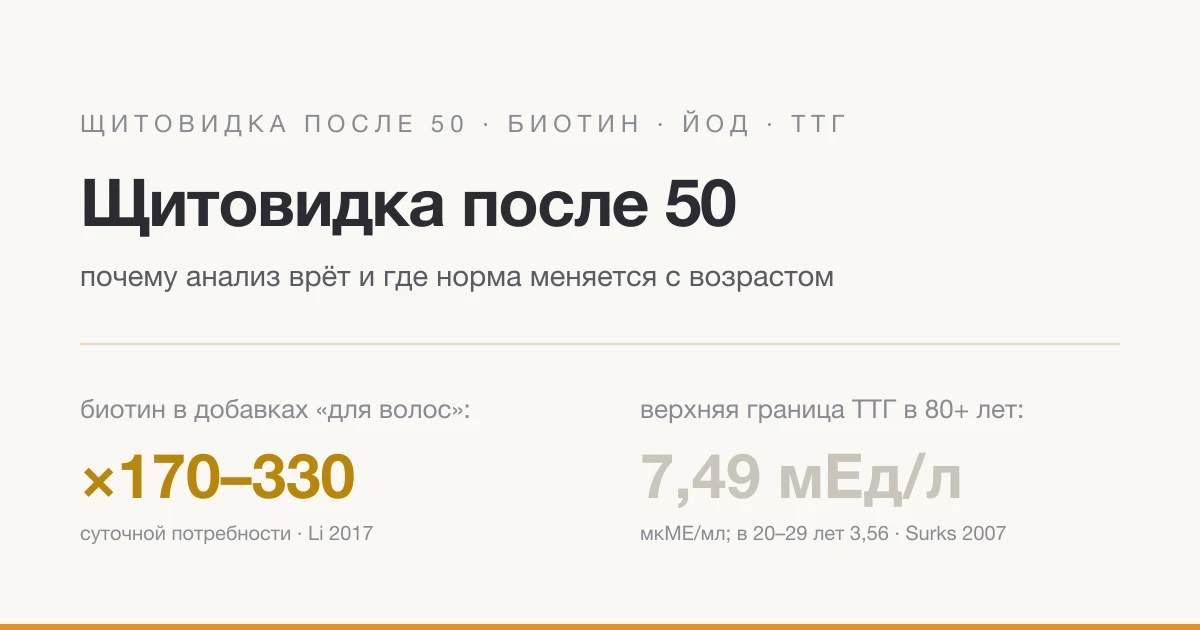
The daily requirement for biotin is about 30 mcg. “Hair” supplements contain 5,000–10,000 mcg, which is 170–330 times the requirement; according to the FDA (the US Food and Drug Administration), supplements for hair, skin and nails can contain up to 650 daily values. Biotin in the blood can cause falsely high or falsely low results, including for hormones and troponin (a test used when a heart attack is suspected); according to the FDA, the main risk is a falsely low troponin.
For the thyroid this looks like overactivity, for example Graves disease: low TSH, high T4. A jar of biotin can be the cause of this picture, so such a result is repeated without it (Kummer S N Engl J Med 2016. PMID 27532849; Elston MS J Clin Endocrinol Metab 2016. PMID 27362288). The interference depends on the instrument: at 10 mg a day on the Roche analyzer it peaked 2 hours after the dose, while on two other platforms hormones did not shift (Ylli D Thyroid 2021. PMID 34042535).
Excess iodine
The iodine content of seaweed varies hundreds-fold: from 16 mcg/g in nori to more than 8,165 mcg/g in kelp granules (Teas J Thyroid 2004. PMID 15588380). One gram of dried kelp can exceed the daily upper limit, which is 600 mcg per EFSA and 1,100 mcg per IOM (the US Institute of Medicine). Older people are a risk group: excess iodine can both slow the thyroid (hypothyroidism) and speed it up (hyperthyroidism) (Leung AM Nat Rev Endocrinol 2014. PMID 24342882).
TSH and age
With age the whole TSH curve shifts upward. In 70% of older people with TSH above 4.5 mIU/L the value fell within the range for their age, and in 14.5% of people over 80 without thyroid disease TSH was above 4.5 mIU/L (Surks MI J Clin Endocrinol Metab 2007. PMID 17911171). Subclinical underactivity of the thyroid (TSH raised, T4 normal) was found in 4.3% of the US population, and antibodies to TPO (thyroid peroxidase, a thyroid enzyme) in 11.3% of the population, more often in women and with age (Hollowell JG J Clin Endocrinol Metab 2002. PMID 11836274).
Symptoms are nonspecific: fatigue, weight gain, feeling cold and dry skin occur in other diseases too, so the diagnosis is not made from symptoms (NIDDK, the US National Institute of Diabetes and Digestive and Kidney Diseases); the sensitivity of individual symptoms is low (Canaris GJ Arch Intern Med 2000. PMID 10695693). Among those receiving treatment, TSH was in range in only 60%, so the test is needed during treatment as well (same source). With TSH above the range but below 10 mIU/L, the decision on treatment is made individually (Garber JR Endocr Pract 2012. PMID 23246686).
What to do
- Iodized salt instead of ordinary salt, without increasing the amount of salt; WHO advises iodizing all food salt, and this is the main way to prevent iodine deficiency.
- A TSH test for fatigue, feeling cold, weight gain, dry skin; check the result against your age together with an endocrinologist.
- Biotin: a pause of at least 3–5 days before the test (the ATA benchmark), tell your doctor about any supplement; repeat an odd result in the same laboratory.
- Count iodine: seaweed and supplements together — no more than 600 mcg a day.
Who should see a doctor first
See an endocrinologist if: TSH is outside the range for your age, TPO antibodies have been found, the test does not match how you feel (first repeat it without biotin), or you are already on treatment. One raised TSH is not yet a diagnosis; decisions on treatment, stopping supplements and iodine doses are made together with a doctor.
Summary
Two simple things matter for the thyroid after 50: iodine from iodized salt, and a timely TSH test adjusted for age and without biotin the day before. You can go through your own numbers at a consultation.
Source: The Thyroid After 50: Biotin, Iodine and TSH — What the Studies Showed — universum.earth. Dr. Pereligyn.


