

The main point
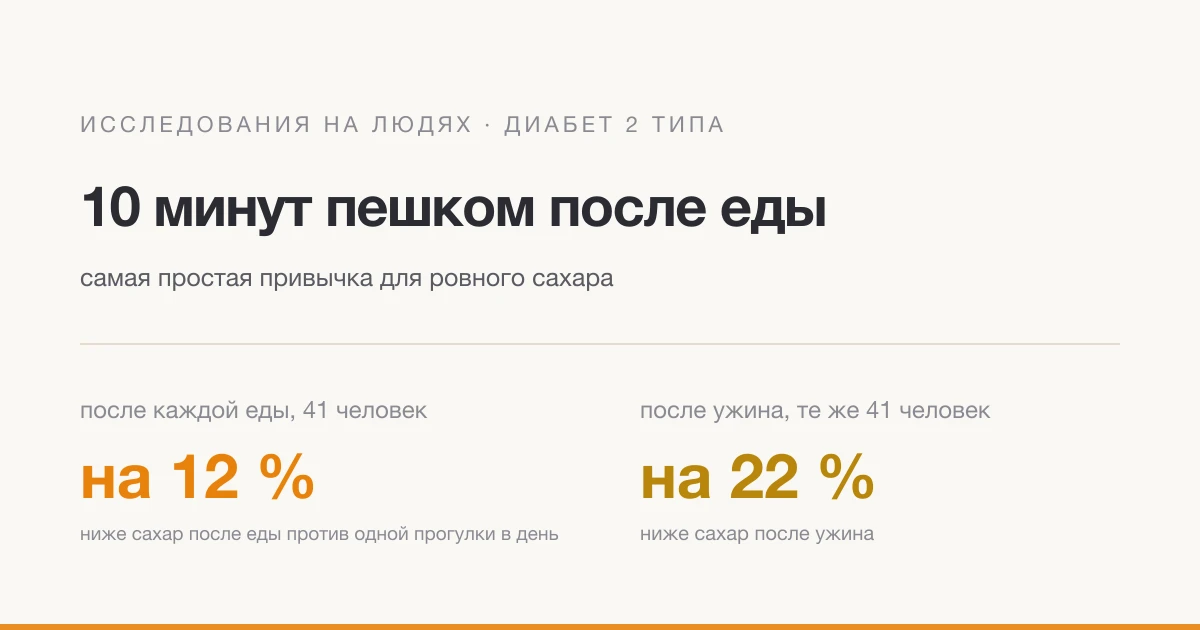
A short walk after a meal is one of the simplest ways to smooth the glucose rise. No special clothes or gym membership: just get up from the table and go outside. In the best studies even 10 minutes works, and after dinner the benefit is the most noticeable. Walking does not replace food or treatment, it adds to them.
| what | how much | why it helps | what studies showed |
|---|---|---|---|
| Walk after main meals | 10 minutes after each meal, 2 weeks | Lower glucose after meals | 41 people with type 2 diabetes: 12% lower versus one half-hour walk a day |
| Walk after dinner | 10 minutes after the evening meal | The most noticeable effect | same 41 people: glucose after dinner 22% lower |
| Right after eating | in the first minutes after the meal | Stronger effect than walking before a meal | 8 trials, 116 people: after a meal beat before a meal and rest |
| Three 15-minute walks | after each meal | Lower glucose over 24 hours | 10 older people with raised glucose: 7.2 to 6.4 mmol/L (129 to 116 mg/dL) |
The trial in people with type 2 diabetes
In 41 adults with type 2 diabetes (average age 60, diabetes for about 10 years), two pieces of advice were compared for two weeks each: walk 30 minutes once a day, or walk 10 minutes after each main meal. Both fit exercise guidelines. Glucose was measured continuously by sensor (Reynolds A N Diabetologia 2016. PMID 27747394).
The total glucose rise over 3 hours after meals was 12% lower (ratio 0.88; 95% CI 0.78-0.99), and after dinner 22% lower (0.78; 0.67-0.91). Dinner is usually the meal richest in carbohydrate and the most sedentary time of day, which is why the evening walk gave the clearest result.
Why going right away matters
A review of 8 trials compared exercise before a meal, after a meal and rest in 116 people (47 with type 2 diabetes and 69 without). Exercise after a meal lowered the glucose rise more than walking before a meal and more than rest. Walking before a meal was not significantly different from rest. The shorter the time between eating and walking, the better the result (Engeroff T Sports Med 2023. PMID 36715875). Practical point: do not put it off. Wash up and go straight out.
Short walks versus one long one
In 10 older people (60 and over) with fasting glucose 5.8-6.9 mmol/L (105-125 mg/dL), three 15-minute walks after meals were compared with 45 minutes of walking in the morning or afternoon. Glucose over 24 hours improved with post-meal walks and with morning walking, while the afternoon 45 minutes made almost no difference: with post-meal walks from 7.2 to 6.4 mmol/L (129 to 116 mg/dL), with a 45-minute morning walk from 7.1 to 6.6 mmol/L (127 to 118 mg/dL). Glucose in the 3 hours after dinner was lowered better by the short post-meal walks (DiPietro L Diabetes Care 2013. PMID 23761134). Walking was at a moderate pace on a treadmill, starting 30 minutes after the meal.
How to use it
The main rule: within a few minutes after a meal, go out and walk 10-15 minutes at a comfortable pace, one where you can still talk. If three times a day is too much, start with dinner. Examples: walking the dog, a phone call to a friend on the move, the way to the shop or to work. In cold weather, walk the stairwell, the corridor or the stairs. Aim for regular walks, not only on good days.
Who should see a doctor first
Glucose: see a doctor if it is repeatedly below 3.0 mmol/L (54 mg/dL) or above 8.9 mmol/L (160 mg/dL). If you do not have diabetes, the same limits apply; with diabetes targets are individual per the doctor's plan, and below 3.0 mmol/L (54 mg/dL) always means see a doctor.
If you are treated for diabetes, a walk may lower glucose more than usual: ask your doctor what to do if you feel dizzy or weak. Chest pain and breathlessness on walking are a reason to see a doctor, not to "walk it off".
A real-life example
After dinner the family usually scatters to the sofas. Instead you can go out together for a lap around the block while the dishes soak. Ten minutes later you are back and the chores are still there. For a person with type 2 diabetes it was exactly these ten minutes after the evening meal that made the clearest difference in glucose. Tie the walk to something constant: the series starts after it, not instead of it.
Summary
Go out for 10 minutes right after eating, especially after dinner. It is the simplest habit for steady glucose.
Source: A 10-Minute Walk After Meals: What It Does for Blood Sugar — universum.earth. Dr. Pereligyn.


