

The main points
The best side dish for steady blood sugar is vegetables and lentils. If rice, potatoes or pasta are already on the plate, these tricks soften the rise after them: the order of dishes, olive oil, lentils in place of half the side dish, almonds, and 15 minutes of walking after eating. All have been tested in people, and you can start with tonight's dinner.
| Trick | How | Why it helps | What studies showed |
|---|---|---|---|
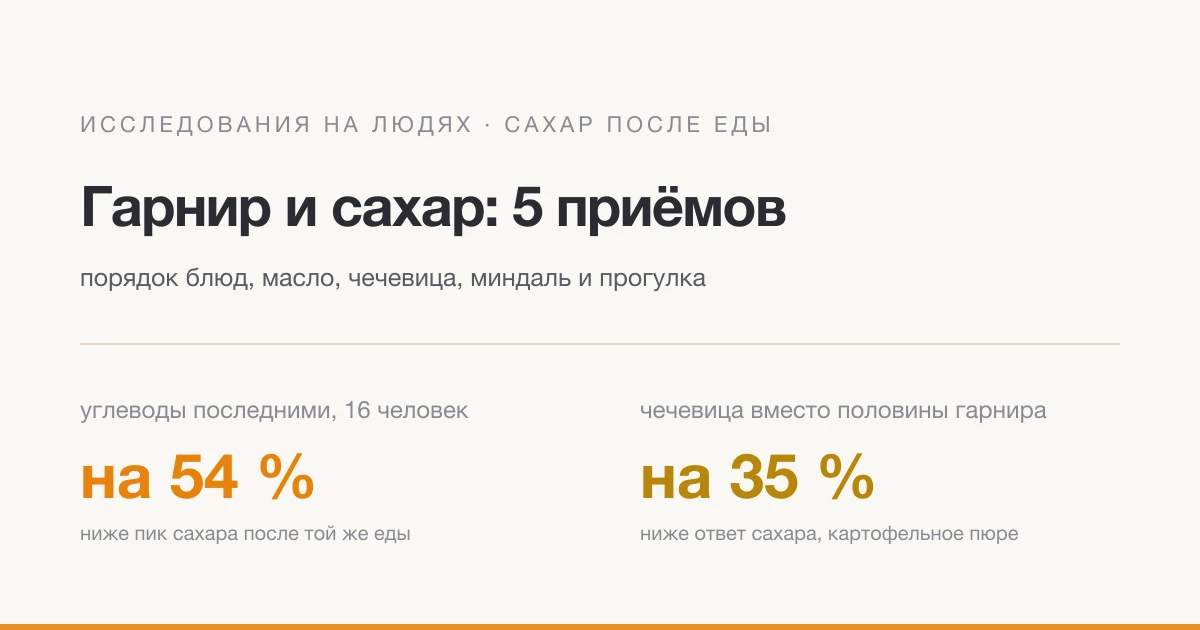
| 1. Carbohydrates last | Vegetables and chicken first, side dish at the end | Lower glucose peak | 16 people with type 2 diabetes: rise to the peak 54% lower, 1.9 versus 4.2 mmol/L (35 versus 75 mg/dL) (Shukla A P BMJ Open Diabetes Res Care 2017. PMID 28989726) |
| 2. Olive oil | With a fast-carbohydrate meal | Lower 3-hour glucose rise | 13 people with type 1 diabetes: almost half that with butter (Bozzetto L Diabetes Care 2016. PMID 26861923) |
| 3. Almonds | With the side dish, about 60 g, or 28 g in type 2 diabetes | Lower glucose rise | 9 healthy people, 60 g: meal index 63 versus 100 for white bread (Josse A R Metabolism 2007. PMID 17292730); 7 people with type 2 diabetes, 28 g: glucose after the meal 30% lower (Cohen A E Metabolism 2011. PMID 21489570) |
| 4. Lentils | Half of the side dish | Lower glucose response | Healthy adults, 24 per group: about 20% lower with rice and 35% lower with mashed potato (Moravek D J Nutr 2018. PMID 29659967) |
| 5. A walk after eating | 15 minutes, half an hour after the meal | Lower 24-hour glucose | 10 people over 60: 24-hour mean glucose 7.2 to 6.4 mmol/L (129 to 116 mg/dL) (DiPietro L Diabetes Care 2013. PMID 23761134) |
| If rice after all: cooling and vinegar | Cool the potato, dress with oil and vinegar | Lower glucose rise | 13 healthy people: potato index 43% lower (Leeman M Eur J Clin Nutr 2005. PMID 16034360) |
How to use it: dinner in five steps
First: start with vegetables and protein (the trial used chicken) and leave the side dish for last. Second: drizzle extra virgin olive oil over the food. Third: replace half the rice or potato with lentils, which cook in 15 to 20 minutes, red ones faster. Fourth: if you have no nut allergy, add almonds. Fifth: after dinner walk for 15 minutes at a moderate pace (about 4.8 km/h).
A note on amounts: the trials did not state the oil dose, so "a spoonful" is a kitchen measure and not a number from a study. The almonds in the trials came in portions of 28 g and 60 g. If rice or potato is on the plate anyway, the cooled version is gentler on sugar; cook it in the evening and reheat it.
Trick 1. Order of dishes: side dish last
In 16 people with type 2 diabetes the same meal was served three times in a different order: ciabatta bread 90 g and orange juice 120 g, chicken breast 150 g, and a salad of romaine, tomato and cucumber. When the bread and juice came last, the glucose rise to the peak was 1.9 mmol/L (35 mg/dL); when they came first it was 4.2 mmol/L (75 mg/dL), which is 54% lower. The total rise over 3 hours was 53% lower, and 25% less insulin was released. When everything was served together, the peak fell in the middle (Shukla A P BMJ Open Diabetes Res Care 2017. PMID 28989726).
Trick 2. Olive oil
In 13 people with type 1 diabetes three kinds of fat were compared in meals with the same carbohydrate. When the meal was made of fast carbohydrates, the 3-hour glucose rise with extra virgin olive oil was almost half (50% lower) that with butter and 52% lower than with minimal fat. With slow carbohydrates there was no difference (Bozzetto L Diabetes Care 2016. PMID 26861923). In another trial of 11 people with type 1 diabetes the stomach emptied more slowly after a meal with olive oil (Bozzetto L Clin Nutr 2019. PMID 30567626).
Trick 3. Almonds
In 9 healthy people, portions of almonds added to 50 g of carbohydrate from white bread gave a meal index of 105.8 at 30 g, 63.0 at 60 g and 45.2 at 90 g (white bread is 100): the more almonds, the lower the rise. 60 g is about two handfuls (Josse A R Metabolism 2007. PMID 17292730). In 7 people with type 2 diabetes a 28 g portion with a bagel and juice lowered glucose after the meal by 30%; in 12 people without diabetes by 7%, which was not significant (Cohen A E Metabolism 2011. PMID 21489570).
Trick 4. Lentils instead of half the side dish
In the trial adults received portions with 50 g of available carbohydrate, and half the carbohydrate of rice or instant mashed potato was replaced by boiled lentils. The glucose response was about 20% lower with rice and 35% lower with potato. This was shown in healthy people, 24 in each group; with large green lentils and rice the difference was not significant (P = 0.057), with small green (P = 0.002) and red lentils (P = 0.006) it was (Moravek D J Nutr 2018. PMID 29659967). In 12 healthy women canned chickpeas with rice lowered the glucose response compared with rice alone (P = 0.047), and black beans were borderline (P = 0.058) (Winham D M Nutrients 2017. PMID 28976933). In a review of 40 articles the glucose response after the meal was lower in 28 when pulses replaced part of other starch (Schiemann T B Nutr Rev 2026. PMID 41317035).
Trick 5. A walk after eating
In 10 sedentary people over 60 (fasting glucose 5.8 to 6.9 mmol/L, 105 to 125 mg/dL) three regimens were compared in a chamber over two days: 15 minutes of walking half an hour after each meal, 45 minutes in the morning and 45 minutes in the afternoon. Walking after meals lowered the 24-hour mean glucose from 7.2 to 6.4 mmol/L (129 to 116 mg/dL), 45 minutes in the morning from 7.1 to 6.6 mmol/L (127 to 118 mg/dL), and glucose over the 3 hours after dinner was lower only after walking after meals (DiPietro L Diabetes Care 2013. PMID 23761134). In a review of 8 trials in 116 people (47 with type 2 diabetes, 69 without) exercise after a meal lowered the glucose rise more than the same exercise before it, and exercise before the meal showed no clear difference from rest (Engeroff T Sports Med 2023. PMID 36715875).
If it is rice or potato after all: cool it and add vinegar
In 13 healthy people cold potato with an olive oil and vinegar dressing gave an index 43% lower than freshly boiled (Leeman M Eur J Clin Nutr 2005. PMID 16034360). In 15 healthy people rice cooled for a day and reheated gave a glucose response 18% lower than fresh rice (Sonia S Asia Pac J Clin Nutr 2015. PMID 26693746).
Who should see a doctor first
Glucose: see a doctor if it is repeatedly below 3.0 mmol/L (54 mg/dL) or above 8.9 mmol/L (160 mg/dL). If you do not have diabetes, the same limits apply; with diabetes, targets are individual under your doctor's plan, and below 3.0 mmol/L (54 mg/dL) always means a doctor. You can estimate insulin resistance with the HOMA-IR calculator.
Prescribed diabetes treatment is not changed on your own. In 32 people with type 1 diabetes cooled rice gave a smaller glucose rise but more episodes of low glucose on the usual treatment plan, 12 versus 3 (Strozyk S Nutr Diabetes 2022. PMID 35429987): with diabetes, introduce cooled dishes together with your doctor. Agree walking after meals with your doctor as well if you are being treated.
Summary
Start the meal with vegetables and protein, replace the side dish with vegetables and lentils, add olive oil and walk after dinner. If rice or potatoes are on the plate anyway, leave them for last.
Source: Side dish and blood sugar: 5 tricks that soften the rise after a meal — universum.earth. Dr. Pereligyn.


