

In brief
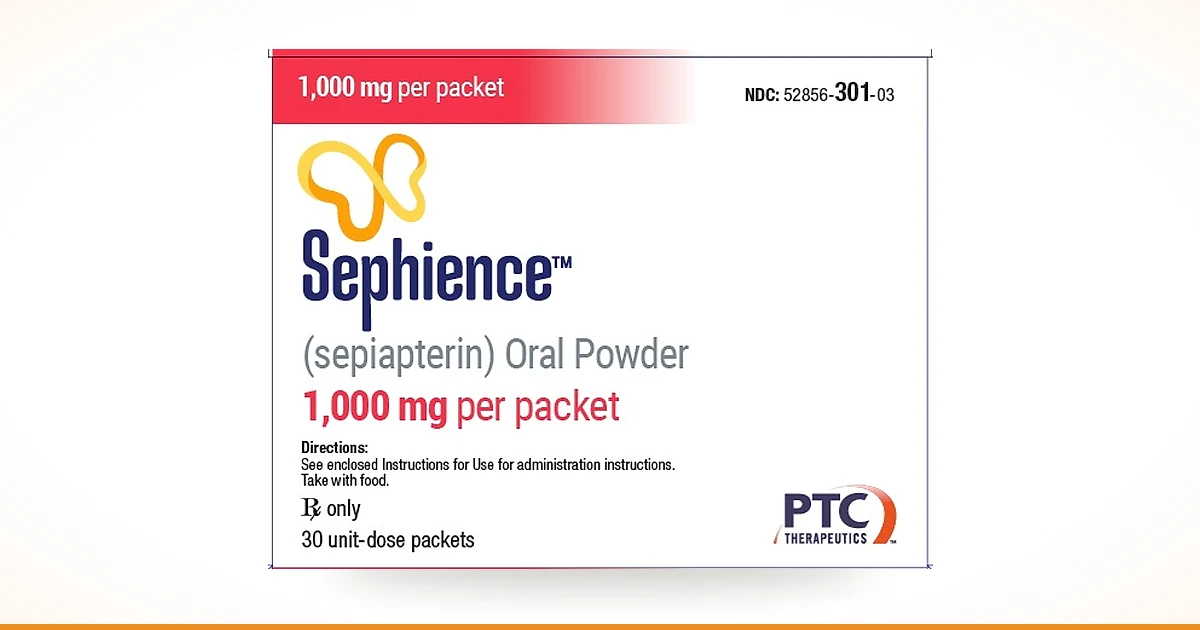
What it is. Sepiapterin (brand name Sephience) is an oral powder for phenylketonuria, approved by the FDA in July 2025 from one month of age.
Why it matters. It is not the cofactor but its precursor: it enters the cell and is converted into the cofactor inside. Hence an effect markedly stronger than that of the existing drug for the same purpose.
For whom. For those whose trial course shows a response. And alongside the diet, not instead of it.
What breaks in phenylketonuria
Phenylalanine is an ordinary amino acid, present in any protein. In the body it should be processed by the enzyme phenylalanine hydroxylase, which converts it into tyrosine.
In phenylketonuria the gene for that enzyme is damaged. Phenylalanine is not processed and accumulates in the blood. The excess is toxic to the nervous system, and above all to a brain that is still being built. Untreated, the disease leads to severe intellectual disability within the first years of life.
This is why phenylketonuria is looked for in every newborn in the first days of life: one of the oldest programmes of mass screening, and one that works — treated in time, the child develops normally.
The price of treatment, rarely said out loud
The treatment has been known since the 1950s and has essentially not changed: severe protein restriction plus special amino-acid formulas covering everything else. For life. From the first weeks.
How severe is visible in a figure from the trial: before starting the drug, participants were receiving an average of 27.6 mg of phenylalanine per kilogram of body weight per day. For an adult that is the order of magnitude at which ordinary protein-containing food is almost entirely excluded: no meat, no fish, no eggs, no dairy, no ordinary bread, no pulses, no nuts.
The diet works, but it is paid for with:
▸ social isolation — the school lunch, the birthday party, the trip, the works canteen all become problems to solve;
▸ lapses in adolescence, when control passes from the parents to the person themselves;
▸ constant arithmetic — every food weighed and converted into milligrams of phenylalanine;
▸ the cost of specialised foods and formulas, which falls on the family.
So for any new drug in this disease there is a question more honest than the laboratory one: how much freer does the plate become.
The idea: the enzyme lacks a helper, not strength
Phenylalanine hydroxylase does not work alone. It needs a cofactor — tetrahydrobiopterin, BH4 for short. This is not part of the enzyme but a separate molecule, without which the reaction does not proceed.
In many patients the enzyme is damaged but not dead: it is assembled, it is capable of working — it simply holds the cofactor less well or loses stability faster. Raise the amount of BH4 in the cell and such an enzyme begins to cope.
This is the basis of the previous-generation drug, sapropterin, in use since 2007. It is BH4 itself. The logic is direct: the cofactor is short, so supply the cofactor. The difficulty is that the BH4 molecule is unstable and passes poorly into the cell: much of the administered dose never reaches its destination.
Sepiapterin approaches from another side. It is the natural precursor of BH4 — the substance from which the cell makes the cofactor itself, by its own built-in route. The precursor enters the cell markedly more easily and is converted into BH4 there.
How much it is transport rather than active substance is visible in the pharmacokinetics: after dosing, blood levels of sepiapterin itself are less than 2% of those of the BH4 formed from it. The molecule is, in effect, spent on delivery.
The comparison that fits: rather than forcing a bulky finished tool through a narrow door, bring in the parts and assemble the tool inside the workshop.
What the APHENITY trial showed
The phase 3 trial ran at 34 sites in 13 countries and was built in two stages.
Part one — selection. Fourteen days of open-label treatment to establish who responds. Response was defined as at least a 15% fall in phenylalanine from baseline. 114 of 156 participants responded — roughly three quarters.
Part two — proof. Responders were split evenly: 49 to sepiapterin, 49 to placebo, for six weeks, with forced dose escalation of 20 → 40 → 60 mg/kg per day every two weeks. Drug and placebo were indistinguishable in appearance.
| Measure over six weeks | Sepiapterin | Placebo |
|---|---|---|
| Change in blood phenylalanine | −63% (SD 20) | +1% (29) |
| Difference between groups | −395.9 μmol/L (SE 33.8), p<0.0001 | — |
| Treatment-emergent adverse events | 59% | 33% |
| Of which mild gastrointestinal | 20% | 19% |
There were no deaths and no serious or severe adverse events. The difference in the overall rate of adverse events — 59% versus 33% — is nonetheless noticeable and worth keeping in mind when talking to a family.
Head to head against its predecessor
A separate trial compared sepiapterin with sapropterin face to face, in crossover: each participant received one drug first and then, after a two-week washout, the other. Sepiapterin was given at its standard 60 mg/kg, sapropterin at its maximum licensed 20 mg/kg.
| Reduction in phenylalanine from baseline | Sepiapterin | Sapropterin |
|---|---|---|
| Mean change | −437.0 μmol/L | −256.6 μmol/L |
| Difference | −180.4 μmol/L (95% CI −229.5 to −131.4), p<0.0001 | — |
| In relative terms | 70% greater | — |
Both drugs were well tolerated and no new safety signals emerged. One caveat matters: the trial was open-label — physicians and participants knew what was being taken. For a laboratory measure that is less critical than for symptoms, but the allowance cannot be dropped entirely.
The main result is measured by the plate
A fall in phenylalanine is, on its own, a number in a laboratory report. It acquires meaning when it turns into permission to eat.
In the APHENITY extension, 169 participants (median age 14 years, median exposure about 73 weeks) received the drug open-label; in 102 of them the specific question was how much dietary phenylalanine they could now tolerate. The diet was widened gradually under blood monitoring.
| Dietary phenylalanine | Baseline | Week 26 |
|---|---|---|
| Mean intake | 27.6 mg/kg/day | 62.5 mg/kg/day |
| Increase | — | +36.4 mg/kg/day |
More than a doubling of permitted protein is precisely the result a family sees without any test. Treatment-related adverse events occurred in 29.0%; 1.8% of participants stopped treatment because of them. There were no related serious events and no deaths.
A caveat: the significance quoted comes from an additional analysis that was not planned in advance, and the study was open-label and is still running. The direction of the effect is not in doubt; the exact size will be refined.
What it costs
The label carries neither a boxed warning nor contraindications, but it does carry three precautions, and all three are practical.
▸ Bleeding. Superficial haematomas, prolonged bleeding and heavy menstrual bleeding have been described. In one patient symptoms appeared 15 days after starting and returned two days after rechallenge at a lower dose; the drug was stopped. Blood counts and coagulation studies were normal at the time. Interruption is advised in active bleeding.
▸ Overshooting in the other direction. In some children phenylalanine fell too far — and it is an essential amino acid, so a deficiency harms too. Levels are monitored regularly, and the diet is widened under laboratory control rather than by guesswork.
▸ Levodopa. Taken together, seizures, over-stimulation and irritability may occur; neurological status is followed.
Plus the practical burden: the sachet powder must be mixed into water or apple juice to the right concentration every time and the measured volume given — this is not a tablet to be swallowed and forgotten.
Who it is not for
▸ Non-responders to the trial course — the drug relies on a surviving, if weakened, enzyme; without a response there is no point continuing.
▸ Primary BH4 deficiency — faults in GCH1, PTS, QDPR, SPR, PCBD1: such patients were excluded from the trials, their disease and its management differ.
▸ As a replacement for the diet — the indication explicitly requires the drug to be used with phenylalanine restriction.
▸ During active bleeding — interruption is advised.
▸ Alongside levodopa — only under neurological supervision.
What cannot be claimed yet
▸ No direct effect on the brain has been shown. All endpoints were laboratory or dietary. In no trial was intelligence, attention, school performance or quality of life the primary endpoint. The link between phenylalanine levels and development is known from decades of dietary therapy, but that is an inference, not direct proof for this drug.
▸ The horizon is short. The main endpoint is six weeks; the extension runs about a year and a half. The disease lasts a lifetime.
▸ The comparison with sapropterin was open-label and on a laboratory measure; which sapropterin responders should actually switch was not studied separately.
▸ The mechanism of bleeding is unclear — coagulation in the described patient was normal, so the explanation has yet to be found.
▸ The youngest are the least studied: children under two accounted for 10 of the 215 in the safety population, precisely the age at which the cost of getting it wrong is highest for the brain.
Bottom line
▸ A precursor instead of the cofactor: sepiapterin enters the cell and becomes BH4 inside, so it works where the previous approach fell short.
▸ Response is established by a trial course — about three quarters respond.
▸ Phenylalanine falls by 63% against a 1% rise on placebo.
▸ Stronger than its predecessor: 437 versus 257 μmol/L head to head, 70% greater.
▸ The diet widens twofold: from 27.6 to 62.5 mg/kg of phenylalanine per day — the practical result that matters.
▸ It does not abolish the diet and has not been tested directly against brain outcomes; bleeding and over-lowered phenylalanine both need watching.
Your own case — whether a trial course is worthwhile and how to widen the diet — can be reviewed at a consultation; the drug can be ordered here.
References
1. Muntau AC, et al. Effects of oral sepiapterin on blood Phe concentration in a broad range of patients with phenylketonuria (APHENITY): a randomised, multicentre, double-blind, placebo-controlled, three-part trial. Lancet. 2024;404(10460):1333–1345. PMID 39368841
2. Giżewska M, et al. Efficacy and safety of sepiapterin versus sapropterin in patients with phenylketonuria: Results of the AMPLIPHY study. Metabolism. 2026;178:156513. PMID 41616812
3. van Spronsen F, et al. Effect of long-term sepiapterin treatment on dietary phenylalanine tolerance in patients with phenylketonuria. Genet Med. 2026;28(4):101683. PMID 41537382
4. Bratkovic D, et al. PTC923 (sepiapterin) lowers elevated blood phenylalanine in subjects with phenylketonuria: a phase 2 randomized, multi-center, three-period crossover, open-label, active controlled, all-comers study. Metabolism. 2022;128:155116. PMID 34973284
5. SEPHIENCE (sepiapterin) — US Prescribing Information, PTC Therapeutics, Inc.


