

In brief
Haemoglobin falls in a patient with kidney disease. The first thought is "not enough iron", and that is usually the wrong one. In chronic kidney disease (CKD) the main cause is different: the damaged kidney stops producing erythropoietin, the hormone that instructs the bone marrow to make red cells. There may be plenty of iron — what is missing is the instruction.
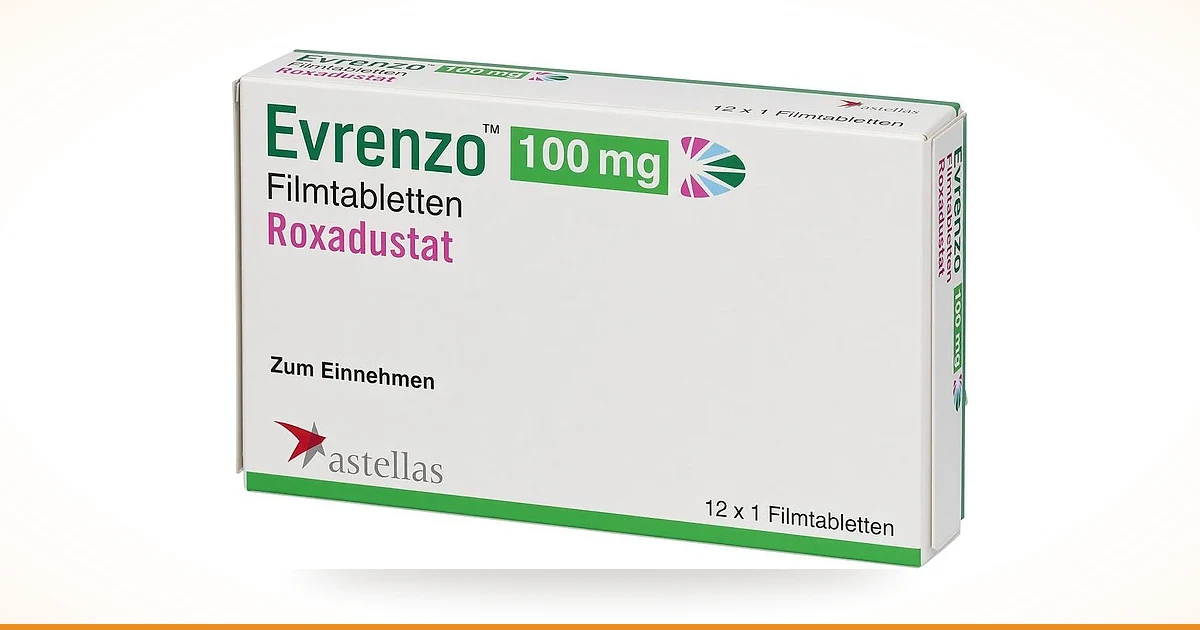
For thirty years the answer was injecting synthetic erythropoietin. Roxadustat (brand name Evrenzo, Astellas) works on a different principle: rather than replacing the hormone, it makes the body produce its own by fooling the cellular oxygen sensor. That sensor was deciphered by William Kaelin, Sir Peter Ratcliffe and Gregg Semenza, who received the 2019 Nobel Prize in Physiology or Medicine for the work.
What follows: how the mechanism works, what the trials showed in numbers, what happens to iron and cholesterol, where proven ends and plausible begins, and why the drug is approved in Japan, China and the EU but not in the United States.
Why haemoglobin falls in kidney disease
The kidney is not only a filter. Its tissue contains specialised cells that continuously measure how much oxygen the blood delivers. When oxygen runs low they release erythropoietin, the bone marrow receives the order and steps up red cell production. More red cells, more oxygen carried — the loop closes.
In chronic kidney disease those cells are lost along with the rest of the tissue. The sensor remains; the instruction does not. Haemoglobin falls, and the patient feels weak, breathless on ordinary exertion, cold-intolerant and less able to work physically. Anaemia in CKD is not cosmetic: it degrades quality of life and is associated with worse outcomes.
How this differs from iron deficiency anaemia. The distinction is fundamental and constantly blurred:
| Iron deficiency anaemia | Anaemia of CKD | |
|---|---|---|
| What is missing | Raw material — iron | The instruction — erythropoietin |
| What the labs show | Low ferritin, low transferrin saturation | Ferritin may be normal or high; kidney function reduced |
| How it is treated | Iron repletion | Stimulating erythropoiesis; iron is supportive |
| What happens with iron alone | Haemoglobin rises | Haemoglobin does not rise — the instruction is still absent |
In practice the two often coexist: iron deficiency is common in CKD and does need correcting — but as a precondition, not as the solution. On reading iron stores correctly, see the ferritin and hair loss guide: the same logic applies to the labs.
How a cell senses oxygen
This is the most interesting part, and it explains the whole drug.
Every cell contains a protein called HIF — hypoxia-inducible factor. It acts as the switch for the "oxygen is scarce" programme, turning on genes that aid survival under low oxygen, including the erythropoietin gene and genes governing iron handling and vessel growth.
At normal oxygen levels HIF is essentially absent, and here is why. Enzymes called prolyl hydroxylases use oxygen as a reagent: they tag HIF, and the tagged protein is immediately sent for disposal. While oxygen is sufficient, the enzymes work, HIF is destroyed within minutes and the programme stays off.
When oxygen becomes scarce — at altitude, after blood loss, in anaemia — the enzymes run out of their reagent. They stall, HIF stops being destroyed, accumulates and switches on adaptation: the kidney and liver produce more erythropoietin.
What roxadustat does. It blocks those enzymes directly. Oxygen in the body is perfectly adequate, but the cell "believes" it is scarce and runs the same programme, producing its own erythropoietin. In effect the drug mimics being at altitude, selectively and reversibly.
Two practical consequences follow. First, the body's own physiological system does the work rather than an externally injected hormone, and erythropoietin concentrations stay closer to physiological than with injections. Second, HIF switches on a programme rather than a single gene — which is why the drug has effects beyond haemoglobin, covered below.
What the trials showed
Patients on dialysis
▸ Pivotal trial (n=305), New England Journal of Medicine, 2019. Roxadustat was compared with injected epoetin alfa in patients on long-term dialysis. The conclusion: non-inferior to standard therapy — a comparable haemoglobin rise with an oral drug instead of injections [1].
▸ Phase 3 (n=2,133), Journal of the American Society of Nephrology, 2022. A larger comparison against epoetin alfa: mean haemoglobin increase 0.77 g/dL versus 0.68 g/dL [2].
"Non-inferior" here means exactly what it says: comparable efficacy, not superiority. The value lies elsewhere — in the route of administration.
Patients not yet on dialysis
▸ Trial (n=154), New England Journal of Medicine, 2019. Compared with placebo in CKD patients not on dialysis: haemoglobin change +1.9 g/dL versus −0.4 g/dL over 8 weeks [3].
Here the difference is large and clinically tangible — on placebo haemoglobin kept falling, on the drug it rose appreciably.
What happens to iron
HIF governs iron handling as well as erythropoietin, and this is one of the most discussed aspects of the drug.
The key player is hepcidin, a hormone that acts as a gate: when it is high, iron stays locked in storage and does not reach the circulation. In chronic inflammation — and CKD is an inflammatory state — hepcidin is elevated and iron sits in the pantry under lock.
A meta-analysis of 16 randomised trials shows that roxadustat lowers hepcidin and raises transferrin and total iron-binding capacity [4]. The gate opens somewhat and iron transport increases.
This is where one must stop and not overstate. The tempting conclusion — "therefore iron from food and tablets is absorbed better" — sounds convincing but is not directly evidenced. The study that specifically tested oral iron absorption on roxadustat enrolled just 25 patients and lacked the power to confirm it [5].
The accurate statement today: iron handling shifts favourably on laboratory measures; the clinical significance of that shift remains an open question.
Cholesterol: a by-product of the mechanism
The HIF programme also touches hepatic cholesterol synthesis. In the non-dialysis trial total cholesterol fell by 40.6 mg/dL versus 7.7 mg/dL on placebo [3], and LDL reduction appears in the meta-analysis too [4].
The effect is real, but restraint is again required. The drug was not studied as a lipid therapy, the effect of this reduction on cardiovascular outcomes has not been shown, and for cholesterol there are agents with proven outcome benefit. The right place for this fact is under "what else happens", not under "why prescribe".
Safety and what to monitor
The central question for any new anaemia treatment is cardiovascular safety: erythropoiesis-stimulating agents have a complicated history here.
▸ Meta-analysis of 15 studies, 143,065 patients, Frontiers in Pharmacology, 2024. No increase in cardiovascular events compared with erythropoiesis-stimulating agents [6].
Two findings did occur more often than on placebo and should be known in advance:
| Finding | Why it matters in CKD | What to do |
|---|---|---|
| Hyperkalaemia — raised blood potassium | Potassium is already cleared less efficiently in kidney disease, and high potassium threatens cardiac rhythm | Monitor potassium on the schedule set by the nephrologist |
| Metabolic acidosis — acidification of the blood | The failing kidney is less able to maintain acid-base balance | Monitor bicarbonate and acid-base status |
Both are tracked with routine tests and both belong to standard nephrology follow-up — what matters is that the clinician knows to look.
How it is taken
Orally, three times a week. That is not a convenience detail but a change in treatment logistics: no injections, no visits for a shot, no cold chain for storage. For a patient who is not yet on dialysis and does not attend a centre three times a week, the difference between a tablet and an injection determines whether treatment happens consistently at all.
The dose is set by the clinician according to haemoglobin and adjusted over time — the haemoglobin target in CKD is bounded on both sides, and "the higher the better" does not apply.
Where the drug is approved
| Region | Status |
|---|---|
| Japan | Approved |
| China | Approved |
| European Union | Approved as Evrenzo (Astellas) |
| United States | FDA declined approval citing safety concerns |
In the US two other HIF prolyl hydroxylase inhibitors are approved — daprodustat (2023) and vadadustat (2024) — both for dialysis patients only. The regulator accepted the class while rejecting this particular molecule.
The practical consequence for a patient is straightforward: availability depends on the country, and the drug is worth discussing with a nephrologist who knows what is registered in your jurisdiction and what can actually be obtained.
Who this is for
▸ adults with confirmed chronic kidney disease and anaemia, on dialysis or before it;
▸ those for whom erythropoietin injections are inconvenient, poorly tolerated or logistically out of reach;
▸ those whose anaemia persists despite repleted iron stores — that is, when the missing element really is the instruction rather than the material.
And what this article does not mean: roxadustat is not an "energy" remedy, not a substitute for iron in ordinary iron deficiency, and not a cholesterol drug. It is prescription treatment for one condition — anaemia of kidney disease — started and monitored by a nephrologist after assessing iron, potassium, acid-base status and cardiovascular risk.
Summary
▸ Anaemia in CKD is a missing instruction, not missing material: the kidney fails to produce erythropoietin, and iron alone will not fix it.
▸ Roxadustat switches on endogenous hormone production by blocking the enzymes that destroy HIF — the applied continuation of work awarded the 2019 Nobel Prize.
▸ Efficacy is established: non-inferior to epoetin alfa on dialysis (0.77 versus 0.68 g/dL in 2,133 patients) and clearly superior to placebo before dialysis (+1.9 versus −0.4 g/dL).
▸ Iron handling shifts favourably — lower hepcidin, higher transferrin — but improved iron absorption is not proven.
▸ Cholesterol falls as a by-product of the mechanism; that is not an indication.
▸ No excess cardiovascular risk was found across 143,065 patients, but potassium and acid-base status require monitoring.
▸ Oral dosing three times a week instead of injections.
▸ Approved in Japan, China and the EU; not in the US, where daprodustat and vadadustat serve dialysis patients from the same class.
References
1. Chen N, et al. Roxadustat treatment for anemia in patients undergoing long-term dialysis. N Engl J Med. 2019;381(11):1011–1022. PMID 31340116
2. Fishbane S, et al. Roxadustat versus epoetin alfa for treating anemia in patients with chronic kidney disease on dialysis: results from the randomized phase 3 ROCKIES study. J Am Soc Nephrol. 2022;33(4):850–866. PMID 35361724
3. Chen N, et al. Roxadustat for anemia in patients with kidney disease not receiving dialysis. N Engl J Med. 2019;381(11):1001–1010. PMID 31340089
4. Lei J, et al. Efficacy and safety of roxadustat in patients with chronic kidney disease: an updated meta-analysis of randomized controlled trials. Biomed Res Int. 2022. PMID 36420092
5. Wu H, et al. Roxadustat and oral iron absorption in Chinese patients with anemia of chronic kidney disease. Adv Ther. 2024;41(3):1168–1183. PMID 38280066
6. Li X, et al. Assessment of the safety of roxadustat for cardiovascular events in chronic kidney disease-related anemia: a systematic review and meta-analysis. Front Pharmacol. 2024. PMID 38962312
7. The Nobel Prize in Physiology or Medicine 2019 — William G. Kaelin Jr., Sir Peter J. Ratcliffe, Gregg L. Semenza, "for their discoveries of how cells sense and adapt to oxygen availability". Nobel Assembly at Karolinska Institutet.


