

Key points
PCOS is a common and manageable condition. Polycystic ovary syndrome affects 8–13% of women of reproductive age (Lim SS Cochrane Database Syst Rev 2019. PMID 30921477). Nutrition, exercise and nutraceuticals change hormones within weeks to months.
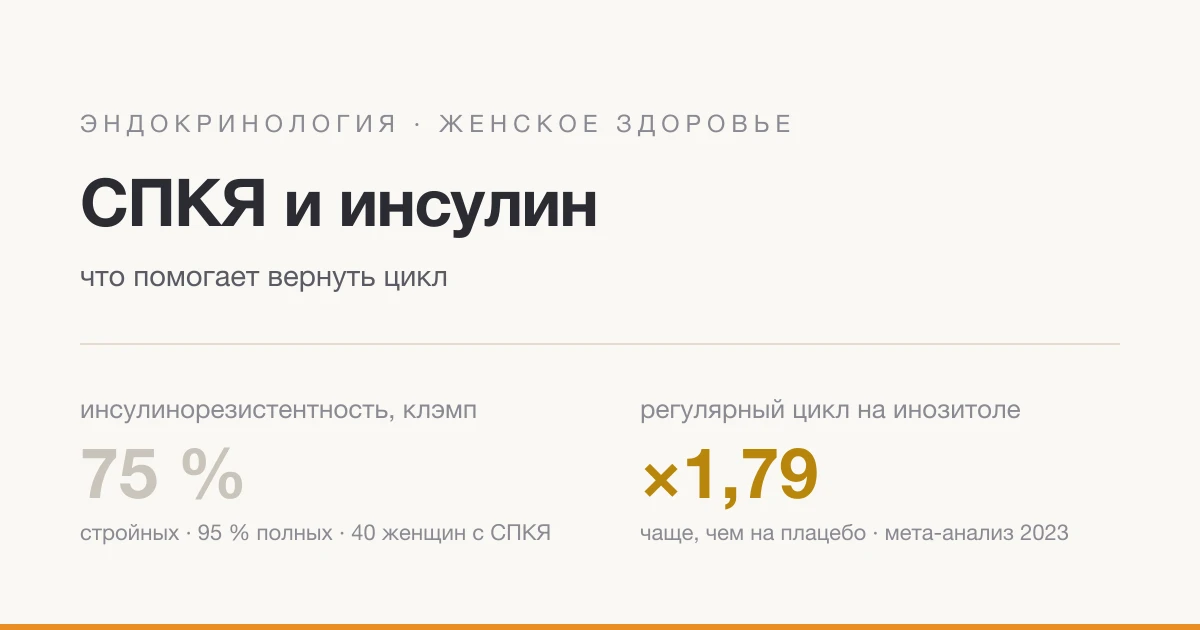
One of the key links is insulin. In a study of 40 women with PCOS, the most accurate method (the clamp — the reference test of insulin sensitivity) found insulin resistance in 75% of lean and 95% of overweight women (Stepto NK Hum Reprod 2013. PMID 23315061). Insulin can be influenced.
Weight loss can bring ovulation back. In a small study, 13 overweight women who were not ovulating lost an average of 6.3 kg over 6 months: ovulation returned in 12, 11 became pregnant, 5 of them without additional treatment (Clark AM Hum Reprod 1995. PMID 8567797).
Inositol is a gentle helper. In a meta-analysis of 26 randomised studies, the likelihood of a regular cycle on inositol was 1.79 times higher than on placebo and no lower than on metformin (Greff D Reprod Biol Endocrinol 2023. PMID 36703143).
Intense exercise lowers insulin resistance. Intense training lowered HOMA-IR by 36% on average and waist circumference by 4%; the authors recommend at least 120 minutes of intense exercise per week (Patten RK Front Physiol 2020. PMID 32733258).
What PCOS is, in plain words
Polycystic ovary syndrome is not a disease of the ovaries themselves but a hormonal imbalance of the whole body. The “cysts” seen on ultrasound are many immature follicles: eggs start to mature but rarely reach ovulation.
The diagnosis is made if two of three features are present:
- infrequent periods or none at all — ovulation happens rarely or not at all;
- an excess of male hormones: acne, hair growth on the face and body, hair loss on the scalp — or high testosterone on a blood test;
- many follicles in the ovaries on ultrasound; since 2023, adults can have an AMH (anti-Müllerian hormone) test instead of ultrasound (Teede HJ J Clin Endocrinol Metab 2023. PMID 37580314).
The 2023 international guideline stresses that PCOS is also about metabolism, the heart and blood vessels, sleep and mood, not just the cycle (Teede HJ J Clin Endocrinol Metab 2023. PMID 37580314). Before the diagnosis is made, causes with similar features are ruled out — thyroid disease, high prolactin, congenital disorders of the adrenal glands.
Why it all starts with insulin
When cells don't hear insulin well, the pancreas releases more of it. High insulin spurs the ovaries to produce more testosterone and lowers SHBG (sex hormone-binding globulin) — so there is even more free testosterone.
This creates a vicious circle: insulin stores fat on the belly, and that fat increases insulin resistance. The circle can be broken from any side — with your plate, exercise, weight, sleep, nutraceuticals or medication. How insulin resistance is assessed with a blood test is explained in the article The HOMA-IR index: the test doctors don't order.
Five pillars of a holistic approach
1. A low glycaemic index (GI) plate. The glycaemic index shows how quickly a food raises blood sugar. The international guideline does not single out one best diet for everyone (Teede HJ J Clin Endocrinol Metab 2023. PMID 37580314), but a low-GI plate has performed well: vegetables, legumes, whole grains, protein and healthy fats instead of sweets and white bread. In a one-year study of 96 overweight women with PCOS, with the same weight loss, the cycle became more regular in 95% on the low-GI diet versus 63% on a standard healthy diet — among those who completed the study (about half of the participants) (Marsh KA Am J Clin Nutr 2010. PMID 20484445).
2. Intense exercise. Running, intervals, swimming at a pace at which it is hard to talk. It was intense exercise that had the strongest effect on insulin resistance and waist circumference; the authors recommend at least 120 minutes per week (Patten RK Front Physiol 2020. PMID 32733258).
3. Gentle weight loss. In a study with an average weight loss of 6.3 kg, the women's fasting insulin and testosterone fell and their SHBG rose (Clark AM Hum Reprod 1995. PMID 8567797). A sustainable routine matters more than a quick result.
4. Sleep and a calm nervous system. The 2023 guideline specifically highlights sleep apnoea and emotional wellbeing in PCOS (Teede HJ J Clin Endocrinol Metab 2023. PMID 37580314). Snoring, daytime sleepiness and anxiety are reasons to tell your doctor about them.
5. Nutraceuticals — inositol, berberine and spearmint tea; more on them below.
Natural helpers
Inositol. Myo-inositol (sometimes paired with D-chiro-inositol) lowered fasting insulin and HOMA-IR, and when taken for at least 24 weeks it raised SHBG (Unfer V Endocr Connect 2017. PMID 29042448). Compared with placebo, inositol also lowered both free and total testosterone, as well as body mass index (Greff D Reprod Biol Endocrinol 2023. PMID 36703143).
Berberine is an alkaloid from barberry. In a meta-analysis of 12 studies, compared with placebo or no treatment, it lowered total testosterone (8 studies, 577 women) and the LH/FSH ratio (luteinising and follicle-stimulating hormones), and compared with metformin it reduced cholesterol and waist circumference more (Xie L Evid Based Complement Alternat Med 2019. PMID 31915452).
Spearmint tea. 42 women were assigned to spearmint tea or an ordinary herbal tea, two cups a day: after 30 days, free and total testosterone fell in the spearmint tea group (Grant P Phytother Res 2010. PMID 19585478).
What the studies showed
| What was tested | Who took part | Result |
|---|---|---|
| Weight loss, 6 months, 1995 | 13 overweight women who were not ovulating | −6.3 kg; ovulation in 12, pregnancy in 11 |
| Low-GI diet, 12 months, 2010 | 96 women with PCOS (about half completed the study) | More regular cycle in 95% vs 63% |
| Intense training, meta-analysis, 2020 | 777 women | HOMA-IR −36%, waist −4% |
| Inositol, meta-analysis of 26 studies, 2023 | 1691 patients | Regular cycle 1.79 times more often than on placebo |
| Myo-inositol, meta-analysis of 9 studies, 2017 | 496 women | Lower fasting insulin and HOMA-IR |
| Berberine, meta-analysis of 12 studies, 2019 | Women with PCOS | Lower total testosterone and LH/FSH |
| Spearmint tea, 30 days, 2010 | 42 women in two groups | Lower free and total testosterone |
Not everything is equally well proven: according to a Cochrane review, lifestyle changes, on low-quality evidence, reduced weight and the free androgen index, while their effect on glucose handling remained unclear (Lim SS Cochrane Database Syst Rev 2019. PMID 30921477); after 30 days of spearmint tea, the doctor's assessment of hair growth did not change significantly — the author attributes this to the short duration (Grant P Phytother Res 2010. PMID 19585478); there is no reliable evidence yet that berberine increases the live birth rate, and in women planning pregnancy there were more births on letrozole than on berberine (Xie L Evid Based Complement Alternat Med 2019. PMID 31915452).
Which tests to discuss with your doctor
- total testosterone and SHBG — they are used to calculate the free androgen index;
- fasting glucose and insulin for HOMA-IR — not part of the international guideline's essential minimum, but they show insulin resistance clearly;
- TSH (thyroid-stimulating hormone) and prolactin — to rule out thyroid and pituitary problems;
- 17-OH progesterone — to rule out congenital disorders of the adrenal glands;
- AMH or pelvic ultrasound;
- lipid profile.
You can check whether you have signs of PCOS with our online test.
What your doctor may prescribe
Metformin is the classic medication that increases insulin sensitivity; its common downside is digestive upset (Greff D Reprod Biol Endocrinol 2023. PMID 36703143). Combined oral contraceptives are used to regulate the cycle and lower androgens, and letrozole to stimulate ovulation when planning pregnancy (Teede HJ J Clin Endocrinol Metab 2023. PMID 37580314). The choice is up to the doctor after the tests.
Who should be more careful
- During pregnancy and breastfeeding, take berberine and any supplements only with your doctor's approval.
- If you take diabetes medication, discuss the dose of inositol and berberine with your doctor first: blood sugar may drop more.
- If you have had no periods for more than three months, or hair is growing quickly, or your voice is deepening — see a doctor without delay.
Bottom line
PCOS is a signal from the whole body, and it responds best to systematic work: a low-GI plate, intense exercise, sleep, gentle weight loss and nutraceuticals that have been studied in PCOS. Start with tests and the PCOS signs test. You can book an appointment with an endocrinologist here, and with obstetrician-gynaecologist and andrologist Dr. Igor Pereligyn here.
This material is for information only and does not replace a consultation with a doctor. Medications and supplements are prescribed by a doctor based on examination results.


