

The main point
A month without alcohol is a simple experiment with a measurable result. In regular drinkers, 30 days lowered the insulin resistance index, blood pressure, weight and liver enzymes. The body responds quickly to a pause, and the first visible changes appear within a month.
| What changes | What was measured | Why it helps | What studies showed |
|---|---|---|---|
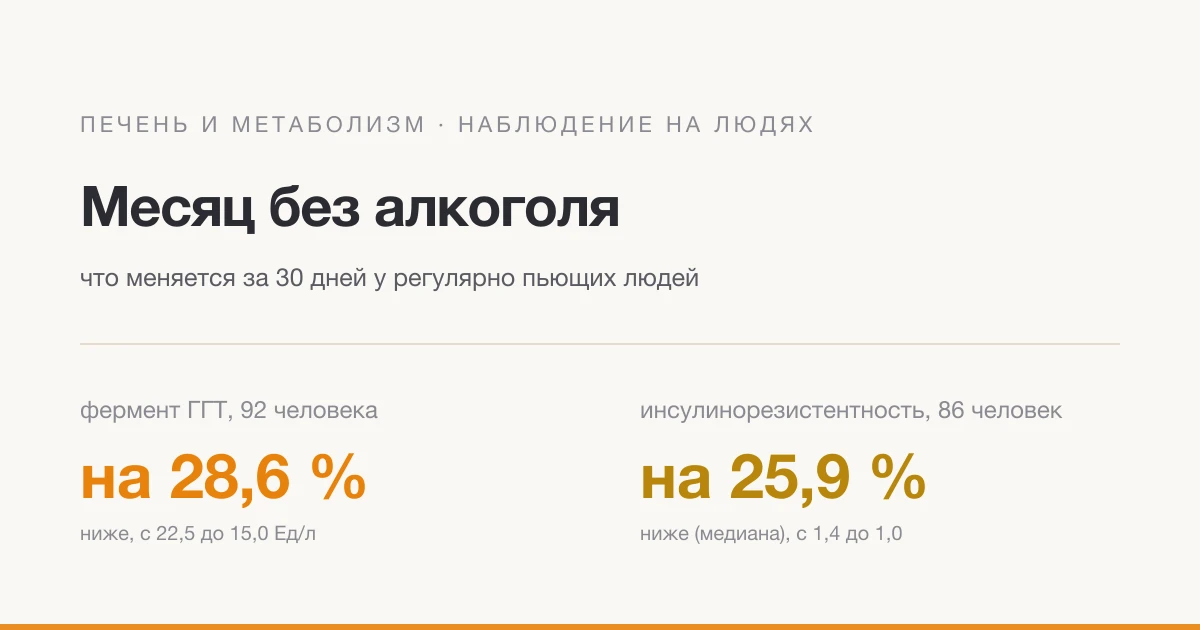
| Insulin sensitivity | HOMA index | Lower risk of type 2 diabetes | 86 people: a median 25.9% lower, from 1.4 to 1.0 |
| Blood pressure | Systolic pressure | Less strain on vessels | 93 people: 6.6% lower, from 136 to 125 mmHg |
| Weight | Body mass | Easier to keep weight down | 89 people: 1.5% lower, from 81.1 to 79.5 kg |
| Liver | GGT and ALT | The liver gets a rest | 92 people: GGT 28.6% lower, from 22.5 to 15.0 U/L; 94 people: ALT 14.5% lower, from 25 to 20 U/L |
| Larynx and pharynx | Cancer risk | Falls gradually | 9 case-control studies: about 15% of alcohol-related excess risk goes away in 5 years |
| Oesophagus | Cancer risk | Falls gradually | 9 studies in the analysis: full return in 16.5 years, half of the reduction in the first third of that time |
What these markers mean
The HOMA index is calculated from fasting glucose and insulin. The lower it is, the better your cells respond to insulin and the less strain on the pancreas. Systolic pressure is the first number in a reading and shows the load on vessels as the heart contracts. GGT and ALT are enzymes of liver cells: when the liver is under strain they leak into the blood and the values rise. All values in the study are medians, the figures of the “middle” participant, so your result may differ.
What the study did
The London study included 94 people who decided not to drink for a month and 47 people who kept drinking as before. All were healthy, with no liver disease and no dependence. People in the abstinence group drank about 258 g of pure alcohol a week on average, the comparison group about 234 g. Tests and measurements were taken before and after a month, adjusting for changes in diet, exercise and smoking (Mehta G BMJ Open 2018. PMID 29730627).
Results in the abstinence group: the insulin resistance index fell by a median of 25.9%, systolic pressure by 6.6%, weight by 1.5%. The group that kept drinking showed no significant change. The changes in pressure, weight and HOMA were not explained by changes in diet, exercise or smoking.
The liver responds quickly
GGT (gamma-glutamyltransferase) is an enzyme that responds sensitively to alcohol. In 92 people it fell by 28.6%, from 22.5 to 15.0 U/L, and ALT in 94 people by 14.5%. For the liver this is a pause without extra load. To see the result in numbers, have ALT, AST and GGT tested before and after the month.
Cancer: the benefit builds up over years
Here the picture differs: a month decides nothing, but quitting works over the long run. In an analysis of 9 case-control studies the risk of laryngeal and pharyngeal cancer fell by about 2% a year after quitting, and about 15% of the alcohol-related excess risk went away in 5 years (Ahmad Kiadaliri A PLoS One 2013. PMID 23469267). For oesophageal cancer the estimate is 16.5 years until the risk equalises, with half of the reduction in the first third of that time (Jarl J Addiction 2012. PMID 22175692).
How to run the month
Pick a date and a length: 30 days. Tell the people around you. Choose evening drinks without alcohol in advance: sparkling water with lemon, herbal tea, alcohol-free beer. Remove alcohol from home. Write down your “before”: morning home blood pressure, weight, how you feel, sleep. Compare after a month. If possible, test ALT, AST and GGT before and after, and estimate insulin resistance with the HOMA-IR calculator.
Who should see a doctor first
See a doctor before stopping if you drink a lot every day and tremor, sweating, anxiety or insomnia appear when you skip: stopping abruptly can be dangerous. The study did not include people with dependence or liver disease. Also see a doctor for yellowish skin, heaviness or pain under the right ribs, recurring nausea, or raised liver enzymes. You can estimate liver fibrosis risk with the FIB-4 calculator.
Bottom line
A month without alcohol is an easy way to see how your body feels without it. In regular drinkers 30 days improved the insulin resistance index, blood pressure, weight and liver markers. Beyond that, the long-term cancer risk is what gains. If you like the result, extend the pause.
Source: One month without alcohol: what changes in 30 days — universum.earth. Dr. Pereligyn.


