

Key points
Oats are valued for beta-glucan, a special soluble fibre. In trials in people it modestly lowers "bad" cholesterol, softens the sugar rise after meals and helps you stay free of hunger for longer. It is an inexpensive breakfast that is easy to make. But for a noticeable effect you need not a spoonful but a full bowl of porridge or oat bran.
| What | How much | Why it helps | What studies showed |
|---|---|---|---|
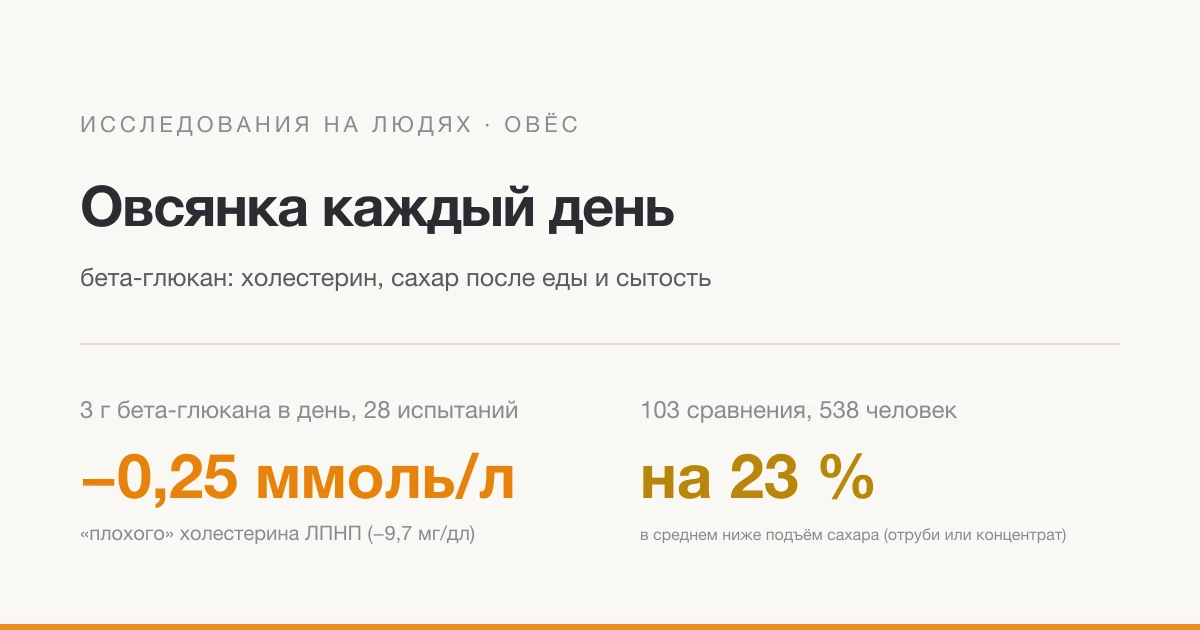
| Cholesterol | From 3 g beta-glucan a day, about 75 g dry flakes | Lower "bad" LDL cholesterol | 28 trials: minus 0.25 mmol/L (9.7 mg/dL) LDL and minus 0.30 mmol/L (11.6 mg/dL) total cholesterol |
| Sugar after a meal | Oat beta-glucan (bran or concentrate) with a carbohydrate meal | Softer sugar rise | 103 comparisons, 538 people: rise lower by 23%, depends on molecular weight |
| Fullness | Oatmeal for breakfast | Longer without hunger, less eaten at lunch | 48 healthy adults: oatmeal more filling than ready-to-eat oat cereal |
| Form | Oats without added sugar | Simple ingredients | Trial conclusions |
Cholesterol: a small but reliable shift
In a pooled analysis of 28 randomised trials, oat beta-glucan at 3 g a day or more lowered LDL cholesterol by 0.25 mmol/L (9.7 mg/dL) on average and total cholesterol by 0.30 mmol/L (11.6 mg/dL). No significant changes in "good" cholesterol or triglycerides were shown. Doses ranged from 3.0 to 12.4 g a day and durations from 2 to 12 weeks; within these ranges no influence of dose or duration was found. The higher the starting LDL, the stronger the effect (Whitehead A Am J Clin Nutr 2014. PMID 25411276).
Is that a lot or a little? Oats alone do not replace treatment for high cholesterol, but as part of your diet they make a small, clear contribution. The authors do not give a total number of participants; individual trials had from 8 to 235 people.
Sugar after a meal: depends on which beta-glucan
A pooled analysis of short trials in which people received a meal with oat beta-glucan or a control meal with the same carbohydrate combined 103 comparisons and 538 people. The post-meal sugar rise (area under the curve) was lower by 23%, the peak by 28%, and insulin by 22%. But the effect appeared only with high molecular weight beta-glucan (above 300 kg/mol); with lower weight no significant reduction was shown. Results were similar in people with and without diabetes (Zurbau A Eur J Clin Nutr 2021. PMID 33608654).
Fullness: porridge versus sweet cereal
In a crossover trial, 48 healthy adults ate calorie-matched portions of oatmeal and ready-to-eat oat cereal. After oatmeal they felt fuller, less hungry and less desire to eat, and ate less at lunch 4 hours later. The beta-glucan in oatmeal had higher viscosity and molecular weight (Rebello C J J Am Coll Nutr 2016. PMID 26273900). The lunch difference was about 85 kcal (Rebello C J J Am Coll Nutr 2016. PMID 26273900).
How to apply this
- For cholesterol, aim for 3 g of beta-glucan a day: roughly a large bowl of porridge from 75 g of dry rolled flakes (67 g contains about 2.7 g), or oat bran in a smaller amount.
- Cook with water or milk, no sugar; add berries, nuts, cinnamon.
- Choose oats without sugar rather than sweet ready mixes.
- Add oat bran to kefir, yogurt or soup and drink enough water.
- Regularity matters: in the trials oats were eaten consistently, not once a month.
Who should see a doctor first
Oats do not replace prescribed treatment for high cholesterol or diabetes. With coeliac disease or gluten intolerance choose oats labelled gluten-free and discuss it with a doctor. A lot of bran without water can cause bloating and constipation; with swallowing difficulty or bowel disease see a doctor first.
If you monitor sugar: a repeat result below 3.0 mmol/L (54 mg/dL) or above 8.9 mmol/L (160 mg/dL) is a reason to see a doctor. In diabetes targets are individual, and below 3.0 mmol/L (54 mg/dL) always means a doctor. Do not change prescribed treatment on your own.
Bottom line
Oatmeal is a simple habit with a small but clear benefit: LDL slightly lower, sugar after meals softer, fullness longer. For the effect you need an adequate portion: a large bowl of porridge from rolled flakes or oat bran, without sweet additions.
Source: Oatmeal every day: what beta-glucan gives and how much porridge you need — universum.earth. Dr. Pereligyn.


