

Key points
A simple test tells a lot. Thyroid-stimulating hormone (TSH), an inexpensive blood test, is the first step in checking the thyroid. In a large US survey many people did not know about their thyroid abnormalities — the test finds them early (Hollowell JG J Clin Endocrinol Metab 2002. PMID 11836274).
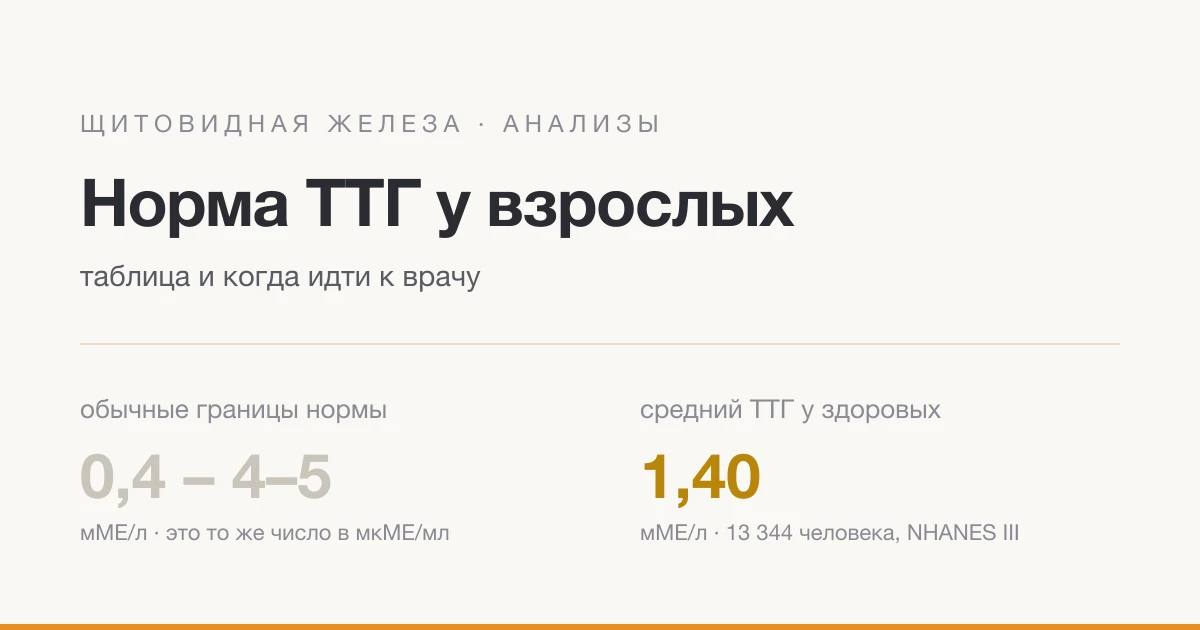
A simple guide to what is normal. Normal is usually roughly 0.4 to 4–5 mIU/L (0.4 to 4–5 µIU/mL); the exact limits are printed on your lab report (Biondi B JAMA 2019. PMID 31287527). The European Thyroid Association (ETA) considers 4.0–10 mIU/L (4.0–10 µIU/mL) a mild rise (Pearce SH Eur Thyroid J 2013. PMID 24783053).
Higher TSH with age is normal. In healthy people aged 20–29 the upper limit of normal was 3.56 mIU/L (3.56 µIU/mL), and after age 80 it was 7.49 mIU/L (7.49 µIU/mL) (Surks MI J Clin Endocrinol Metab 2007. PMID 17911171).
A mild rise often goes away. In 62.1% of people with TSH of 5.5–10 mIU/L (5.5–10 µIU/mL), it returned to normal without treatment over 5 years of follow-up (Meyerovitch J Arch Intern Med 2007. PMID 17646608).
What TSH is
TSH is made by the pituitary gland at the base of the brain. It works like a volume control: when there is too little thyroid hormone, the pituitary “turns up” TSH; when there is too much, it “turns it down”.
The units mIU/L (milli-international units per liter), mU/L (milliunits per liter) and the American µIU/mL (micro-international units per milliliter) give the same number: 2.0 mIU/L = 2.0 µIU/mL.
Normal range and age
In the NHANES III survey (the US National Health and Nutrition Examination Survey), the reference group (13,344 people without thyroid disease or antibodies) had a mean TSH of 1.40 mIU/L (1.40 µIU/mL); it is higher in women and rises with age (Hollowell JG J Clin Endocrinol Metab 2002. PMID 11836274).
Of older people with TSH above 4.5 mIU/L (4.5 µIU/mL), 70% were within the reference interval for their age (Surks MI J Clin Endocrinol Metab 2007. PMID 17911171). The ETA advises taking age-specific reference intervals into account and usually monitoring people over 80–85 with TSH up to 10 mIU/L (10 µIU/mL) without treatment (Pearce SH Eur Thyroid J 2013. PMID 24783053).
What your TSH means and when to see a doctor
| TSH | What it may mean | What to do |
|---|---|---|
| Below 0.1 mIU/L (0.1 µIU/mL) | Possibly an overactive thyroid (hyperthyroidism) | See a doctor soon; test free T4 and free T3 |
| 0.1–0.39 mIU/L (0.1–0.39 µIU/mL) | Mild decrease, often temporary | Retest with free T4 and free T3; if over 65 or with palpitations, see a doctor |
| 0.4–4.0 mIU/L (0.4–4.0 µIU/mL) | Usual normal range (check your lab report) | Nothing; repeat as your doctor advises |
| 4.0–10 mIU/L (4.0–10 µIU/mL) | Mild rise; often temporary, in older people often normal for age | Retest TSH, free T4 and TPO antibodies after 2–3 months; with symptoms, see a doctor |
| Above 10 mIU/L (10 µIU/mL) | A more marked rise | See a doctor: the decision on treatment is made individually |
In the table: free T4 — free thyroxine; free T3 — free triiodothyronine; TPO antibodies — antibodies to thyroid peroxidase. Thresholds follow ETA guidelines (Pearce SH Eur Thyroid J 2013. PMID 24783053; Biondi B Eur Thyroid J 2015. PMID 26558232); otherwise, use your laboratory’s limits. “Often temporary” for low TSH comes from an observational study in which low TSH was defined as below 0.35 mIU/L (0.35 µIU/mL): it normalized in more than half (Meyerovitch J Arch Intern Med 2007. PMID 17646608).
With a normal TSH, the chance of an abnormal result over the next 5 years is about 2% (Meyerovitch J Arch Intern Med 2007. PMID 17646608). If TSH is high and free T4 is below normal, that is overt hypothyroidism — with this result, see a doctor.
Next step: free T4
TSH above normal with normal free T4 is called subclinical (mild) hypothyroidism. Up to 10% of adults have it, usually because of Hashimoto’s thyroiditis; with positive TPO antibodies, the risk of progressing to overt hypothyroidism is higher. Most people are monitored without treatment (Biondi B JAMA 2019. PMID 31287527).
According to the ETA, in people under 65–70, treatment is recommended for TSH above 10 mIU/L (10 µIU/mL) even without symptoms; at lower values with symptoms, tablets are tried and the effect is assessed 3–4 months after TSH has returned to normal; if there is no improvement, they are usually stopped (Pearce SH Eur Thyroid J 2013. PMID 24783053).
The diagnosis is made if low TSH persists on a repeat test. Persistent TSH below 0.1 mIU/L (0.1 µIU/mL) is linked to a risk of atrial fibrillation, heart failure and fractures, and after 65 treatment is indicated, although there are no randomized trials; young people without symptoms with TSH of 0.1–0.39 mIU/L (0.1–0.39 µIU/mL) are monitored (Biondi B Eur Thyroid J 2015. PMID 26558232).
What distorts the result
Biotin. Biotin (vitamin B7) 10 mg a day for a week in 6 healthy adults distorted 9 of 23 biotin-based tests: some results were falsely high, others falsely low (Li D JAMA 2017. PMID 28973622). How long to pause before the test is covered in the article Biotin for hair and nails distorts lab tests.
Time of day. In 465,593 measurements, the TSH reference interval depended on age, sex and time of day, and TSH rose at night; the difference between men and women was no more than 0.1 mIU/L (0.1 µIU/mL) (Ehrenkranz J Thyroid 2015. PMID 26061389). Retest at about the same time of day.
Severe illness. In intensive care patients, TSH falls, and during recovery it can be temporarily raised; glucocorticoids and dopamine can also lower it. Tests are repeated after recovery (Young R Crit Care Resusc 2004. PMID 16556110).
Pregnancy. TSH norms are different in pregnancy — see the article TSH norms in pregnancy for details.
TSH is not the whole picture
TSH is an excellent first step, but it is not a diagnosis. We read test results as a series, not a single point, and look at the whole system: a repeat test, free T4, antibodies, symptoms and other causes of fatigue — iron, vitamin B12, sleep, stress. More in the article TSH is a pituitary hormone, not a thyroid one.
What the studies showed
| What was studied | Who took part | Result |
|---|---|---|
| NHANES III, 2002 | 17,353 people aged 12 and over, USA | Reduced thyroid function in 4.6% (overt hypothyroidism 0.3%), increased in 1.3% |
| Age-specific norms, 2007 | People without thyroid disease | Upper limit 3.56 mIU/L (3.56 µIU/mL) at 20–29 and 7.49 mIU/L (7.49 µIU/mL) after 80 |
| Retesting over 5 years, 2007 | 346,549 untreated people | TSH of 5.5–10 mIU/L (5.5–10 µIU/mL) normalized in 62.1%, above 10 mIU/L (10 µIU/mL) in 27.2% |
| Daily rhythm, 2015 | 465,593 TSH measurements | Reference interval depends on age, sex and time of day; difference between sexes no more than 0.1 mIU/L (0.1 µIU/mL) |
| Biotin 10 mg a day for a week, 2017 | 6 healthy adults | 9 of 23 biotin-based tests distorted |
| Tablets for mild hypothyroidism, 2019 | 21 studies, 2,192 adults | No clinically meaningful benefit for quality of life or symptoms (moderate- and high-quality evidence) |
Guidelines disagree for TSH of 10–20 mIU/L (10–20 µIU/mL). In 21 studies, tablets for mild hypothyroidism gave no clinically meaningful benefit for quality of life, fatigue or depressive symptoms (moderate- and high-quality evidence). A BMJ (British Medical Journal) panel advises against them for most adults, except people planning pregnancy, people with TSH above 20 mIU/L (20 µIU/mL), possibly young adults under 30, and people with marked symptoms (Bekkering GE BMJ 2019. PMID 31088853). Here, the ETA recommends treatment for people under 65–70.
Who should be more careful
- Pregnant women and those planning pregnancy: norms are different; discuss your TSH with a doctor right away.
- With TSH below 0.1 mIU/L (0.1 µIU/mL) or above 10 mIU/L (10 µIU/mL), see a doctor; the diagnosis is confirmed by a repeat test.
- With palpitations, tremor, unexplained weight loss, marked weakness or feeling cold, see a doctor whatever your TSH.
- If you take biotin, glucocorticoids or thyroid hormone, tell your doctor before the test.
Bottom line
TSH is a simple, inexpensive test and the first step in checking the thyroid. The usual normal range is roughly 0.4 to 4–5 mIU/L (0.4 to 4–5 µIU/mL), and it is higher with age; a mild deviation often goes away on its own, so it is confirmed by a repeat test with free T4. You can go through all your results in a consultation.
This material is for information only and does not replace a doctor’s consultation. Norms depend on the laboratory; decisions about treatment are made by a doctor.


