

The main points
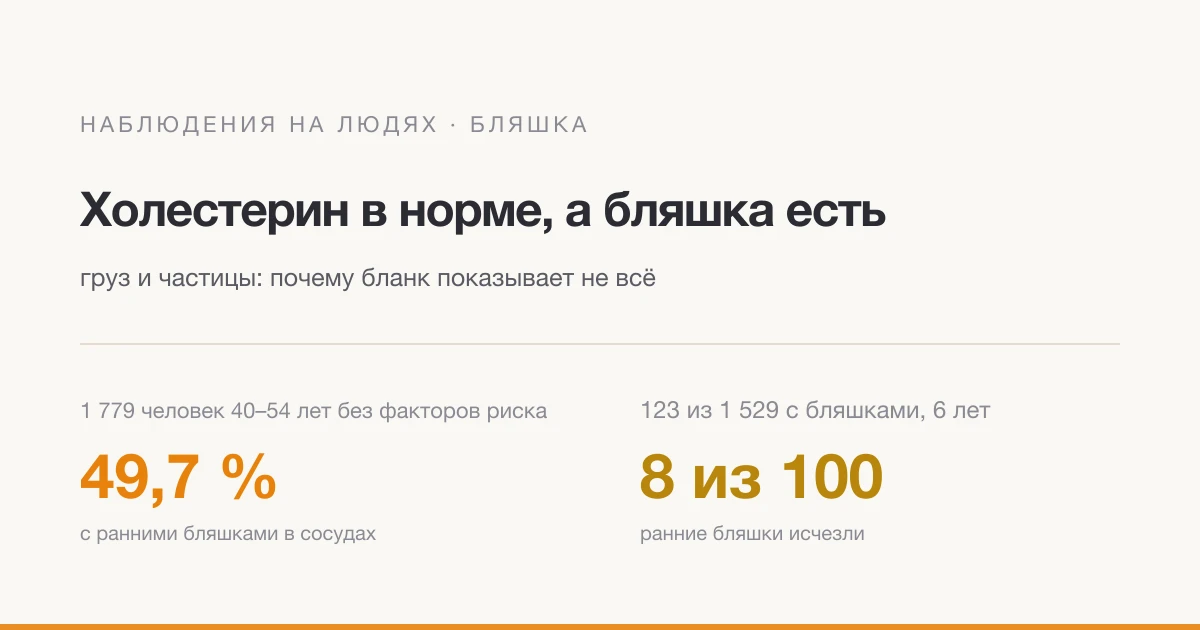
Cholesterol is normal, yet a plaque is there: it happens, and it is not a reason for alarm but a reason to learn more. Among 1,779 examined people aged 40 to 54 without usual risk factors, early plaques were found in every second person, 49.7% (Fernández-Friera L J Am Coll Cardiol 2017. PMID 29241485). And the good news is that early plaques can disappear: over 6 years this happened in 8 of 100 people who already had them (Mendieta G J Am Coll Cardiol 2023. PMID 37993199).
| What | How much | Why it helps | What studies showed |
|---|---|---|---|
| Early plaque on vascular ultrasound or heart CT | Every second examined person aged 40 to 54 without usual risk factors | Shows what the lab form does not | 49.7% of 1,779 people (Fernández-Friera L J Am Coll Cardiol 2017. PMID 29241485) |
| ApoB, a particle counter | A blood test at a doctor's decision | Shows how many particles carry cholesterol | Coronary calcium after 25 years in 30 of 100 with high apoB but not high LDL (241 of 2,794 people) versus 19 of 100 with neither high (Wilkins J J Am Coll Cardiol 2016. PMID 26791067) |
| Years lived with high LDL | More important than one number | A clear reason to watch the trend | Consensus covering more than 200 studies and more than 2 million people (Ference B Eur Heart J 2017. PMID 28444290) |
| Regression of early plaques | Over 6 years | Good news: a plaque does not always grow | Disappeared in 8 of 100 (123 of 1,529) (Mendieta G J Am Coll Cardiol 2023. PMID 37993199) |
Load and particles
Picture a road with trucks carrying cargo. Cholesterol on the form is the cargo, while the trucks themselves hit the vessel wall. The usual test shows the cargo: LDL cholesterol, the cholesterol inside the particles that carry it through the blood. A plaque is built by the particles that carry it. The apolipoprotein B test, apoB for short, counts them: each such particle has exactly one apoB molecule, so the test gives the number of particles.
That is why there can be little cargo and many trucks. The road shows only the tonnage, yet a heavy load in a few vehicles and a light load in a hundred vehicles strain the road differently. Looking at the form alone, the second case looks fine even though the particles are many. The simplest way to remember it: the form answers the question how much cholesterol, while the apoB test answers the question how many vehicles carry it. For a vessel the second question is often more important, because every single particle can hit the wall.
What studies showed
Early plaques in every second person. In a study of 1,779 people aged 40 to 54 without usual risk factors, early plaques on vascular ultrasound or coronary calcium on CT were found in 49.7% (Fernández-Friera L J Am Coll Cardiol 2017. PMID 29241485). These are early small plaques, and that is exactly why finding them early is useful: there is plenty of time to change something.
Particles versus load. In a follow-up of young adults (2,794 people, 25 years), 241 people with high apoB but not high LDL were singled out. In them coronary calcium after 25 years was found in 30 of 100, versus 19 of 100 among those with neither apoB nor LDL high (Wilkins J J Am Coll Cardiol 2016. PMID 26791067). This is an observation: an association, not proof of cause. In a large observation of 389,529 people not taking cholesterol-lowering treatment, a rise in apoB of one standard deviation was associated with a 27% higher risk of a first heart attack (myocardial infarction) (Marston N JAMA Cardiol 2022. PMID 34773460). When apoB, non-HDL cholesterol and triglycerides were considered together, only apoB remained associated with heart attack: the trucks mattered more than the cargo.
Years matter. A consensus of European experts covering more than 200 studies and more than 2 million people speaks of a cumulative dose: what counts is not only today's LDL number but how many years the vessels live with it (Ference B Eur Heart J 2017. PMID 28444290). The good side: every year with calmer numbers works in your favor.
A plaque can get smaller. In a follow-up of 3,471 people over 6 years, early plaques disappeared in 8 of 100 people who already had them (123 of 1,529) (Mendieta G J Am Coll Cardiol 2023. PMID 37993199). This does not tell what exactly helped; what helps a plaque get smaller is in the next part.
What to do with the results
Keep the form of your latest test: to compare with the next one you need dates and numbers side by side. Discuss the results with a doctor and ask whether you need an apoB test: the doctor decides. For non-HDL, that is total cholesterol minus the “good” HDL, there is a calculator: /en/tools/non-hdl-cholesterol-calculator.
A good rule is to look at tests not as pass or fail but as a graph. If a level stays low for years, it works for the vessels. If you have just learned about a high value, it is a chance to start today rather than ten years from now. It is handy to keep one folder or a file on your phone where all forms land by date. In two or three years such a collection will tell more about your vessels than any single result, and the doctor will find it easier to see the course of events and calmly discuss the next steps.
What it looks like in life
For example, a test is taken for peace of mind: cholesterol on the form is normal, and so are pressure and sugar. A vascular ultrasound finds a small early plaque. There is no contradiction: the form shows the cargo, while particles are counted by a separate test, and it is worth asking a doctor about it. It helps to keep the form, write down the date and bring all results to the next appointment.
It can be the other way round: the form shows high numbers, and it seems all is lost. It is not: a plan for the coming years is calmly made together with a doctor. Both examples show one thing: a finding at the start helps because it leaves time.
Who should see a doctor first
If you have already been told about plaques in the vessels, about high cholesterol in the family, or the form has values outside the normal range, discuss it with a doctor rather than only reading articles. Discuss test results with a doctor: treatment decisions are made by the doctor.
Seek urgent help for pressing chest pain, sudden weakness or numbness, or trouble speaking. These are observations on vascular ultrasound, and no home conclusions should be drawn from them.
Summary
Normal cholesterol does not rule out early plaques: cargo and particles are different things, and apoB counts particles. Years matter, not one number. And most important: early plaques can disappear, over 6 years this happened in 8 of 100 people who already had them. Keep the form, discuss the results with a doctor, and in the next part we cover what helps a plaque get smaller.
Source: Normal cholesterol but a plaque: particles, apoB and good news — universum.earth. Dr. Pereligyn.


