

The Essentials
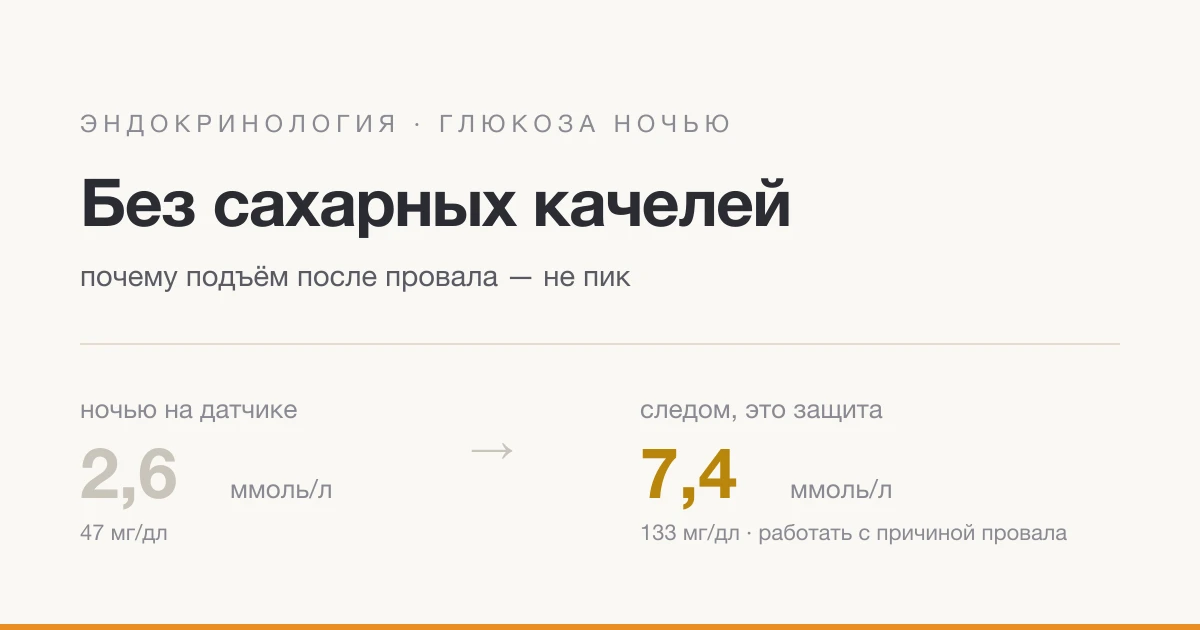
A rise after a dip is not a spike. At night the continuous glucose monitor (CGM) shows 2.6 mmol/L (47 mg/dL), then 7.4 mmol/L (133 mg/dL), and the urge is to «bring the spike down». But the body has just switched on its defence and returned glucose to the blood. What needs work is why the sugar reached 2.6 mmol/L (47 mg/dL), not the figure 7.4 mmol/L (133 mg/dL).
Two thresholds. Repeatedly below 3.0 mmol/L (54 mg/dL) or above 8.9 mmol/L (160 mg/dL) is a reason to see a doctor. 7.4 mmol/L (133 mg/dL) is within the limits.
Dinner is a meal, not a snack. Half the plate vegetables, a quarter protein, a quarter slow carbohydrate, a little fat; carbohydrate last. This beats both «hake with salad» and a huge bowl of porridge «just in case».
Exercise works, if done wisely. Walking for 10 minutes after each meal in people with type 2 diabetes lowered the glucose rise more than a single 30-minute walk a day (Reynolds AN Diabetologia 2016. PMID 27747394). Falling sugar is not «finished off» with exercise.
The guide. 11 pillars of stability and 7 dinners in grams — download the PDF «No Sugar Swings» (18 pages, in Russian).
What Happens at Night
With a real fall in glucose, the adrenaline surge is part of the normal defence. Hence the racing heart, anxiety, inner shakiness; sweating comes with them. In a study, a fall in glucose during sleep to 2.2 mmol/L (40 mg/dL) woke 10 of 16 healthy volunteers, and waking went in parallel with the adrenaline surge (Schultes B PLoS Med 2007. PMID 17326710; Towler DA Diabetes 1993. PMID 8243825).
Chronic overload, lack of sleep, anxiety and constant readiness for a fight make the picture less stable. That is why the nervous system needs to be taken out of this mode regularly — see the sections on sleep and the evening.
Eleven Pillars of Stability
You cannot work only with the number on the sensor. If you want fewer sugar swings, the foundation is 11 down-to-earth pillars:
- Proper meals instead of snacks
- Protein at every meal
- Vegetables and fibre
- Moderate quality carbohydrates instead of «bombs»
- Movement after meals
- Strength training
- Normal sleep
- Less alcohol
- Coffee in moderation
- Morning light
- Less stimulation in the evening
Exercise: Yes and No
Yes — a walk after a meal. Muscles take up glucose more actively and the post-meal curve becomes flatter (Engeroff T Sports Med 2023. PMID 36715875). Walking for 10 minutes after each meal in people with type 2 diabetes lowered the glucose rise more than a single 30-minute walk a day, after dinner by 22% (Reynolds AN Diabetologia 2016. PMID 27747394).
No — finishing off low sugar. If the sugar is already low and keeps falling, there is no need to «finish off the spike» with walking, squats, running or interval training: exercise itself increases glucose uptake by the muscles. A hard workout right before bed, with a tendency to night dips, is not the best idea.
Strength training. Muscles are among the main consumers of glucose. The American Diabetes Association (ADA) recommends strength training 2–3 times a week on non-consecutive days and 150 minutes of aerobic activity a week, if there are no contraindications (ADA Diabetes Care 2026. PMID 41358898). Exercise is not a punishment for eating.
Sleep, Coffee, Alcohol
Sleep. A single night of about 4 hours of sleep lowered insulin sensitivity in healthy people the very next day (Donga E J Clin Endocrinol Metab 2010. PMID 20371664; Sondrup N Sleep Med Rev 2022. PMID 35189549). Enough sleep, getting up at the same time, darkness at night, a cool bedroom, no work in bed.
Coffee. Caffeine 400 mg disrupted sleep even 6 hours before bedtime; sensitivity varies from person to person (Drake C J Clin Sleep Med 2013. PMID 24235903). Poor sleep, night waking and evening coffee — remove the obvious first, then look for a rare pathology.
Alcohol. At night the liver keeps glucose up between meals. 48 g of alcohol (about three glasses of wine) reduced the liver's synthesis of new glucose by 45% and total glucose output by 12% (Siler SQ Am J Physiol 1998. PMID 9815011). While stabilising — a minimum; with night dips — remove it.
Morning and Evening
Morning light. Light is the main signal for the internal clock: bright light soon after waking can shift the rhythm 10–30 minutes earlier (López-Velasco C J Pineal Res 2026. PMID 41832758). It is not a remedy for hypoglycemia but a tool for a normal sleep–wake rhythm. Woke up → water → outside or the balcony → daylight.
Evening: 10–15 minutes for one practice. Slow calm breathing without holding it, light stretching or a warm shower, a body scan, calm music or reading. The goal is a repeating signal «the day is over, time to switch to sleep». One practice is enough, not all at once.
The Plate Formula
The task is not to remove carbohydrates but to build a plate after which glucose arrives gradually: half vegetables and fibre, a quarter protein (about 150 g), a quarter slow carbohydrate. A little avocado, olive oil or tahini for taste and satiety.
Order. Vegetables and protein first, carbohydrate last — in mild type 2 diabetes the post-meal glucose rise is lower (Saldarriaga-Callejas LM Acta Diabetol 2026. PMID 41081830).
Two extremes. Hypoglycemia is not treated by giving up carbohydrates: «hake with salad» is, for some people, too light a dinner and hunger 1–2 hours later. Nor is it prevented by a huge portion of porridge, fruit or sweets «just in case».
Seven Dinners in Grams
| Dinner | Protein | Carbohydrate | Vegetables and fat |
|---|---|---|---|
| Turkey, sweet potato, broccoli | turkey 150–170 g | sweet potato 120–150 g | broccoli 150 g, courgette 100–150 g, avocado ¼–½ |
| Salmon, quinoa, green vegetables | salmon 140–160 g | cooked quinoa 100–120 g | broccoli, green beans, courgette 100 g each |
| Beef with vegetables and a small potato | beef 150–170 g | potato 120–150 g | aubergine, courgette, tomatoes, pepper |
| Asian-style chicken with basmati | chicken 150 g | cooked basmati 80–120 g | broccoli, mushrooms, pepper, carrot, sesame |
| White fish with a warm salad | hake or cod 170–180 g | cooked quinoa 100 g | courgette, green beans, pepper, avocado ¼–½ |
| Turkey, pumpkin, lentils, tahini | turkey 140–160 g | lentils 80–100 g, pumpkin 120–150 g | cucumber, rocket, tahini 1 tsp |
| Build-your-own dinner | meat or poultry 150 g | sweet potato 120–150 g | vegetables 100 g each, avocado ¼ |
The recipes, the mechanism of each dinner and what to expect from the curve are in the guide «No Sugar Swings» (PDF, in Russian). We expect not a perfect straight line on the sensor but a physiological picture: ate → glucose rose moderately, not above 8.9 mmol/L (160 mg/dL) → gradually returned → no dip, no ravenous hunger, no constant snacking.
When to See a Doctor
Below 3.0 mmol/L (54 mg/dL). If values below 3.0 mmol/L (54 mg/dL) are confirmed with a glucometer and recur in a person who is not on insulin or drugs that can cause hypoglycemia, it is a reason not to keep perfecting the plate but to find the cause with a doctor. Hypoglycemia is confirmed by a blood test during symptoms (Cryer PE J Clin Endocrinol Metab 2009. PMID 19088155; Elghobashy M Diagnostics 2023. PMID 37892096).
Above 8.9 mmol/L (160 mg/dL). If values above 8.9 mmol/L (160 mg/dL) recur, that is also a reason to see a doctor: check glucose metabolism.
On insulin or a sulfonylurea. The most common cause of hypoglycemia is the glucose-lowering treatment itself. Night dips are a reason to review the doses with your doctor, not to change dinner.
A dip on the sensor. If the CGM shows a real 2.6 mmol/L (47 mg/dL), the adrenal glands deserve close attention — how they hold up glucose is in the article Cortisol and the Adrenal Glands: the HPA Axis. If energy is lacking for no obvious reason, where to start with tests is in the article The Stress Axis: Sleep, Energy and Which Tests to Discuss.
Summary
A rise after a night dip is not the enemy but a defence; the cause of the dip is what needs work. The main rule: enough food → proper protein → plenty of fibre → moderate carbohydrate → quality fat. Plus movement after meals, sleep, less alcohol and evening coffee, morning light. Two thresholds — below 3.0 mmol/L (54 mg/dL) and above 8.9 mmol/L (160 mg/dL) — are a reason to see a doctor.
This material is for information only and does not replace a consultation with a doctor. On insulin or a sulfonylurea, doses are changed only with a doctor. The draft was prepared with the help of a language model; author and reviewing physician — Vladimir Pereligyn, endocrinologist.


