

In brief
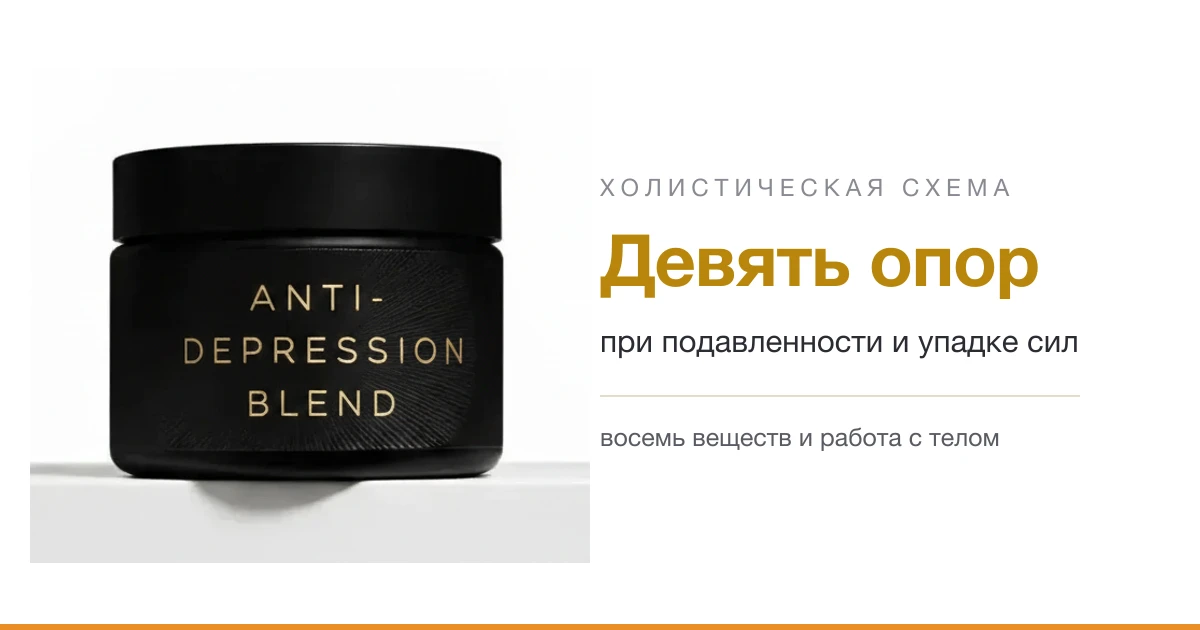
What this is. Nine supports on which holistic care for low mood and exhaustion is built: eight substances and one block of habits.
The core idea. None of them replaces treatment, and none is prescribed to everyone alike. The scheme is assembled for a person — and the whole point lies in the assembly, not in any single jar.
An honest frame. Trials testing several substances at once barely exist: science studies one component at a time, while a doctor treats a whole person. So what follows is mechanism and experience, with numbers where they genuinely exist.
Why a scheme rather than a pill
Mood is not one broken part but several at once. Under one person lies iron and B12 deficiency, under another years of smouldering inflammation, under a third an exhausted reward system — nothing interests you and nothing good is expected.
Hence the logic of selection: different substances enter through different doors. One supplies raw material for dopamine, another repairs the work of methyl groups, a third calms the glia — the helper cells of the brain that start making noise under inflammation. Together they close several points rather than one.
Note the key limitation of evidence-based medicine here: combinations are not studied. A trial is built so that exactly one substance differs between groups, otherwise the result is unreadable. Each component therefore has data behind it, while the scheme as a whole has none to be had — and here clinical judgement decides.
The nine supports
1. Mucuna pruriens
Tropical velvet beans, a natural source of L-DOPA, the direct precursor of dopamine. Dopamine governs not pleasure as such but the will to act — the «I want to get up and do it» that disappears first in low mood.
What is known: mucuna has been studied seriously in Parkinson’s disease, where it worked as a source of levodopa. Trials of comparable quality in depression do not exist — it enters this scheme by mechanism, not by protocol.
2. Saffron
The only substance on this list with a genuinely large evidence base. A meta-analysis of 34 trials with 1,769 participants showed a marked drop in depression and anxiety scores. Eight trials compared saffron directly with SSRIs: no difference in effect was found, and saffron caused fewer adverse events.
The honest detail: the effect is clear on scales people fill in themselves and does not reach significance on scales completed by a clinician. Doses used in trials are 28–30 mg of standardised extract daily.
3. Fermented red ginseng
A classic adaptogen of eastern tradition. Fermentation changes the form of its active compounds so the gut absorbs them better. Its job in the scheme is not to lift mood but to return stamina: to ease the sense of being hunted, to support mental and physical capacity, to improve microcirculation.
4. Ademetionine (SAMe)
A substance the body makes itself — the principal donor of methyl groups in the nervous system. Methylation underlies neurotransmitter synthesis, membrane function and detoxification in the liver.
The data here are strong. In a network analysis of 192 trials with 17,437 patients comparing 44 nutraceuticals, SAMe alone outperformed antidepressants and added to them produced a still larger effect — it sits in the top group beside omega-3, curcumin and saffron. Two multicentre trials compared it with imipramine: 1,600 mg orally and 400 mg intramuscularly matched it and were tolerated significantly better.
The caveat: a Cochrane review rates the quality of this evidence as low, and in a separate trial 800 mg as an add-on did not work — dose matters.
5. B vitamins by injection
B12, B6 and B1 are not about advertised pep but about the insulation of nerve fibre and that same methylation. B12 deficiency masquerades as depression for years: slowness, fog, fatigue, tingling in hands and feet.
Why injections: when absorption is impaired — after stomach surgery, on metformin or acid-suppressing drugs, in older age — a tablet may not arrive. The injectable form bypasses the gut and raises levels faster.
Before prescribing, the level is checked by a blood test: this is a case where «just in case» does not work.
6. Fermented papaya (Immune Age)
A functional food with studied antioxidant action. In older people and in patients with Alzheimer’s disease, six months of use lowered 8-OHdG, a marker of oxidative damage to DNA; in a two-year controlled study, vascular function and self-rated quality of life improved. A separate paper confirmed safety in people over seventy.
In the scheme it stands not as an antidepressant but as background: the lower the oxidative stress, the lighter the load on nervous tissue.
7. Glialia — palmitoylethanolamide with luteolin
The least obvious and perhaps the most interesting participant. Palmitoylethanolamide (PEA) is a compound the body produces itself when tissue is damaged; it calms the glia, the brain’s helper cells. When glia are over-excited — which is what neuroinflammation is — mood, memory and pain sensitivity all suffer. Luteolin strengthens the effect, and the ultramicronised form exists so the substance is absorbed at all.
The data: in a trial of 58 patients, PEA 600 mg twice daily was added to citalopram; the difference from placebo appeared as early as week two, and by the end of six weeks every patient on PEA had responded against three quarters on placebo. The sample is small, but the direction is clear — and it fits the wider picture, in which anti-inflammatory interventions improve depression as an add-on to standard treatment.
8. Cordyceps sinensis
A fungus used for centuries in Tibetan and Chinese tradition to restore strength after illness. Modern data are modest and concern mainly stamina and tolerance of exertion. Its role here matches ginseng’s: it does not lift mood directly but returns the reserve from which mood grows.
9. Skin and breath — the two doors that are always open
The subconscious cannot be reached by argument. But the body has two entrances through which it yields directly, bypassing reasoning — the skin and the breath.
Through the skin. Massage, rubbing, cupping, acupuncture, cold training and cold water. Skin is the largest sense organ, and the stream of signals from it runs straight into the regions that govern anxiety and tone. That is why after a good massage or a cold shower it is not only mood that changes, but breathing, pulse and the ability to sleep.
Through the breath. The Wim Hof method, Vietnamese noi cong, the breathing techniques of martial arts, qigong breathing — and the simplest of all, attentive observation of your own inhale and exhale. Breathing is unique in being the only autonomic function open to voluntary control: by lengthening the exhale a person acts directly on a system that otherwise does not obey them.
Both doors serve one purpose: to bring body and mind into a synchronised state. When the two are out of step — thoughts racing, body clenched, breathing shallow — low mood sustains itself with no outside cause. Not one of the eight jars above will undo that desynchronisation.
And this is the most accessible part of the scheme: it requires no prescription, no purchase and nobody’s permission.
How the scheme is assembled
Not all nine at once and not the same for everyone. The usual order:
▸ tests first: TSH, ferritin, B12, folate, vitamin D, full blood count. Any deficiency found is closed first, because without that the rest works at half strength;
▸ then the core of the scheme: whatever fits the mechanism — depleted dopamine, inflammation, disturbed methylation;
▸ and only then the background: adaptogens and antioxidants;
▸ sleep, light, movement and body work run in parallel, from day one.
Doses, combinations and duration are chosen individually: age, coexisting illness, everything already being taken. Which is exactly why there is no ready-made «take this» table here — it would be a deception.
The limits that matter more than any scheme
Everything described concerns mild and moderate states and supportive care. Some situations cannot wait:
▸ thoughts of not wanting to live, plans to harm yourself, the sense that those close to you would be better off — help is needed today, not from Monday;
▸ severe depression, when a person cannot get up, eat or work — here medication remains the foundation of treatment;
▸ bipolar disorder — if there have been past episodes of unusual elevation, the scheme is built differently;
▸ pregnancy and breastfeeding — some of these substances are not used, and the decision is made separately.
And one more thing: this scheme does not cancel prescribed treatment. If you are taking an antidepressant, stopping it on your own is not an option — abrupt withdrawal brings discontinuation symptoms. What is described here usually goes alongside medication, not instead of it.
On selection. Which of these nine supports you need, at what doses and in what order, is worked out in consultation, from your tests and your history. Schemes like this are not assembled blind.
Sources
1. Mahmoudi R, et al. Effect of saffron on depression, anxiety and mood disorder: a GRADE assessed systematic review and meta-analysis of 34 randomized controlled trials. Nutr Neurosci. 2026. Consensus
2. Shafiee A, et al. Effect of Saffron Versus Selective Serotonin Reuptake Inhibitors (SSRIs) in Treatment of Depression and Anxiety: A Meta-analysis of Randomized Controlled Trials. Nutr Rev. 2024. Consensus
3. Cheng YC, et al. Comparative efficacy and tolerability of nutraceuticals for depressive disorder: a systematic review and network meta-analysis. Psychol Med. 2025. Consensus
4. Delle Chiaie R, et al. Efficacy and tolerability of oral and intramuscular S-adenosyl-L-methionine 1,4-butanedisulfonate in the treatment of major depression: comparison with imipramine in 2 multicenter studies. Am J Clin Nutr. 2002;76(5):1172S–1176S. PMID 12418499
5. Galizia I, et al. S-adenosyl methionine (SAMe) for depression in adults. Cochrane Database Syst Rev. 2016;10:CD011286. PMID 27727432
6. Ghazizadeh-Hashemi M, et al. Palmitoylethanolamide as adjunctive therapy in major depressive disorder: a double-blind, randomized and placebo-controlled trial. J Affect Disord. 2018;232:127–133. PMID 29486338
7. Köhler-Forsberg O, et al. Efficacy of anti-inflammatory treatment on major depressive disorder or depressive symptoms: meta-analysis of clinical trials. Acta Psychiatr Scand. 2019;139(5):404–419. PMID 30834514
8. Barbagallo M, et al. Oxidative stress in patients with Alzheimer's disease: effect of extracts of fermented papaya powder. Mediators Inflamm. 2015;2015:624801. PMID 25944987
9. Noetel M, et al. Effect of exercise for depression: systematic review and network meta-analysis of randomised controlled trials. BMJ. 2024;384:e075847. PMID 38355154


