

Key points
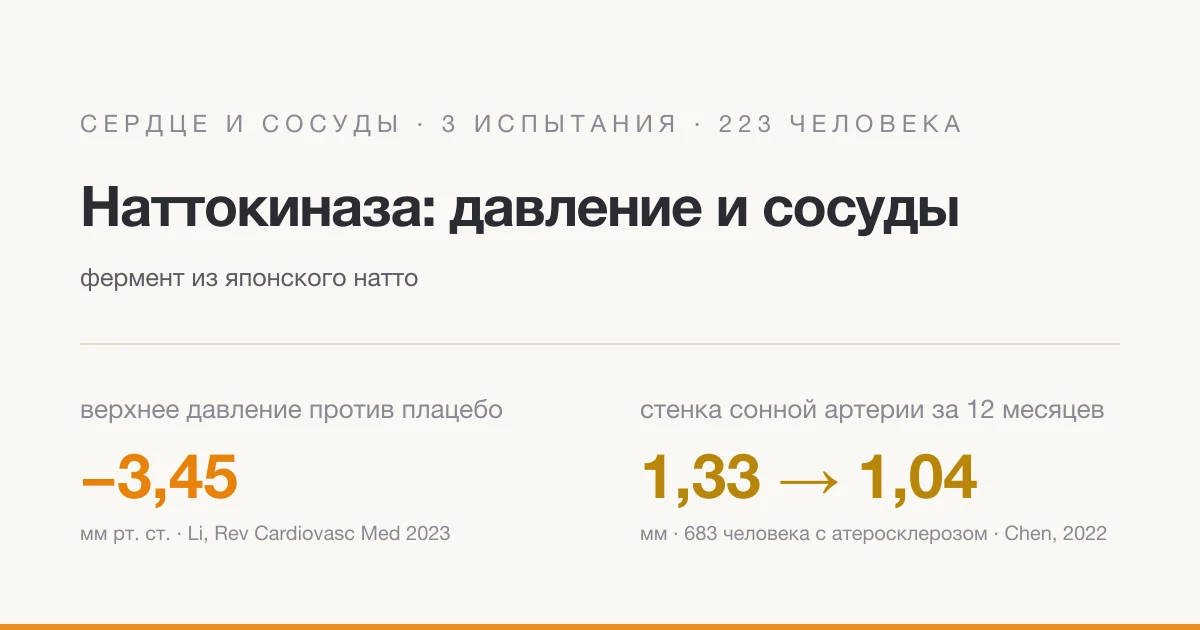
Nattokinase is an enzyme from natto, the fermented soy that people in Japan eat for breakfast. The enzyme breaks down fibrin, the protein that blood clots are made of. In a pooled analysis of three randomized trials (223 people), systolic blood pressure on nattokinase was 3.45 mmHg lower and diastolic 2.32 mmHg lower than with placebo (Li X Rev Cardiovasc Med 2023. PMID 39076715). In an observational study of people with elevated cholesterol, in 683 participants with atherosclerosis, over 12 months of 10,800 FU (fibrinolytic units) a day the carotid artery wall became thinner and the plaque 36% smaller (Chen H Front Cardiovasc Med 2022. PMID 36072877). Below: what each study showed, the doses, and who should see a doctor first.
| Substance | Daily amount (in studies) | How it helps | What the studies showed |
|---|---|---|---|
| Nattokinase | 2,000 FU (about 100 mg) — blood pressure trials; 10,800 FU — vascular observational study | Breaks down fibrin, the protein of blood clots | Systolic pressure 3.45 mmHg lower, diastolic 2.32 mmHg lower vs placebo (3 trials, 223 people); carotid artery wall 1.33 → 1.04 mm over 12 months (683 people with atherosclerosis) |
What nattokinase is
Natto is made from soybeans that Bacillus subtilis bacteria ferment for about a day. The result is a sticky dish with a sharp taste: in Japan it is served on rice with mustard and soy sauce. In the 1980s an enzyme that dissolves fibrin was found in natto and named nattokinase. Supplements contain the purified enzyme in capsules, with strength given in FU: the more units, the higher the activity. Many natto supplements have vitamin K2 removed, which is present in the dish itself.
Blood pressure: what the trials showed
The systematic review found 6 randomized controlled trials (RCTs) — studies in which participants are randomly divided into a supplement group and a placebo group. Blood pressure was measured in three of them, 223 people in total (115 on nattokinase, 108 on placebo). On nattokinase, systolic (upper) pressure was 3.45 mmHg lower and diastolic (lower) pressure 2.32 mmHg lower. The authors rated the quality of the trials as high and concluded that nattokinase can be used as an adjunct for elevated blood pressure (Li X Rev Cardiovasc Med 2023. PMID 39076715). Below are two of these three trials.
In Korea, 86 people aged 20 to 80 with untreated systolic pressure of 130–159 mmHg received 2,000 FU a day or placebo for 8 weeks. Systolic pressure on nattokinase was 5.55 mmHg lower and diastolic 2.84 mmHg lower than with placebo; renin activity also decreased — renin is a kidney enzyme that raises blood pressure (Kim J Y Hypertens Res 2008. PMID 18971533).
In the USA, 79 people with elevated blood pressure received 100 mg of nattokinase (2,000 FU) a day or placebo for 8 weeks. Diastolic pressure fell on average from 87 to 84 mmHg, while in the placebo group it stayed at 87 mmHg. In men the result was more noticeable: from 86 to 81 mmHg (Jensen G S Integr Blood Press Control 2016. PMID 27785095).
Blood vessels and cholesterol: an observational study of 1,062 people
In China, records were collected on 1,062 people with elevated cholesterol who took nattokinase for 12 months; 683 of them had signs of atherosclerosis. Before and after, they had a blood test and an ultrasound of the carotid arteries. In the 683 people with atherosclerosis, at a dose of 10,800 FU a day, the thickness of the inner carotid artery wall decreased on average from 1.33 to 1.04 mm, and plaque area by 36% (Chen H Front Cardiovasc Med 2022. PMID 36072877).
Cholesterol also improved. In 1,001 people on 10,800 FU a day, "bad" LDL cholesterol (low-density lipoprotein) fell from 3.64 to 3.02 mmol/L (from 141 to 117 mg/dL), total cholesterol from 5.59 to 4.68 mmol/L (from 216 to 181 mg/dL), and triglycerides from 1.73 to 1.46 mmol/L (from 153 to 129 mg/dL). "Good" HDL cholesterol (high-density lipoprotein) rose from 1.35 to 1.57 mmol/L (from 52 to 61 mg/dL). According to the authors, the effect was slightly stronger in smokers and in people with a body mass index (BMI) of 27.5 or higher, and slightly higher in those who exercised regularly. At a dose of 3,600 FU a day (61 people), neither cholesterol nor blood vessels changed notably (Chen H Front Cardiovasc Med 2022. PMID 36072877).
How it is taken
In the blood pressure trials, 2,000 FU a day was taken for 8 weeks; the result was measured after 8 weeks (Kim J Y Hypertens Res 2008. PMID 18971533). In the vascular study, 10,800 FU a day for 12 months (Chen H Front Cardiovasc Med 2022. PMID 36072877). Blood pressure is conveniently tracked with a home monitor: morning and evening, seated, after 5 minutes of rest. Nattokinase supplements, not replaces, the basics — movement, sleep, less salt, vegetables and legumes. Blood pressure treatment prescribed by a doctor is not stopped; the dose and duration are chosen with a doctor.
Who should see a doctor first
Nattokinase dissolves blood clots, so together with blood-related medicines (blood thinners and anti-clotting drugs) it raises the risk of bleeding — if you take them, take nattokinase only in agreement with a doctor. Before planned surgery or a tooth extraction, stopping it is discussed with a doctor in advance. See a doctor first with bleeding disorders, a recent bleed or stroke, and in pregnancy and breastfeeding. The natto dish itself contains vitamin K2: if you take medicines whose action is affected by vitamin K, the amount of natto is agreed with a doctor.
Summary
Nattokinase is an enzyme from Japanese natto. In randomized trials it lowered blood pressure: systolic by 3.45 mmHg and diastolic by 2.32 mmHg versus placebo. In a large observational study, a high dose of 10,800 FU a day over a year was accompanied by a thinner carotid artery wall, a smaller plaque, and better cholesterol. People who take blood-related medicines choose nattokinase with a doctor.
Source: Nattokinase: Blood Pressure and Arteries — What the Studies Showed — universum.earth. Dr. Pereligyn.


