

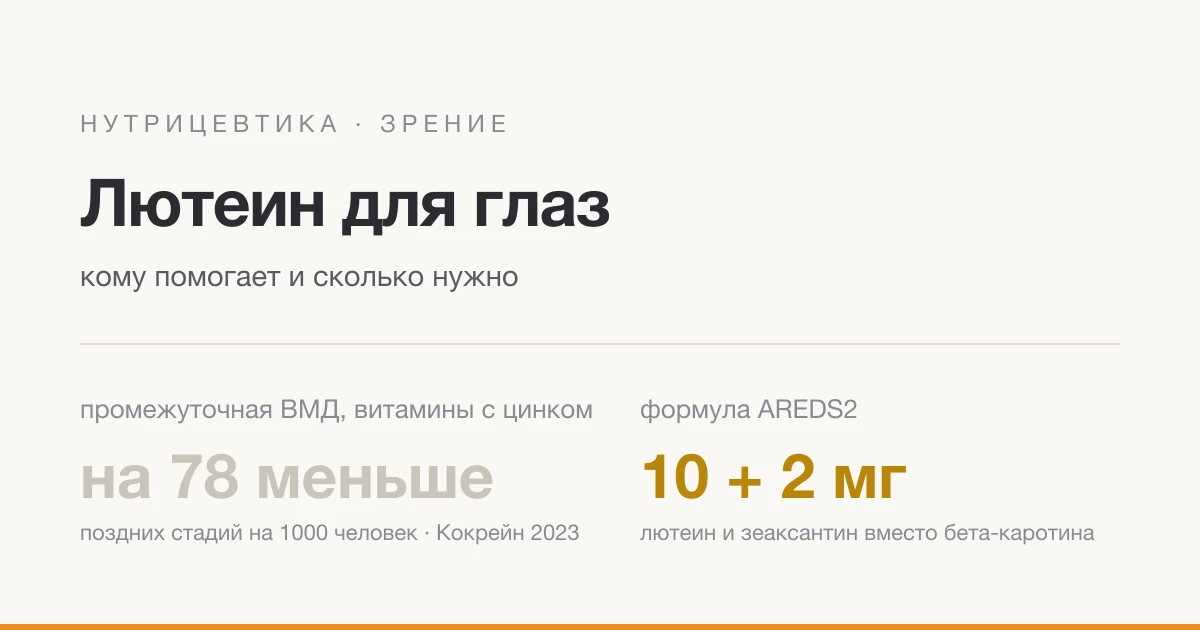
Key points
Lutein and zeaxanthin are yellow carotenoid pigments in the center of the retina. The best-studied option is the eye vitamin formula for age-related macular degeneration (AMD): lutein entered it in place of beta-carotene. The table shows the main results of studies in humans.
| Where it applies | How it helps | What human studies showed |
|---|---|---|
| Age-related macular degeneration (AMD) | antioxidant vitamins with zinc (the AREDS formula: vitamins C and E, beta-carotene, zinc with copper) slow the progression of the disease to the late stage; later, lutein replaced beta-carotene in it | AREDS: 3,640 people aged 55–80 with signs of AMD, 6.3 years — odds of late AMD 0.72, at high risk 0.66 (AREDS Research Group Arch Ophthalmol 2001. PMID 11594942); in intermediate AMD, about 78 fewer cases of the late stage per 1,000 people (Evans JR Cochrane Database Syst Rev 2023. PMID 37702300) |
| An eye formula without beta-carotene | lutein 10 mg with zeaxanthin 2 mg replaced beta-carotene in the formula; lutein is safer than beta-carotene | AREDS2: 4,203 people aged 50–85 — lung cancer with beta-carotene 2.0% vs 0.9% without it, mainly in former smokers (AREDS2 Research Group JAMA 2013. PMID 23644932); after 10 years, in 3,882 participants, lutein vs beta-carotene: late AMD 15% less often (0.85; post-trial follow-up, exploratory analysis), lung cancer: beta-carotene 1.82, lutein 1.15 — no significant rise (Chew EY JAMA Ophthalmol 2022. PMID 35653117) |
| Vision in AMD | lutein and zeaxanthin slightly improve visual acuity and contrast sensitivity | 8 randomized trials, 1,176 patients with AMD (Liu R Invest Ophthalmol Vis Sci 2014. PMID 25515572) |
| Long hours at a screen | higher pigment density, better visual tests and sleep, fewer headaches and less eye fatigue | one study: 48 healthy young people with at least 6 hours a day at screens, six months of 24 mg of a mix of lutein, zeaxanthin and meso-zeaxanthin vs placebo (Stringham JM Foods 2017. PMID 28661438) |
How it helps
What these pigments are
The macula (the yellow spot) is the center of the retina that we use to read and recognize faces. Its color comes from lutein and zeaxanthin. This pigment absorbs blue light; its amount is measured as macular pigment optical density (Stringham JM Foods 2017. PMID 28661438). The Burgerstein handbook classes lutein as an antioxidant and links it to the density of macular pigment (Burgerstein, Handbuch Nährstoffe 2015, p. 61, 63).
Which foods have more of them
Among 33 vegetables and fruits studied, plus egg yolk, lutein and zeaxanthin made up the largest share of carotenoids in egg yolk and corn — more than 85%. Dark green leafy vegetables have a lot of lutein (15–47% of carotenoids) but almost no zeaxanthin; among vegetables, orange pepper has the most zeaxanthin (Sommerburg O Br J Ophthalmol 1998. PMID 9828775).
Macular degeneration: AREDS
AMD is a disease of the macula in people over 50 in which central vision suffers. An early sign is drusen, yellow deposits under the retina; an ophthalmologist sees them during a fundus examination.
AREDS. In the Age-Related Eye Disease Study (AREDS), 3,640 people aged 55–80 took vitamin C 500 mg, vitamin E 400 IU (international units), beta-carotene 15 mg, zinc 80 mg with copper 2 mg, or placebo for 6.3 years. Antioxidants with zinc lowered the odds of late AMD (0.72) and of noticeable vision loss (0.73). At higher risk — for example, with large drusen or late AMD in one eye — the effect was larger (0.66). No serious side effects were found (AREDS Research Group Arch Ophthalmol 2001. PMID 11594942).
Who this matters for. By the Cochrane review’s estimate, in intermediate AMD the vitamins give about 78 fewer cases of the late stage per 1,000 people, and in early AMD, where the risk is low anyway, about 4 (Evans JR Cochrane Database Syst Rev 2023. PMID 37702300).
Lutein instead of beta-carotene: AREDS2
AREDS2. 4,203 people aged 50–85 with large drusen in both eyes or late AMD in one eye received, on top of the AREDS formula, lutein 10 mg with zeaxanthin 2 mg, omega-3 or placebo for 5 years on average. With beta-carotene, lung cancer occurred in 2.0% versus 0.9% without it, mainly in former smokers — and lutein was proposed as a replacement (AREDS2 Research Group JAMA 2013. PMID 23644932). On omega-3, see the article Omega-3: how much EPA and DHA you need and who benefits.
After 10 years. In 3,882 participants, in a direct comparison with beta-carotene, late AMD developed 15% less often on lutein (hazard ratio 0.85; post-trial follow-up, exploratory analysis). Beta-carotene almost doubled the odds of lung cancer (1.82), while lutein gave no significant rise (1.15) (Chew EY JAMA Ophthalmol 2022. PMID 35653117). The Cochrane review supports replacing beta-carotene with lutein (Evans JR Cochrane Database Syst Rev 2023. PMID 37702300).
Screens and “blue light”
In one study, 48 healthy young people who spent at least 6 hours a day at screens took 24 mg of a mix of lutein, zeaxanthin and meso-zeaxanthin, or placebo, for six months. On the supplement, pigment density rose, visual tests and sleep improved, and headaches and eye fatigue were less frequent (Stringham JM Foods 2017. PMID 28661438).
How to take it
In AMD, 10 mg of lutein with 2 mg of zeaxanthin a day was studied as part of the full formula (AREDS2 Research Group JAMA 2013. PMID 23644932). The handbook gives 5–20 mg of lutein a day for a supplement — this is the authors’ own dose, not a norm (Burgerstein, Handbuch Nährstoffe 2015, p. 63). Safety data are reliable up to 20 mg of lutein a day; above that, it is insufficiently studied rather than proven harmful (Shao A Regul Toxicol Pharmacol 2006. PMID 16814439).
Who should see a doctor first
- Formulas with beta-carotene are not suitable for smokers and people who have quit smoking; the handbook warns smokers about high doses of synthetic beta-carotene (Burgerstein, Handbuch Nährstoffe 2015, p. 65).
- The AREDS formula contains 80 mg of zinc — this dose is worth discussing with a doctor: in AREDS, zinc was linked to more frequent genitourinary problems in men (Evans JR Cochrane Database Syst Rev 2023. PMID 37702300); more in the article Zinc: why you need it, signs of deficiency and how much is safe.
- With a constant excess of carotenoids, the skin turns yellow — this is carotenodermia; the handbook describes it with a daily intake of about 1 kg of carrots (Burgerstein, Handbuch Nährstoffe 2015, p. 62). Show yellowed skin to a doctor so as not to miss jaundice.
- If straight lines look bent, a spot appears in the center of vision, or vision drops quickly, you need an ophthalmologist: a supplement does not replace an examination and treatment.
Bottom line
Lutein and zeaxanthin are macular pigments; in egg yolk and corn they make up the largest share of carotenoids — more than 85% — and leafy greens are also rich in lutein. The data are most reliable in intermediate AMD: the AREDS formula slows the disease, and lutein in it is safer than beta-carotene. In people with AMD, lutein with zeaxanthin slightly improved the sharpness of vision. You can discuss testing and whether you personally need a supplement at a consultation.
Source: Lutein for the eyes: who it helps and how much is needed — universum.earth. Dr. Pereligyn.


