

Key points
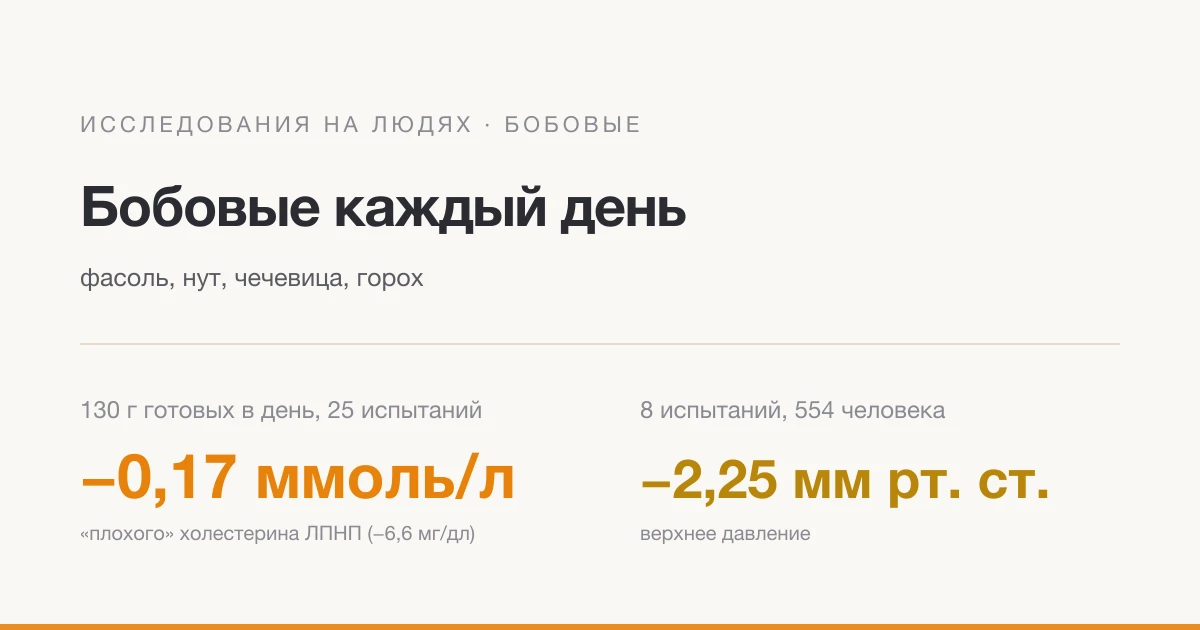
Beans, chickpeas, lentils and peas are inexpensive food with protein and fibre, and their benefit shows up in trials in people. One serving a day, about 130 g of cooked legumes, slightly lowers "bad" cholesterol, systolic pressure and weight, and in large cohorts legumes are associated with a lower risk of cardiovascular disease and hypertension. Legumes fit an ordinary day easily: soup, salad, a side for fish or meat, hummus. If they make your stomach bloat, this usually passes; just start small.
| What | How much | Why it helps | What studies showed |
|---|---|---|---|
| Cholesterol | About 130 g cooked a day, 6 weeks | Lower "bad" LDL | 25 trials: minus 0.17 mmol/L (6.6 mg/dL) |
| Blood pressure | Legumes in the diet | Lower systolic pressure | 8 trials, 554 people: minus 2.25 mmHg |
| Weight | About 132 g a day, 6 weeks | Small weight loss without dieting | 21 trials, 940 people: minus 0.34 kg |
| Fasting sugar | Legumes as part of the diet | Lower fasting sugar | Analysis of 11 trials showed a reduction |
| Heart and vessels (association) | More legumes in the diet | Lower risk of cardiovascular disease and hypertension | 7 cohorts, 231,353 people: cardiovascular disease risk 8% lower; 7 cohorts, 288,352 people: hypertension risk 9% lower |
| Length of life (association) | +50 g a day | Lower risk of death from any cause | 19 cohorts: 6% lower |
Cholesterol: a small but steady shift
In a review of randomised trials, people were given legumes in place of other food with the same calories. The median dose was about 130 g of cooked legumes a day and the median duration 6 weeks. LDL ("bad" cholesterol) fell by 0.17 mmol/L (6.6 mg/dL) on average, 25 trials (95% CI 0.09 to 0.25 mmol/L) (Ha V CMAJ 2014. PMID 24710915).
Why this happens is simple: legumes contain a lot of soluble fibre, which binds part of the bile acids and cholesterol in the gut. So a bowl of lentil soup or a chickpea salad is not just filling but good for your vessels.
Blood pressure and weight
In 8 controlled feeding trials (554 people, with and without hypertension), legumes lowered systolic pressure by 2.25 mmHg on average (95% CI 0.28 to 4.22). Diastolic pressure did not change significantly (Jayalath VH Am J Hypertens 2014. PMID 24014659). That is not much, but it comes with no extra effort, simply with ordinary meals.
Another review gathered 21 trials in 940 people: legumes, about 132 g a day, lowered weight by 0.34 kg on average (95% CI 0.04 to 0.63 kg), with calories deliberately not cut (Kim SJ Am J Clin Nutr 2016. PMID 27030531). Legumes keep you full for long, so it is easier not to snack on extras.
Fasting sugar and the heart
In a review of trials where legumes were eaten on their own (11 trials, in people with and without diabetes), fasting sugar was lower than in the comparison without them (Sievenpiper JL Diabetologia 2009. PMID 19526214). The result there is expressed in standardised units, so an exact figure in mmol/L (mg/dL) cannot be given.
In large observational studies, eating more legumes was associated with an 8% lower risk of cardiovascular disease overall (7 cohorts, 231,353 people; RR 0.92; 0.85-0.99) and a 9% lower risk of hypertension (7 cohorts, 288,352 people; RR 0.91; 0.86-0.97) (Viguiliouk E Adv Nutr 2019. PMID 31728500). This is an association: people who eat legumes may have other healthy habits too.
Another analysis pooled prospective cohorts with soy excluded: every 50 g of legumes a day was associated with a 6% lower risk of death from any cause (19 cohorts; HR 0.94; 0.89-0.99) (Zargarzadeh N Adv Nutr 2023. PMID 36811595).
How to eat legumes so it is tasty and comfortable
Most people eat legumes less often than they should simply because they do not know where to put them. A few simple options: lentil soup with carrots and herbs, a chickpea salad with cucumber, tomatoes and olive oil, beans baked with vegetables, hummus with vegetable sticks, peas in a green salad. For steady sugar it helps that these dishes need no grains or bread.
If legumes make your stomach bloat, that is normal at the start. In 11 trials bloating and gas were reported, but in most of them it faded by the end (Ha V CMAJ 2014. PMID 24710915). So begin with a quarter of a serving, add more a week later, until you reach a whole one. Rinse tinned beans and chickpeas; with boiled legumes you can pour off the first water.
An example day without grains or bread: lentil soup with vegetables and herbs for lunch, a chickpea salad with cucumber, tomatoes and a spoon of olive oil for dinner, and a side of stewed beans with onion next to fish or eggs. This way legumes replace part of the quick sides, and the plate is filling yet calm for sugar. Red lentils, by the way, cook in about a quarter of an hour, and chickpeas and beans are handy from a jar or tin and just need rinsing, which saves an evening. Even if it is four or five times a week rather than every day, that is already a good step towards the habit. Hummus works too: two or three spoons with cucumber or sweet pepper make a handy snack at work.
How to use it
- Guide from the trials: about 130 g of cooked legumes a day, roughly one serving.
- Beans, chickpeas, lentils and peas all count; soy was not part of the mortality calculations.
- Build up the portion gradually, starting with a quarter: bloating is easier to get through.
- Put legumes in place of part of the meat or quick sides in soup, salad or a main dish.
- Choose tinned ones without added sugar and rinse the beans before eating.
Who should see a doctor first
Legumes do not replace prescribed treatment for high cholesterol, blood pressure or diabetes. With bowel disease with bloating, gout or reduced kidney function, agree the amount of legumes in your diet with a doctor. If you take prescribed treatment, discuss diet at your appointment.
If you monitor sugar: a repeat result below 3.0 mmol/L (54 mg/dL) or above 8.9 mmol/L (160 mg/dL) is a reason to see a doctor. In diabetes targets are individual, and below 3.0 mmol/L (54 mg/dL) always means a doctor. Do not change prescribed treatment on your own.
Bottom line
Legumes are a simple habit with several small pluses at once: slightly lower "bad" cholesterol, systolic pressure and weight, steadier sugar. One serving a day of beans, chickpeas, lentils or peas, best in place of less useful food and with a gradual start so your stomach gets used to it.
Source: Legumes every day: beans, chickpeas and lentils for the heart and blood pressure — universum.earth. Dr. Pereligyn.


