

Key points
Iodine is the raw material for thyroid hormones, and the thyroid needs it in Hashimoto’s too. The table shows how getting enough iodine helps and what human studies showed.
| Where it applies | How it helps | What human studies showed |
|---|---|---|
| Thyroid hormones | the thyroid uses iodine to make its hormones, thyroxine (T4) and triiodothyronine (T3) (Burgerstein, Handbuch Nährstoffe 2015, p. 128) | — |
| Prevention in the population | normal iodine intake across the population is an important part of preventing thyroid disease, and enough iodine early in life is needed for mental development and growth (Zimmermann MB Lancet Diabetes Endocrinol 2015. PMID 25591468) | — |
| Pregnancy | more iodine is needed: the World Health Organization (WHO) raised the norm for pregnant women from 200 to 250 µg a day; in areas of severe deficiency, iodine is given before conception or at the very start of pregnancy to protect the baby’s brain development (Zimmermann MB Am J Clin Nutr 2009. PMID 19088150) | — |
| Hashimoto’s | the thyroid needs iodine in Hashimoto’s too; the main source is food and iodised salt (Leung AM Nat Rev Endocrinol 2014. PMID 24342882) | — |
How it helps
The thyroid builds iodine into its hormones, thyroxine (T4) and triiodothyronine (T3). Without iodine it is overworked: the Burgerstein handbook describes goitre, nodules, cysts and areas that work on their own (Burgerstein, Handbuch Nährstoffe 2015, p. 128).
In Hashimoto’s thyroiditis (autoimmune thyroiditis), the immune system attacks the thyroid. The main marker of the disease is thyroid peroxidase antibodies (TPO antibodies); more on them in the article Anti-TPO: the main marker of autoimmune thyroiditis. Thyroid function is assessed by thyroid-stimulating hormone (TSH) from the pituitary gland: when thyroid hormones are lacking, TSH rises.
Prevention in the population. Normal iodine intake across the population is an important part of preventing thyroid disease, and a lack of iodine early in life impairs mental development and growth (Zimmermann MB Lancet Diabetes Endocrinol 2015. PMID 25591468).
Pregnancy needs more. WHO raised the iodine norm for pregnant women from 200 to 250 µg a day. When the mother has severe iodine deficiency, the baby’s brain development suffers, so in such areas iodine is given before conception or at the very start of pregnancy (Zimmermann MB Am J Clin Nutr 2009. PMID 19088150).
How much is needed and where to get it
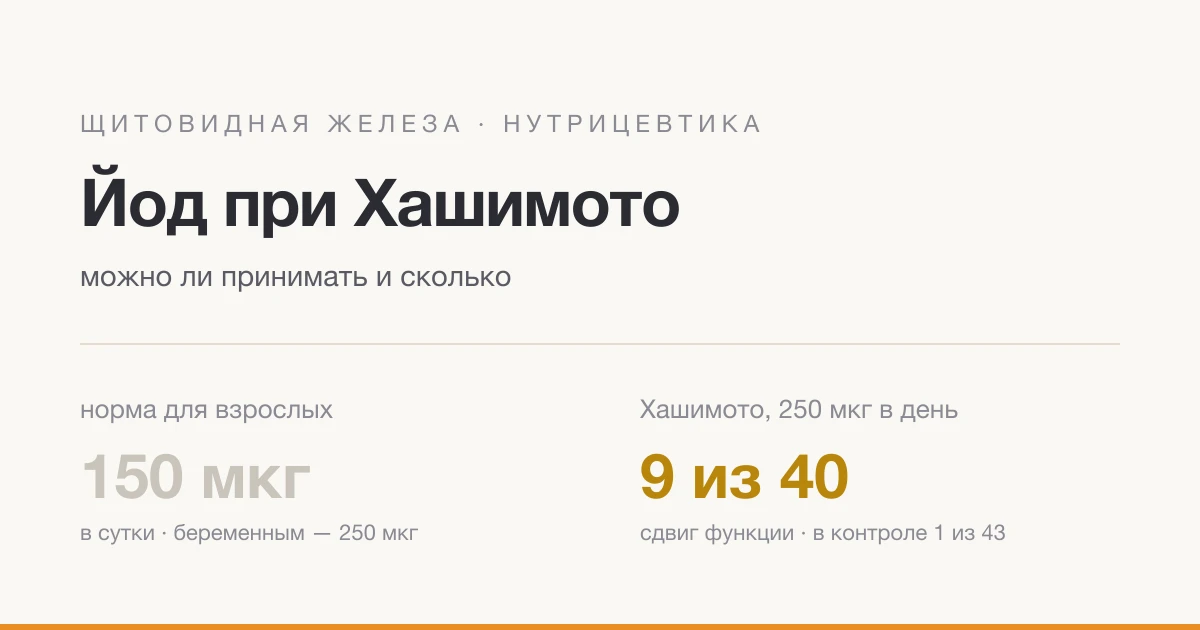
Adults. 150 µg a day outside pregnancy and breastfeeding; intake above this threshold is usually well tolerated, but in thyroid disease, including Hashimoto’s, the risk of disruptions may be higher (Leung AM Nat Rev Endocrinol 2014. PMID 24342882). The handbook gives similar figures: 150–200 µg under the German norms of 2000 and 150 µg under the US norms of 2001 (Burgerstein, Handbuch Nährstoffe 2015, p. 130).
In pregnancy and breastfeeding. In 2006 the American Thyroid Association (ATA) advised all pregnant and breastfeeding women in the US and Canada to take a supplement of 150 µg of iodine a day (Becker DV Thyroid 2006. PMID 17042677); whether a supplement is needed with Hashimoto’s and levothyroxine is decided by the doctor according to the ATA 2026 guideline (Korevaar TIM Thyroid 2026. PMID 42219800).
The main source is food: products with added iodine, such as salt, dairy products and bread, and, among natural sources, seafood (Leung AM Nat Rev Endocrinol 2014. PMID 24342882).
When there is too much iodine
The Wolff–Chaikoff effect in plain words. When a large amount of iodine reaches the thyroid at once, it temporarily slows down hormone production. The gland usually escapes from this slowdown, but in vulnerable people it does not, and hypothyroidism develops. In others, the excess instead triggers overactivity: this is the Jod-Basedow phenomenon (Sohn SY Endocr Rev 2024. PMID 38870258).
Population data. In China, 3018 people in three regions were followed for 5 years. Subclinical hypothyroidism (raised TSH with normal thyroid hormones) appeared in 0.2% with mild iodine deficiency, in 2.6% with intake above the norm and in 2.9% with excess intake. In people with antibodies and normal function, TSH rose more often where iodine intake was higher (Teng W N Engl J Med 2006. PMID 16807415).
In Denmark, 4649 people were examined before cautious mandatory salt iodisation and 3570 people 4–5 years after it. Even though intake was raised only to the lower end of the normal range, TPO antibodies were found in 23.8% of people in the general population versus 14.3% before it, and thyroglobulin antibodies (Tg antibodies) in 19.9% versus 13.7%. The rise was more noticeable in young women and was mostly due to low antibody levels (Pedersen IB Clin Endocrinol 2011. PMID 21521277).
Patients with Hashimoto’s themselves. In Germany, in an area with mild iodine deficiency, 40 people with Hashimoto’s and normal thyroid function received 250 µg of iodine a day for about 4 months. Most had no significant changes. Subclinical hypothyroidism developed in 7, overt hypothyroidism in 1 and overactivity in 1; in the control group of 43 people there was 1 case of subclinical hypothyroidism. In three of the seven and in the person with overactivity, everything returned to normal after iodine was stopped (Reinhardt W Eur J Endocrinol 1998. PMID 9703374).
Supplements and seaweed. Seaweed is a special case: it contains a lot of iodine, and the amount is unpredictable. In 12 species of edible seaweed it ranged from 16 µg per gram in nori to 8165 µg per gram in one sample of kelp salt-substitute granules (Teas J Thyroid 2004. PMID 15588380). Supplements, and kelp in particular, can give a dose several times above the norm.
The European tolerable upper intake level for adults is 600 µg a day. Of 224 seaweed products in the UK, only 10% stated their iodine content, and 26, calculated per serving, could exceed this level (Bouga M Foods 2015. PMID 28231201). The US upper level is 1100 µg a day for adults, and some Asian seaweed dishes can also exceed it (Teas J Thyroid 2004. PMID 15588380). The upper level is a ceiling, not a target; in Hashimoto’s, sensitivity to iodine may be higher (Leung AM Nat Rev Endocrinol 2014. PMID 24342882), so a supplement on top of food is discussed with a doctor.
Who should see a doctor first
- With Hashimoto’s or raised TPO antibodies, do not start iodine supplements on top of food on your own: discuss the dose with your doctor and plan TSH monitoring.
- Older people with nodules that work on their own (functional autonomy): excess iodine can trigger acute overactivity (Burgerstein, Handbuch Nährstoffe 2015, p. 130).
- Before tests with iodine-containing contrast and when amiodarone is prescribed, tell your doctor about Hashimoto’s: these are common sources of large amounts of iodine (Sohn SY Endocr Rev 2024. PMID 38870258).
Pregnancy with Hashimoto’s. The need for iodine rises in pregnancy in all women (Zimmermann MB Am J Clin Nutr 2009. PMID 19088150), and with Hashimoto’s it is important not to overdo it: the fetus and the newborn are also sensitive to excess iodine (Leung AM Nat Rev Endocrinol 2014. PMID 24342882). Whether a supplement is needed, at what dose and how often to check TSH is decided together with the doctor. TSH targets in pregnancy are covered in the article TSH norms in pregnancy.
Bottom line
The thyroid needs iodine in Hashimoto’s too: the main source is food and iodised salt, and the need rises in pregnancy. Supplements on top of food and seaweed are discussed with a doctor. A general overview of the topic is in the article Iodine and the thyroid. You can work out a plan and a testing schedule at a consultation.
Source: Iodine in Hashimoto’s: can you take it and how much — universum.earth. Dr. Pereligyn.


