

Key points
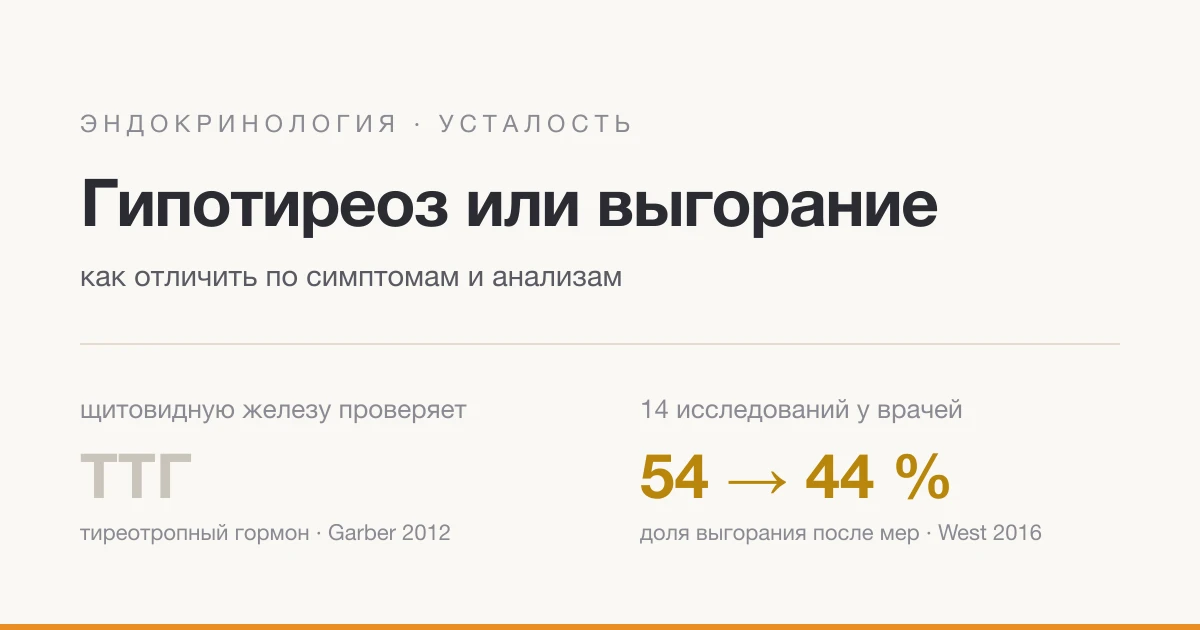
TSH checks the thyroid. Thyroid-stimulating hormone (TSH), the pituitary hormone that controls the thyroid, is the best first test for a thyroid disorder in almost everyone seen by a doctor as an outpatient (Garber JR Endocr Pract 2012. PMID 23246686).
Dangerous diseases are rare. Among people who came to a family doctor with fatigue, serious physical illness was found in 4.3% and anaemia in 2.8%, while depression was a common finding — in 18.5% (Stadje R BMC Fam Pract 2016. PMID 27765009).
Burnout can be reduced. Across 14 studies of doctors, the share with burnout fell from 54% to 44%; in a review of 52 studies, both individual and organisational measures helped (West CP Lancet 2016. PMID 27692469).
Iron when ferritin is low. In 198 menstruating women aged 18–53 without anaemia, with unexplained fatigue and ferritin below 50 µg/L (50 ng/mL), 12 weeks of oral iron reduced fatigue more than placebo: the score fell by 47.7% versus 28.8%. There was no significant effect on quality of life or mood (Vaucher P CMAJ 2012. PMID 22777991).
Why they are easy to confuse
Fatigue and low energy occur both with a shortage of thyroid hormones (hypothyroidism) and with burnout. The most common complaints in hypothyroidism are fatigue and lethargy (Chaker L Lancet 2017. PMID 28336049). Burnout is described as emotional exhaustion, cynicism and a feeling that one’s own accomplishments have declined; it shares a loss of interest and difficulty concentrating with depression (Koutsimani P Front Psychol 2019. PMID 30918490).
So these conditions cannot be told apart by how you feel alone. A blood test shows whether you have hypothyroidism; burnout is not determined by a lab test.
Signs of hypothyroidism
Besides fatigue, hypothyroidism often brings feeling cold (a person is chilly where others are comfortable), weight gain, constipation, voice changes and dry skin (Chaker L Lancet 2017. PMID 28336049).
A Danish study compared 140 people with newly diagnosed overt autoimmune hypothyroidism and 560 people without thyroid disease. The most common symptoms among those with the disease were fatigue (81%), dry skin (63%) and shortness of breath (51%). Dry skin and hair loss were more frequent among the patients than among healthy people, but no single sign is reliable on its own. The more symptoms from the list, the higher the likelihood of hypothyroidism, and when none were present at all it fell to 21% of the initial likelihood. The authors’ conclusion: even a slight suspicion is a reason to get tested (Carlé A Eur J Endocrinol 2014. PMID 25305308).
What burnout is
The World Health Organization (WHO) included burnout in the 11th revision of the International Classification of Diseases (ICD-11) as an occupational phenomenon, not as a medical condition. It results from chronic workplace stress that has not been successfully managed. Three signs: exhaustion, mental distance from one’s job or cynicism towards it, and a sense of one’s own ineffectiveness. The term refers only to work (WHO, ICD-11, 2019).
A practical question to ask yourself: is the fatigue linked primarily to work?
Burnout and depression are noticeably linked (correlation coefficient 0.52); the authors of the meta-analysis considered them distinct, though partly overlapping, conditions (Koutsimani P Front Psychol 2019. PMID 30918490).
Thyroid test: TSH and free T4
TSH is the best single test to check whether the thyroid is working properly (Garber JR Endocr Pract 2012. PMID 23246686). If TSH is raised, the doctor adds free thyroxine (T4), the gland’s main hormone. High TSH with low free T4 means overt hypothyroidism; high TSH with normal free T4 means subclinical, that is, mild hypothyroidism. Reference ranges are statistical and depend on the laboratory (Chaker L Lancet 2017. PMID 28336049).
For subclinical hypothyroidism with TSH below 10 mU/L (10 µIU/mL), the guideline advises deciding on treatment individually (Garber JR Endocr Pract 2012. PMID 23246686).
Cortisol: what can and cannot be checked
Morning blood cortisol together with adrenocorticotropic hormone (ACTH, the pituitary hormone that controls the adrenal glands) is needed to rule out adrenal insufficiency. The US Endocrine Society advises testing for primary insufficiency when there are signs of it; in pregnant women, with persistent nausea, fatigue and low blood pressure. Morning cortisol with ACTH is the first step if a short ACTH test cannot be done right away (Bornstein SR J Clin Endocrinol Metab 2016. PMID 26760044).
Saliva cortisol “curves”, however, do not diagnose burnout. In a systematic review of 58 studies of cortisol in fatigue and burnout (33 of them in healthy people), the results almost always contradicted each other, and “adrenal fatigue” as a disease was not confirmed (Cadegiani FA BMC Endocr Disord 2016. PMID 27557747).
The “Stress axis” questionnaire can help you get your bearings — it is a guide, not a diagnosis. Which tests to discuss with a doctor based on its results is covered in the article Stress axis: sleep, energy and which tests to discuss.
What else to check if fatigue persists
The doctor decides what else to test based on your symptoms and examination.
Iron. Ferritin shows iron stores; in practice it is usually checked together with C-reactive protein (CRP), a marker of inflammation. A complete blood count is often added.
Vitamins. Vitamins B12 and D — when indicated.
Metabolism. Glucose and glycated haemoglobin — so as not to miss diabetes.
Mood. Depression is a common finding in fatigue: among those who complained of fatigue, it occurred more often than among others (Stadje R BMC Fam Pract 2016. PMID 27765009). The doctor may offer a short questionnaire for depression and anxiety.
It can be both
Hypothyroidism does not protect against burnout, and burnout does not rule out thyroid disease. Even when test results on treatment return to normal, a noticeable proportion of patients still have symptoms (Chaker L Lancet 2017. PMID 28336049). On the link between hypothyroidism and mood, see the article Hypothyroidism, Hashimoto’s, depression and anxiety.
What the studies showed
| What was studied | Who took part | Result |
|---|---|---|
| Symptoms in newly diagnosed overt autoimmune hypothyroidism, 2014 | 140 patients and 560 people without thyroid disease | Fatigue in 81%, dry skin in 63%; no single sign is reliable on its own |
| Causes of fatigue in family practice, review of 26 studies, 2016 | Patients with fatigue | Depression 18.5%, serious physical illness 4.3%, anaemia 2.8% |
| Burnout and depression, meta-analysis, 2019 | Studies from 2007–2018 | Noticeable link (0.52); the authors considered them distinct, though partly overlapping, conditions |
| Iron for fatigue without anaemia, 2012 | 198 menstruating women aged 18–53 with ferritin below 50 µg/L (50 ng/mL) | Fatigue fell more than on placebo (−47.7% vs −28.8%); no significant effect on quality of life or mood |
| Measures against burnout, meta-analysis, 2016 | 52 studies, 3630 doctors; overall burnout share from 14 of them | Share with burnout from 54% to 44% |
| Thyroid hormones in subclinical hypothyroidism, meta-analysis, 2018 | 21 studies, 2192 non-pregnant adults | No improvement in quality of life or thyroid-related symptoms shown |
Not everything was confirmed: in subclinical hypothyroidism in non-pregnant adults, thyroid hormones lowered TSH, but across 21 studies they did not show an improvement in overall quality of life or thyroid-related symptoms (Feller M JAMA 2018. PMID 30285179). So a slightly raised TSH does not always explain fatigue.
Who should be more careful
- If you have thoughts that you do not want to live, seek help right away without waiting for test results.
- If fatigue is accompanied by persistent unexplained nausea and low blood pressure, see a doctor without delay: the guideline advises testing for primary adrenal insufficiency when there are signs of it; in pregnant women, with persistent nausea, fatigue and low blood pressure (Bornstein SR J Clin Endocrinol Metab 2016. PMID 26760044).
- If you are already taking levothyroxine and the fatigue does not go away, do not change the dose yourself: discuss the dose and other causes with your doctor.
- Do not start thyroid hormones “for fatigue” without a test.
Bottom line
Hypothyroidism and burnout feel similar. Hypothyroidism often brings feeling cold, weight gain, constipation and dry skin, but no single sign is reliable on its own; burnout is exhaustion and cynicism linked to work. TSH shows whether you have hypothyroidism, with free T4 if needed; what else to check — iron, vitamins, blood sugar, mood — the doctor decides based on your symptoms and examination. Both can occur at once. You can sort out the causes of your fatigue at a consultation.
This material is for information only and does not replace a doctor’s consultation. Tests and treatment are prescribed by a doctor based on the results of an examination.


