

Key points
Memory works in three steps: take in, consolidate, recall. Each step can be helped, and studies have shown how. New information fits into working memory in chunks of 3 to 5. Sleep consolidates what you learned, and the night after learning matters most. Recalling works best when it is active: test yourself instead of rereading. Spacing out repetitions and ordinary walking help too. Below, all the habits are in one table, then in order, with examples from an ordinary day.
| Step / habit | What to do | Why it helps | What studies showed |
|---|---|---|---|
| Take in: chunks of 3 to 5 | Split long material into meaningful parts | Easier to hold in mind | Review: an adult's working memory holds 3 to 5 meaningful chunks at once |
| Consolidate: sleep | Sleep the night after something important | Less is forgotten | 14 young men aged 18, at 48 hours an average loss of 0.2 words after sleep vs 1.8 words after a sleepless night |
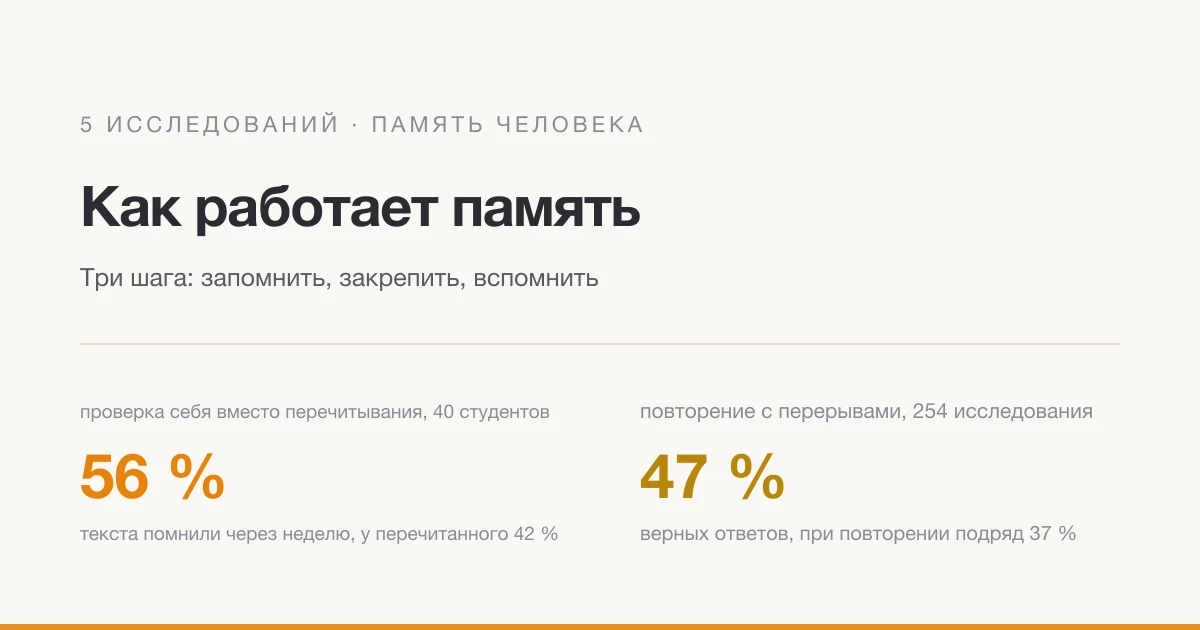
| Recall: self-testing | Retell from memory instead of rereading | Remembered longer | 40 students: 56% of the text after a week vs 42% for the reread one |
| Space out repetitions | Return to the material after a day, after a week | More correct answers | 271 comparisons from 254 studies: on average 47.3% correct vs 36.7% for repetition in a row |
| Walking | Regular walking or other endurance exercise | Better memory for events | 36 trials, 2,750 people: a small average improvement in people over 55 |
Why a new acquaintance's name slips away
A familiar situation: someone tells you their name, you nod, and a minute later you cannot recall it. This is not a sign of poor memory. The brain simply did not go through all three steps. It caught the new item, but did not consolidate it and never retrieved it. The good news is that each step has a simple habit, and most take seconds.
Step 1. Take in: chunks of 3 to 5
Working memory is like a small table that holds a limited number of items. In an adult that is 3 to 5 meaningful chunks at once (review: Cowan N Curr Dir Psychol Sci 2010. PMID 20445769). The lesson for life is clear: break long things into parts. A phone number is easier to remember in groups than as one string of digits, and a to-do list in groups by meaning: home, work, shopping.
A chunk does not have to be short. The word "milk" is one chunk even though it has four letters. So the more meaningfully you combine information, the more fits on the table. Invent a link, an image or a short story, and several separate things become one chunk.
Step 2. Consolidate: sleep
What you saw and heard during the day is not yet a reliable memory. It is consolidated later, and sleep helps with that. In an experiment, 14 young men aged 18 learned lists of 24 word pairs. Each took part in two conditions: in one they slept the night after the lesson, in the other they stayed awake all night. At 48 hours after the lesson, when memory was tested, they lost on average 0.2 words after a night of sleep and 1.8 words after a sleepless night (Gais S Learn Mem 2006. PMID 16741280).
An important detail: after the sleepless night, participants caught up on sleep before testing. So the difference was not tiredness at the test but the missing sleep in the night right after learning. The practical takeaway is simple: after important study or a key conversation, protect that night. If sleep does not come, start with 5 drug-free insomnia remedies.
Step 3. Recall: self-testing
Recalling does not just pull a record from the archive, it makes it stronger. In an experiment, students read texts and then tested themselves on one text by retelling it from memory and reread another. After a week they remembered the self-tested text at 56% and the reread text at 42%; 40 students in this calculation, a within-person comparison (Roediger HL, Karpicke JD Psychol Sci 2006. PMID 16507066).
Why does rereading feel so reliable? After 5 minutes it was even slightly better (81% vs 75%). A text in front of your eyes feels familiar, and it seems learned. The benefit of self-testing shows after a week, not at once. So close your notes and retell them aloud or write them from memory, then check.
Spacing out repetitions
You can repeat in a row or with breaks. A pooled analysis covered 271 comparisons from 254 studies with verbal material: with spaced repetition the average was 47.3% correct answers, with repetition in a row 36.7% (Cepeda NJ Psychol Bull 2006. PMID 16719566).
A simple tip: return to the material the next day and once more after a week. It is quicker than it sounds, especially if each time you test yourself rather than reread.
Movement
One more helper for memory that needs nothing but shoes. In a pooled analysis of 36 randomized trials with 2,750 people with an average age of about 71, endurance exercise, including walking, improved memory for events. The average improvement is small, and it is clearer in studies where the average age of participants was 55 to 68 (Aghjayan SL Commun Med 2022. PMID 35603310). All participants were over 55, and the finding applies to them.
How to use this in an ordinary day
A phone number. Split it into parts of 3 or 4 digits, repeat the parts aloud, and a minute later dial it from memory without looking.
A new acquaintance's name. Repeat it aloud at once, recall it a minute later and again in the evening. That way you pass all three steps: caught, consolidated, retrieved.
An exam or a talk. Learn the material in the evening, sleep that night, and in the morning do not reread but retell from memory. Come back to it once more after a day and after a week.
Foreign words. Do not copy out a column; cover the translation and recall it. Return to the words with breaks, and take a walk between sessions.
Who should see a doctor first
The habits above are for the ordinary memory of a healthy person. See a doctor if memory has noticeably worsened over a short time; if a person gets lost in familiar places, repeats the same questions or no longer manages familiar tasks; if the decline began after a head injury; or if there is persistent insomnia or low mood.
If memory decline comes with sudden weakness, trouble speaking or a drooping face, call an ambulance urgently.
Summary
Memory works in three steps: take in, consolidate, recall. It is helped by chunks of 3 to 5, sleep the night after something important, self-testing instead of rereading, spaced repetition and walking. Start with one habit: tomorrow recall a new person's name after a minute and again in the evening. If you are worried about your own memory or a relative's, discuss it at a consultation.
Source: How memory works: three steps and what improves it — universum.earth. Dr. Pereligyn.


