

Key points
High uric acid is usually more about how the body clears it and how metabolism works than about what is on the plate. Uric acid is made inside the body, in the liver, and cleared by the kidneys and the gut, and the level in the blood depends on the balance between the two. The good news: much of what affects this balance can be checked with ordinary tests instead of guesswork. Food stays a useful part of the plan, but it makes sense to start with the cause, not with a list of bans. Below: how this balance works, where insulin comes in, what to check and who should see a doctor first.
| Study | How many people | What was found |
|---|---|---|
| Analysis of five US cohorts, diet questionnaires and uric acid (Major TJ BMJ 2018. PMID 30305269) | 16,760 adults without gout or kidney disease | The 14 foods significant in the full sample together explain 3.28% of the differences between people; common inherited variants explain 23.9% (analysis of 12,162 people) |
| Kidney handling of uric acid in gout (Perez-Ruiz F Arthritis Rheum 2002. PMID 12522834) | 100 people with primary gout and 72 healthy people | In people with gout the kidneys cleared uric acid less well; the authors call reduced excretion the main mechanism |
| Experiment raising insulin in the blood (Quiñones Galvan A Am J Physiol 1995. PMID 7840165) | 20 healthy volunteers | With high insulin the kidneys excreted less uric acid: 1.66 vs 2.12 µmol/min |
| Genetic analysis, Mendelian randomization (McCormick N Arthritis Rheumatol 2021. PMID 33982892) | 288,649 people for uric acid, 153,525 for fasting insulin; checked in 360,453 UK Biobank participants | Genetically higher fasting insulin was linked to higher uric acid: +0.37 mg/dL (≈22 µmol/L) per log unit of insulin; no reverse link found |
Where uric acid comes from and where it goes
Picture a basin with a tap. Uric acid is constantly produced in the body, in the liver, and constantly leaves through the kidneys and the gut. If the inflow rises or the drain is partly closed, the level in the blood goes up. In a large analysis of diet and uric acid the authors describe exactly this balance between production in the liver and excretion by the kidneys and gut (Major TJ BMJ 2018. PMID 30305269). So the question "what did I eat" matters, but it is only one of the reasons the level can be high.
The comparison of people with gout and healthy people is telling. The study included 100 people with primary gout and 72 healthy people. In people with gout the kidneys cleared uric acid less well: lower clearance and lower fraction excreted. This was seen even in those whose daily excretion looked high. The authors conclude that reduced kidney excretion is the main mechanism of primary rise in uric acid in gout (Perez-Ruiz F Arthritis Rheum 2002. PMID 12522834). So the cause is worth looking for in how the kidneys work and in what affects them.
Why the kidneys hold on to it: the role of insulin
Insulin is the hormone that helps cells take sugar from the blood. Here there is a link to the kidneys. In an experiment on 20 healthy volunteers, insulin in the blood was raised artificially (an insulin clamp). During that time the kidneys excreted less uric acid: 1.66 vs 2.12 µmol/min, and sodium excretion fell by 30%. The level in the blood did not change during the experiment because it was short (Quiñones Galvan A Am J Physiol 1995. PMID 7840165). This is an acute experiment in healthy people, but it shows a mechanism: with high insulin the kidneys hold back uric acid.
The second argument comes from genetics. Researchers used inherited variants as a natural experiment: they are set at birth and do not depend on lifestyle. The analysis used data from 288,649 people for uric acid and 153,525 for fasting insulin, and was checked in 360,453 UK Biobank participants. The higher the genetically determined fasting insulin, the higher the uric acid. No link was found in the opposite direction. The authors conclude that high insulin leads to high uric acid and not the other way round, and that reducing insulin resistance could lower the uric acid level (McCormick N Arthritis Rheumatol 2021. PMID 33982892). Note the wording "could". These are genetic data that point to the direction of the link, not a treatment trial. It cannot be promised that working on insulin will "cure gout".
What to check
If uric acid is high, it helps to look at metabolism as a whole. Here is a list to discuss with your doctor, with a note on why each item matters.
Kidneys. Creatinine and the estimated glomerular filtration rate show how well the kidneys filter. Since uric acid is cleared by the kidneys, this is the first item. You can do the calculation in the eGFR calculator.
Fasting insulin together with glucose. This pair shows how sensitive cells are to insulin. The HOMA-IR index is calculated from it: HOMA-IR calculator. If insulin is not among your tests, first estimate the likelihood with the insulin resistance test and discuss with your doctor whether to have it measured.
Triglycerides and HDL ("good" cholesterol). These are ordinary markers of metabolism, and together with insulin they complete the picture. Waist circumference and blood pressure can be measured at home in a couple of minutes.
The list of medicines you take. Your doctor needs to know everything you take, including diuretics. Do not stop anything on your own: bring the full list to the appointment and discuss it.
An example of a question for the doctor: "My uric acid is 480 µmol/L (8.1 mg/dL). What else should I check: kidneys, insulin, triglycerides?" This is an example of a question, not a threshold: how to interpret a specific number is for the doctor to decide.
What the diet analysis showed
The BMJ study compared diet questionnaires with uric acid levels in 16,760 people: 8,414 men and 8,346 women of European ancestry, over 18, without gout or kidney disease, not taking urate-lowering drugs or diuretics. The data came from five US cohorts and are cross-sectional. Beer, liquor, wine, potato, poultry, sugary soft drinks and meat (beef, pork, lamb) were linked with a higher level. Eggs, peanuts, cold cereal, skim milk, cheese, brown bread, margarine and non-citrus fruits were linked with a lower level. This is an association in questionnaires, not a trial, and not an "eat" and "don't eat" list (Major TJ BMJ 2018. PMID 30305269).
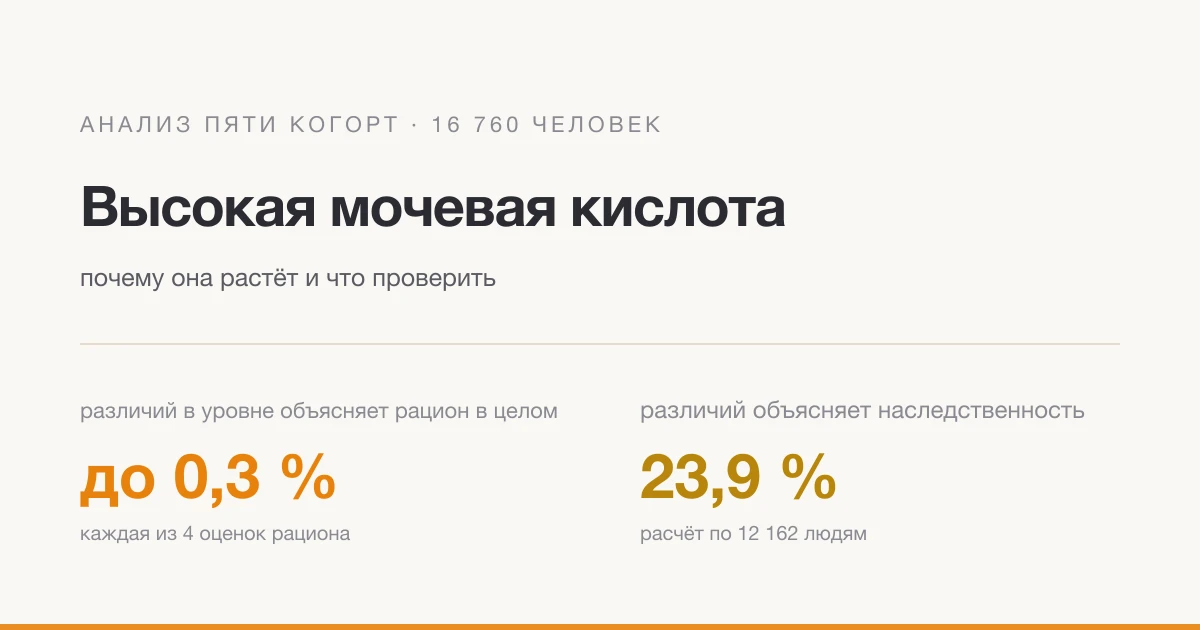
The main result is about scale. Each single food explained less than 1% of the differences between people (0.06 to 0.99%), and the 14 foods significant in the full sample together explained 3.28%. Four scores of the overall diet explained no more than 0.3% each: DASH 0.28%, healthy eating 0.15%, Mediterranean 0.06%, a data-driven pattern 0.16%. For comparison, common inherited variants explained 23.9% of the differences (calculation without one cohort, 12,162 people). It is important to know the limits: this is about differences between people in the general population without gout. The study says nothing about people with gout or about attacks.
So food remains part of the plan, but not the only part. Less alcohol and fewer sugary drinks are good for metabolism in general. These are habits that help the whole body, not a bet on one number in a test.
Who should see a doctor first
See a doctor without delay if there is sharp pain, redness and swelling of a joint, especially the big toe; repeated attacks; kidney stones; kidney disease; or pregnancy. Also see a doctor if uric acid is high on repeat tests. Gout treatment is prescribed by a doctor, and diet does not replace it. The doctor will decide which tests you need and how to combine them with nutrition.
Bottom line
High uric acid is rarely explained by one plate. In the diet analysis of 16,760 people the overall diet explained no more than 0.3% of the differences, and inheritance 23.9% (analysis of 12,162 people). In people with gout the kidneys clear uric acid less well, and high insulin, according to an experiment and genetics, is linked to holding it back. So a sensible order is: check the kidneys, insulin with glucose, triglycerides, waist, blood pressure and the list of medicines, and keep food and alcohol reasonable. You can go through your tests together at a consultation.
Source: High uric acid: why it rises and what to check — universum.earth. Dr. Pereligyn.


