

The main point
Blood sugar on the test is normal, but there is more insulin in the blood than usual: the pancreas is already working under strain. This is an early signal, not a diagnosis. The seven habits are introduced one a day, at home; most have been tested in people, usually looking at post-meal blood sugar.
| Habit | What to do | What studies in people showed |
|---|---|---|
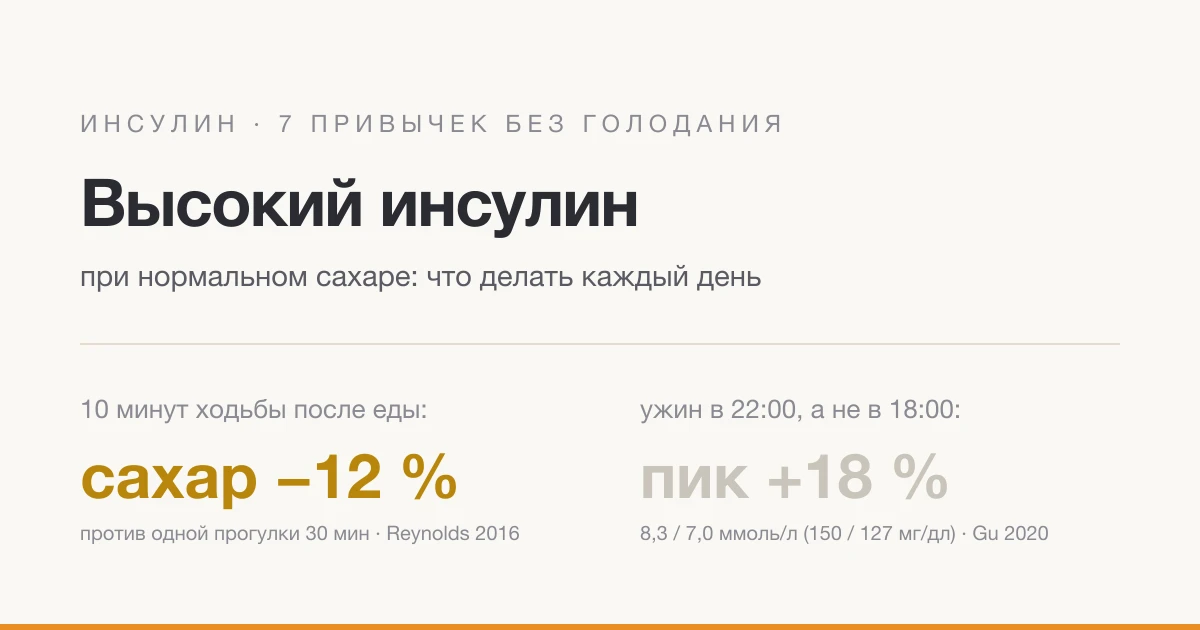
| 1. Walking after meals | 10 minutes after breakfast, lunch and dinner | Type 2 diabetes, 41 people: post-meal blood sugar 12% lower than with a single 30-minute walk a day (Reynolds 2016) |
| 2. Order on the plate | Vegetables and protein first, carbohydrates last | Prediabetes, 15 people: the post-meal blood sugar peak was more than 40% lower than with the reverse order (Shukla 2019) |
| 3. Protein breakfast | Eggs, fish, cottage cheese, thick unsweetened yogurt | Type 2 diabetes: post-meal blood sugar over the day was 12% lower than after a carbohydrate breakfast (Jakubowicz 2017) |
| 4. Earlier dinner | Closer to 18:00 than to 22:00 | 20 healthy people: the blood sugar peak after a 22:00 dinner was 18% higher than after an 18:00 dinner (Gu 2020) |
| 5. Sleep | The same bedtime | 20 healthy young men: a week of 5-hour nights lowered insulin sensitivity by 11–20% (Buxton 2010) |
| 6. Muscles | Strength exercises, seated heel raises | Type 2 diabetes, 24 studies: glycated hemoglobin HbA1c (average blood sugar over 3 months) was 0.61 percentage points lower (≈6.7 mmol/mol) with high intensity (Liu 2019) |
| 7. Mediterranean menu | Vegetables, fish, olive oil, nuts, legumes, a little whole grain | People with metabolic disorders: the HOMA-IR index (a calculation of insulin resistance from fasting glucose and insulin) improved, moderate-certainty evidence (Muscogiuri 2026) |
How it works
Cells respond less well to insulin, so the pancreas releases more of it to keep blood sugar normal. An ordinary blood sugar test notices the change late: insulin sensitivity starts to fall about 5 years before a diabetes diagnosis, while fasting glucose rises sharply only about 3 years before (Tabák AG Lancet 2009. PMID 19515410). In a 24-year follow-up of 515 people with normal blood sugar, the top fifth of insulin levels (quintile) was the strongest predictor of later blood sugar disorders (Dankner R Diabetes Care 2009. PMID 19435961).
You can check yourself with a tape measure. The UK National Institute for Health and Care Excellence (NICE) advises keeping the waist below half of height: at a height of 170 cm, a waist below 85 cm. A ratio of 0.4–0.49 is normal, 0.5–0.59 means increased risk, and 0.6 and above means higher risk; this applies to people with a body mass index (BMI) below 35 (NICE NG246, 2025).
What the studies showed
- Walking. With 10 minutes of walking after each meal, post-meal blood sugar was 12% lower than with a single 30-minute walk a day, and after dinner it was 22% lower (Reynolds AN Diabetologia 2016. PMID 27747394). Blood sugar was measured, not insulin. In 10 people over 60 with borderline fasting blood sugar of 5.8–6.9 mmol/L (105–125 mg/dL), 15 minutes of walking after each meal lowered blood sugar in the 3 hours after dinner more than one 45-minute walk (DiPietro L Diabetes Care 2013. PMID 23761134).
- Order of eating. In 11 people with type 2 diabetes, when bread and juice came at the end rather than at the start, the area under the blood sugar curve was 73% smaller and under the insulin curve 48.5% smaller (Shukla AP Diabetes Care 2015. PMID 26106234). In prediabetes the blood sugar peak fell by more than 40% (Shukla AP Diabetes Obes Metab 2019. PMID 30101510). In 10 healthy people, fish or meat before rice slowed the emptying of food from the stomach (Kuwata H Diabetologia 2016. PMID 26704625).
- Breakfast. In people with type 2 diabetes (average age about 59), with a breakfast of various protein foods, post-meal blood sugar over the day was 12% lower than with a carbohydrate breakfast. With a whey protein shake, fullness was higher and hunger lower (Jakubowicz D J Nutr Biochem 2017. PMID 28863364).
- Late dinner. The blood sugar peak after a 22:00 dinner was 8.3 mmol/L (150 mg/dL) vs 7.0 mmol/L (127 mg/dL) after an 18:00 dinner; insulin did not differ (Gu C J Clin Endocrinol Metab 2020. PMID 32525525).
- Sleep. One night of 4 hours reduced the glucose infusion rate on a clamp (a test in which glucose is infused together with insulin so that blood sugar stays constant) by about 25% compared with a normal night in 9 healthy people (Donga E J Clin Endocrinol Metab 2010. PMID 20371664). In 20 healthy young men, a week of 5-hour nights lowered insulin sensitivity by 11–20% (Buxton OM Diabetes 2010. PMID 20585000).
- Muscles. In type 2 diabetes, HbA1c fell by 0.61 percentage points (about 6.7 mmol/mol) with high intensity and by 0.23 percentage points (about 2.5 mmol/mol) with low and moderate intensity; insulin fell only with high intensity (Liu Y Int J Environ Res Public Health 2019. PMID 30621076). There are no direct studies of short home workouts, but you can start at home.
- Menu. In people with obesity, type 2 diabetes or metabolic syndrome, Mediterranean eating improved HOMA-IR; the review authors rated the evidence as moderate (Muscogiuri G Nutrition 2026. PMID 41175779).
What to do
One habit a day. Day 1 — 10 minutes of walking after meals, even around the apartment. Day 2 — vegetables and protein first. Day 3 — a protein breakfast. Day 4 — an earlier dinner; if dinner is late, add a walk. Day 5 — the same bedtime. Day 6 — squats at a chair, wall push-ups, lunges; build up the load gradually. Day 7 — the whole menu, dinner closer to 18:00 and 10 minutes of walking. It is more honest to assess the result at 3 months.
Who should see a doctor first
If you do not have diabetes: blood sugar repeatedly below 3.0 mmol/L (54 mg/dL) or above 8.9 mmol/L (160 mg/dL) — see a doctor. With diabetes, targets are individual per your doctor's plan; below 3.0 mmol/L (54 mg/dL) — always see a doctor. Habits do not replace prescribed treatment.
Summary
Normal blood sugar does not rule out insulin overload. A tape measure, a walk after meals and the order on the plate are where you can start today. Discuss your tests and plan at a consultation.
Source: High Insulin with Normal Blood Sugar: 7 Habits — universum.earth. Dr. Pereligyn.


