

Key points
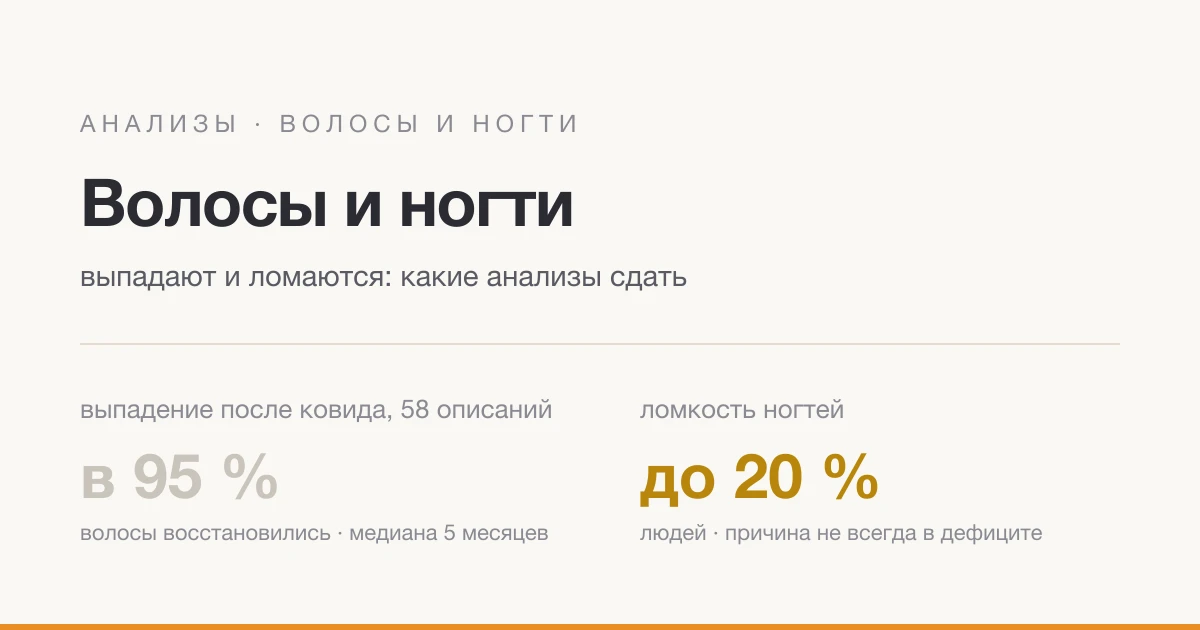
Most often it is temporary. After an illness, stress, childbirth or a strict diet, hair starts shedding months later and often grows back: after COVID, the median time to the start of shedding was 2 months and to recovery 5 months; it resolved in 95% of 58 reported cases (individual case reports) (Czech T J Cosmet Dermatol 2022. PMID 35801366).
The set of tests is short. For female pattern hair loss, experts advise checking androgens, and it is also desirable to check iron, thyroid hormones, vitamin D, zinc and prolactin (Carmina E J Clin Endocrinol Metab 2019. PMID 30785992).
Iron is a common finding. In a meta-analysis of 36 studies (10,029 participants in total), ferritin in women with non-scarring hair loss was on average lower than in women without hair loss; the studies were observational, and the meta-analysis contains no trials of iron replenishment (Treister-Goltzman Y Skin Appendage Disord 2022. PMID 35415182).
Brittle nails: not always a deficiency. Brittle nail syndrome affects up to 20% of people, more often women over 50, and it is far from always a lack of vitamins (Chessa MA Dermatol Ther (Heidelb) 2020. PMID 31749091).
Why hair falls out
Telogen effluvium. A hair grows for years, then “rests” for a few months and falls out. An illness, childbirth, sudden weight loss or emotional distress push many hairs into the resting phase (telogen) at once. That is why hair sheds 2–4 months later: according to a review, 3–4 months after the event (Malkud S J Clin Diagn Res 2015. PMID 26500992), and earlier after COVID — a median of 2 months to onset and 5 months to recovery; it resolved in 95% of 58 reported cases (individual case reports) (Czech T J Cosmet Dermatol 2022. PMID 35801366). This is often reversible, but a chronic form also exists.
Protein and strict diets. By 2002, almost everything known about nutrition and hair loss came from protein and calorie deficiency, starvation and eating disorders (Rushton DH Clin Exp Dermatol 2002. PMID 12190640). The first question to ask yourself: was there a strict diet in the 2–4 months before the shedding?
Female pattern hair loss. It looks like thinning on the top of the head while the hairline above the forehead is preserved. On its own it does not mean an excess of male hormones (androgens) if their levels are normal, but experts advise checking androgens in any such hair loss (Carmina E J Clin Endocrinol Metab 2019. PMID 30785992). If the thinning comes with irregular periods or acne, it is worth discussing polycystic ovary syndrome (PCOS) with a doctor as well.
The thyroid. With hair loss, endocrine diseases are ruled out along with nutritional deficiencies (Malkud S J Clin Diagn Res 2015. PMID 26500992); with female pattern hair loss, it is desirable to check thyroid hormones (Carmina E J Clin Endocrinol Metab 2019. PMID 30785992). In practice, testing usually starts with thyroid-stimulating hormone (TSH).
Test checklist
| Test | Why | What is looked at |
|---|---|---|
| Complete blood count | To check for anemia | Hemoglobin and red blood cell size |
| Ferritin + ESR (erythrocyte sedimentation rate) or C-reactive protein | Iron stores | 15 µg/L (15 ng/mL) and below — the definition of deficiency in one study; an inflammation marker so that ferritin does not mislead |
| TSH | Thyroid function | Outside the laboratory reference range in either direction |
| Vitamin D — 25-hydroxyvitamin D (25(OH)D) | Vitamin D stores | Level in nmol/L (ng/mL); the normal range is set by the laboratory |
| Serum zinc | Zinc deficiency | In a hair loss study — below 10.7 µmol/L (70 µg/dL); the normal range is set by the laboratory |
| Androgens | Excess of male hormones | In any female pattern thinning |
| Prolactin | Hormonal causes | If indicated |
Iron: what ferritin counts as low. Ferritin is the body’s iron store; ng/mL and µg/L give the same number. In a study of 381 women with hair loss and 76 without, deficiency was defined as 15 µg/L (15 ng/mL) and below, and with a threshold of 40 µg/L (40 ng/mL) no difference from the control group was found (Olsen EA J Am Acad Dermatol 2010. PMID 20947203). In another study (80 women aged 18–45), the calculated cut-offs were 27.5 and 29.4 µg/L (27.5 and 29.4 ng/mL) (Rasheed H Skin Pharmacol Physiol 2013. PMID 23428658), and a 2002 review recommended a benchmark of 70 µg/L (70 ng/mL) with a normal ESR, while acknowledging that the required level has not been established (Rushton DH Clin Exp Dermatol 2002. PMID 12190640). These are practical benchmarks, not proven cut-offs. Inflammation raises ferritin, so an inflammation marker is needed. More in the article Ferritin and hair loss: how much iron is needed.
Vitamin D. In a study of 80 women with hair loss and 40 without, vitamin D2 levels were lower in chronic telogen effluvium and in female pattern hair loss; the calculated cut-offs were 40.9 nmol/L (16 ng/mL) and 67.9 nmol/L (27 ng/mL), respectively (Rasheed H Skin Pharmacol Physiol 2013. PMID 23428658).
Zinc. In 312 patients with hair loss, serum zinc averaged 12.9 µmol/L (84 µg/dL) versus 15.0 µmol/L (98 µg/dL) in healthy people, and levels below 10.7 µmol/L (70 µg/dL) were more common in alopecia areata and telogen effluvium (Kil MS Ann Dermatol 2013. PMID 24371385). More in the article Zinc: why you need it and how much is safe.
Biotin can distort test results. 6 healthy adults took 10 mg of biotin a day for a week: the results of 9 of 23 assays that use biotin were distorted — some falsely high, others falsely low. Those tested included TSH, thyroxine, vitamin D, ferritin and prolactin — exactly the tests done for hair loss (Li D JAMA 2017. PMID 28973622). If you take biotin or “hair vitamins”, tell your doctor before the blood draw; more in the article Biotin for hair and nails and lab tests.
Brittle nails
Nails split at the edge (onychoschizia), break, crumble and become soft. There is a primary form with no obvious cause and a secondary form — with inflammatory nail diseases, infections, general illnesses, injuries and over-drying of the nail. That is why the cause is treated first; for the nail plate itself, moisturizers and strengthening coatings can be considered, and for the primary form, according to individual reports, biotin, trace elements and amino acids (Chessa MA Dermatol Ther (Heidelb) 2020. PMID 31749091).
What the studies showed
| What was studied | Who took part | Result |
|---|---|---|
| Hair loss after COVID, 2022 | 58 reported cases | Median onset 2 months, recovery 5 months; resolved in 95% |
| Ferritin, meta-analysis, 2022 | 36 observational studies, 10,029 participants in total | Ferritin on average lower in women with hair loss; no replenishment trials |
| Iron deficiency, 2010 | 381 women with hair loss and 76 without | Deficiency common, but no more common than without hair loss |
| Zinc, 2013 | 312 patients and 30 healthy people | Zinc on average lower in patients |
Not everything is clear-cut: the effect of iron replenishment on hair remained unknown (Olsen EA J Am Acad Dermatol 2010. PMID 20947203); a 2002 review found no evidence that low zinc causes hair loss (Rushton DH Clin Exp Dermatol 2002. PMID 12190640). These studies show an association, they do not prove a cause.
Who should be more careful
- Practical advice: if hair falls out in patches — round smooth areas — see a dermatologist.
- Redness, flaking, pain or smooth shiny skin where hair has fallen out are a reason not to put off a visit to a dermatologist.
- If hair falls out in clumps, very quickly or for longer than six months, it is better not to wait for it to pass on its own.
- An androgen check is needed in any female pattern thinning (Carmina E J Clin Endocrinol Metab 2019. PMID 30785992); if irregular periods, acne or hair growth on the face and body have come along with it, it makes sense to see an endocrinologist.
- A dark lengthwise stripe on a nail, pain or the nail lifting off are a reason to see a dermatologist.
- Do not take iron, zinc and “hair vitamins” blindly: excess supplements can themselves cause hair loss, so they are not recommended without a proven deficiency (Rushton DH Clin Exp Dermatol 2002. PMID 12190640).
Bottom line
Think back to what happened 2–4 months before the shedding (after COVID it began earlier; according to a review, after 3–4 months), get the basic set of tests and tell your doctor about biotin. Telogen effluvium is often reversible, although a chronic form also exists. You can go through your results and make a plan at a consultation.
This material is for information only and does not replace a doctor’s consultation. The set of tests and treatment are chosen by a doctor based on an examination and medical history.


