

Key points
Green tea is one of the simplest rituals doctors discuss: water, leaves and a couple of minutes of pause. In large cohorts of hundreds of thousands of people in Asia, those who drink 1-3 cups a day died less often from any cause and from heart and vessel disease, and 2-3 cups were associated with a lower stroke risk. In trials the drink itself slightly lowers total cholesterol. All this is association, not a promise, but it fits nicely with the fact that tea is pleasant, has no sugar and easily replaces a sweet drink.
| What | How much | Why it helps | What studies showed |
|---|---|---|---|
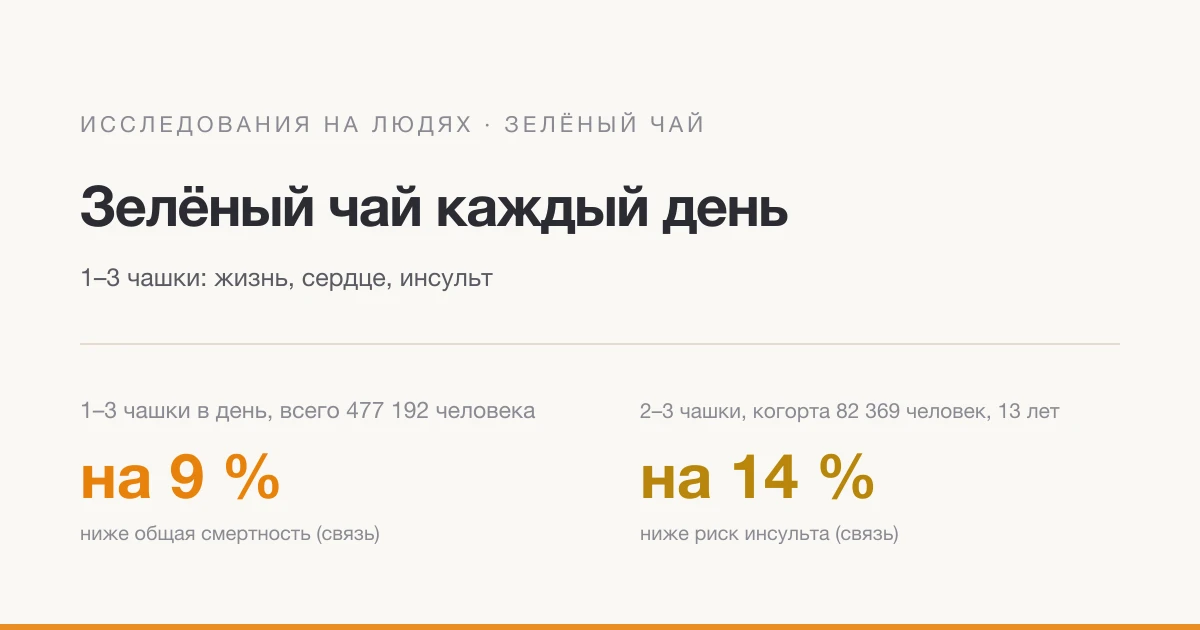
| Length of life (association) | 1-3 cups of green tea a day | Lower risk of death from any cause | 12 cohorts, 477,192 people across all groups: 9% lower in men and women |
| Heart and vessels (association) | 1-3 cups; 5 or more | Lower risk of death from heart and vessel disease | At 1-3 cups 15% (men) and 12% (women), at 5 or more 21% and 22% |
| Stroke (association) | 2-3 cups a day | Lower stroke risk | Cohort of 82,369 people, 13 years: 14% lower than in those who seldom drink it; at 4 or more 20% |
| Cholesterol | Green tea as a drink | Slightly lower total cholesterol | 9 trials: minus 0.07 mmol/L (2.8 mg/dL) |
Length of life: a large Asian cohort
The largest analysis pooled 12 Asian cohorts (Japan, China, Korea, Singapore): the green tea calculation included 477,192 people in total, all groups together from non-drinkers to people drinking five cups or more, followed for 6.5 to 22.7 years, with 94,744 deaths. Compared with non-drinkers, 1-3 cups a day were associated with a 9% lower risk of death from any cause: HR 0.91 (0.86-0.96) in men and HR 0.91 (0.86-0.95) in women (Shin S Int J Epidemiol 2022. PMID 34468722).
The risk of death from heart and vessel disease at 1-3 cups was 15% lower in men (HR 0.85; 0.80-0.91) and 12% in women (HR 0.88; 0.80-0.96). Among those drinking 5 cups or more the link looked stronger still: 21% in men and 22% in women (Shin S Int J Epidemiol 2022. PMID 34468722). In men the link with overall mortality was the same at any amount of tea, so no single "best" number of cups can be singled out.
Stroke: the Japanese cohort
A large Japanese cohort followed 82,369 people aged 45 to 74 for 13 years, during which 3,425 strokes occurred. Those who drank 2-3 cups a day, compared with people who seldom drink tea, were associated with a 14% lower stroke risk (HR 0.86; 0.78-0.95), and those who drank 4 cups or more with 20% lower (HR 0.80; 0.73-0.89) (Kokubo Y Stroke 2013. PMID 23493733).
This is a case where a household habit looks very "Mediterranean": tea instead of a sweet drink, a cup after a meal, a cup in the middle of the day.
Cholesterol: a small plus from the drink
A review of randomised trials separately counted the subgroup in which green tea was drunk as a beverage. In the drink subgroup total cholesterol was lower by 0.07 mmol/L (2.8 mg/dL) on average, 9 trials. LDL ("bad") did not change significantly, nor did "good" cholesterol or triglycerides (Xu R Nutr J 2020. PMID 32434539). So tea will not replace work on diet, but it is a small, measurable plus.
How to drink green tea
Brew loose tea or a teabag in a mug with hot but not boiling water, and drink it warm. It tastes better and is gentler on the throat. A simple rule: let the tea stand for a couple of minutes and take the first sip when it no longer burns your lips. If you are in a hurry, add a splash of cold water or pour the tea into a wide cup: it cools faster that way.
A simple plan for the day: a cup in the morning after breakfast, a cup in the middle of the day instead of a sweet drink, a cup after lunch or dinner. Three cups is within what was studied and is not burdensome at all. For work it is handy to take a thermos of brewed, slightly cooled tea: a cup is always at hand, and the sweet drink from the vending machine is not needed.
Tea also works well as a substitute. If you now drink sweet fizzy drinks, packet juice or coffee with syrup during the day, one or two cups of green tea in their place take a portion of sugar out of the day and ask for nothing in return. So the habit is not about "one more chore" but a simple swap that comes easily.
Brewing needs no special skill either. Put the tea in a mug or teapot, pour over hot water, wait a couple of minutes and drink. If you brewed it too long and it turned bitter, next time just shorten the time and let the water cool a little. Many people like to sip tea slowly without hurry: it is a small pause that is calming in itself.
It helps if tea becomes part of the rhythm of the day: a morning cup while planning the day, a cup in the middle of the day on a walk or by the window, an evening cup with a book. Such anchors help you remember the habit, and after a couple of weeks it settles without effort. Choose loose tea with a clear ingredient list, so that it contains only tea, without flavourings or sugar. If you want variety, change the types of tea and the ways of brewing: different teas taste different, and the habit will not get boring.
How to use it
- Guide from the cohorts: 1-3 cups a day; the link with benefit is also seen at more cups.
- Drink the actual drink: loose tea or a teabag without sugar.
- Use it to replace sweet drinks, not to add on top of them.
- Drink it warm: let the tea cool a little.
- If evening tea disturbs your sleep, move it to the first half of the day.
Who should see a doctor first
Green tea does not replace prescribed treatment for heart disease, blood pressure or cholesterol. If a doctor has limited your caffeine, you are pregnant or breastfeeding, or you have insomnia, anxiety or rhythm disorders, discuss the number of cups with a doctor. If you take prescribed treatment, discuss diet at your appointment.
Bottom line
Green tea is a simple habit with several pluses at once: it is associated with lower mortality and lower stroke risk in large cohorts and, as a drink, slightly lowers total cholesterol. One to three cups a day, without sugar and warm, is an easy way to make the day calmer and healthier.
Source: Green tea every day: what large cohort studies showed — universum.earth. Dr. Pereligyn.


