

Key points
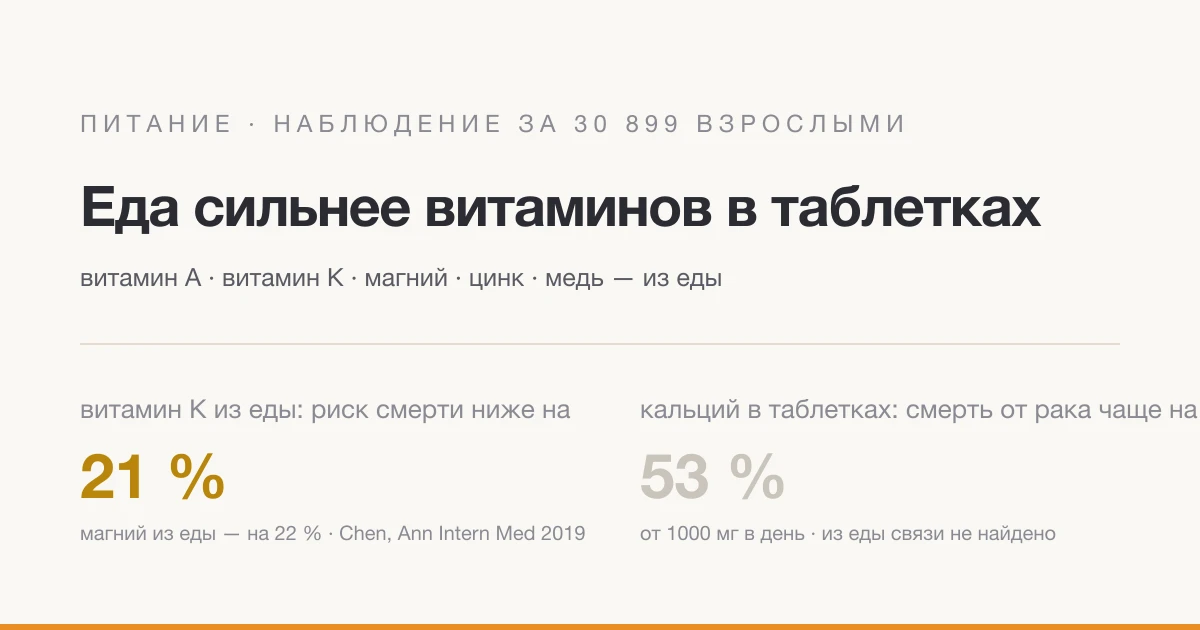
Vegetables, greens, nuts, legumes, eggs, meat and seafood give the same vitamins and minerals as pills. In a follow-up of 30,899 adults, adequate intake of vitamins A and K, magnesium and zinc was linked to a lower risk of death, including from heart disease, and the link held only for nutrients from food. No such link was found for the same nutrients from supplements (Chen F Ann Intern Med 2019. PMID 30959527). The good news: the foods are ordinary and the portions small — a handful of nuts, a plate of greens, a piece of beef. Below are a table of the nutrients, foods with portions, and a 7-day plate.
| Nutrient | Per day (reference) | What it does | What the study showed |
|---|---|---|---|
| Vitamin A | 700–900 µg RAE | Vision, skin and mucous membranes, immunity | Adequate intake (food and supplements together): 39% lower risk of death from cardiovascular disease (RR 0.61; 0.43–0.88); link only for food |
| Vitamin K | 90–120 µg | Blood clotting, bone strength | From food: 21% lower risk of death from all causes (RR 0.79; 0.69–0.92). Adequate intake (food and supplements together): 32% lower from cardiovascular disease (RR 0.68; 0.54–0.86); link only for food |
| Magnesium | 310–420 mg | Muscles and nerves, energy metabolism, bones | From food: 22% lower risk of death from all causes (RR 0.78; 0.65–0.93); no link from supplements (RR 1.00; 0.87–1.14) |
| Zinc | 8–11 mg | Immunity, wound healing, taste and smell | Adequate intake (food and supplements together): 50% lower risk of death from cardiovascular disease (RR 0.50; 0.36–0.71); link only for food |
| Copper | 0.9 mg | Blood formation, iron metabolism, connective tissue | From food: named in the abstract among nutrients linked to death from all causes or from cardiovascular disease; no separate number for copper |
Reference is the recommended dietary allowance (RDA) or adequate intake (AI) for adults according to NIH, the range covers women and men; vitamin A as retinol activity equivalents (RAE). In the study, the threshold for “adequate” was the estimated average requirement (EAR) or the adequate intake.
What the study showed
The study: follow-up of 30,899 adults aged 20 and older from the national nutrition survey NHANES 1999–2010, median 6.1 years, 3,613 deaths, of which 945 from cardiovascular disease and 805 from cancer. More than half of participants (51.2%) used supplements in the previous 30 days. Supplement use as such — ever — was not linked to the risk of death from all causes, cardiovascular disease or cancer (Chen F Ann Intern Med 2019. PMID 30959527).
Adequate intake — not below the estimated average requirement or the adequate intake, from all sources (food and supplements together) — was linked to lower risk. Death from all causes, values for food only: vitamin K lower by 21%, magnesium lower by 22%. Death from cardiovascular disease at adequate intake: vitamin A lower by 39%, vitamin K by 32%, zinc by 50%. The authors showed separately that these links held only in people who got the nutrients from food; for the same nutrients from supplements there were none (magnesium from supplements: RR 1.00; 0.87–1.14). The authors note that supplement users already have a higher intake of nutrients from food, are on average better supplied and have a healthier lifestyle, so the benefit of supplements could look larger than it is; the link with food may reflect a generally healthy diet (Chen F Ann Intern Med 2019. PMID 30959527).
Calcium: from food and from pills
Excess calcium intake — above the tolerable upper level — was linked to a 62% higher risk of death from cancer (RR 1.62; 95% CI 1.07–2.45). The link appeared to be related to calcium from supplements: at 1000 mg a day or more versus none, the risk of death from cancer was 53% higher (RR 1.53; 1.04–2.25). No such link was found for calcium from food (Chen F Ann Intern Med 2019. PMID 30959527). Practical conclusion: it is convenient to get calcium from foods, and to take a calcium supplement as prescribed by a doctor.
What other studies showed
The picture is supported by reviews of randomized trials. In an umbrella review of 277 trials (992,129 participants), vitamin A, vitamin B6, multivitamins, antioxidants, iron and a number of other supplements showed no significant effect on mortality or cardiovascular outcomes (certainty from very low to moderate). Calcium plus vitamin D raised the risk of stroke by 17% (RR 1.17; 95% CI 1.05–1.30) (Khan S U Ann Intern Med 2019. PMID 31284304).
In systematic reviews and meta-analyses of trials, multivitamins, vitamins C and D, beta-carotene, calcium and selenium had no effect on cardiovascular outcomes or mortality. Antioxidant mixtures and niacin (together with a statin) were linked to higher all-cause mortality, while folic acid and B vitamins were linked to fewer strokes (moderate- or low-quality evidence). The authors conclude that no supplement has been shown to give convincing benefit with any diet (Jenkins D J A J Am Coll Cardiol 2018. PMID 29852980).
In a Cochrane review of 78 trials (296,707 participants), antioxidant supplements were compared with placebo. In 56 trials at low risk of bias, mortality among those taking supplements was 4% higher (RR 1.04; 1.01–1.07): 5% higher for beta-carotene (RR 1.05; 1.01–1.09) and 3% higher for vitamin E (RR 1.03; 1.00–1.05); vitamin C and selenium had no effect on mortality. The authors see no grounds for taking antioxidants for prevention (Bjelakovic G Cochrane Database Syst Rev 2012. PMID 22419320).
For calcium in pills the data agree with each other. In a meta-analysis of 15 trials (calcium from 500 mg a day, without vitamin D, age over 40), in 5 trials with patient-level data (8,151 people, median 3.6 years) myocardial infarction was 31% more frequent (HR 1.31; 1.02–1.67), and in 11 trials with pooled data it was 27% more frequent (RR 1.27; 1.01–1.59); mortality did not differ significantly (HR 1.09; 0.96–1.23) (Bolland M J BMJ 2010. PMID 20671013). The conclusion is the same: food remains the foundation, and a calcium supplement is taken as prescribed by a doctor.
Where to get it: foods
The tables show typical portions and nutrient content from food composition databases, rounded. The share is calculated from the middle of the reference range: vitamin A 800 µg, vitamin K 100 µg, magnesium 370 mg, zinc 10 mg, copper 0.9 mg. Content varies with variety and cooking.
Vitamin A (reference: 700–900 µg RAE per day)
| Food | Portion | Nutrient per portion | Share of daily reference |
|---|---|---|---|
| Carrot | 1 medium, 60 g | 500 µg | about 60% |
| Baked sweet potato | 100 g | 900 µg | about 110% |
| Chicken egg | 1 piece | 75 µg | about 9% |
| Fried beef liver | 30 g | 2300 µg | about 290% |
| Boiled pumpkin | 100 g | 290 µg | about 36% |
Vitamin K (reference: 90–120 µg per day)
| Food | Portion | Nutrient per portion | Share of daily reference |
|---|---|---|---|
| Raw spinach | 30 g | 145 µg | over 100% |
| Cooked broccoli | 80 g | 110 µg | about 110% |
| Raw kale | 30 g | 115 µg | about 115% |
| Fresh parsley | 10 g | 165 µg | over 150% |
Magnesium (reference: 310–420 mg per day)
| Food | Portion | Nutrient per portion | Share of daily reference |
|---|---|---|---|
| Pumpkin seeds | 30 g | 180 mg | about 50% |
| Almonds | 30 g | 80 mg | about 20% |
| Cooked chickpeas | 150 g | 70 mg | about 20% |
| Dark chocolate (70–85% cocoa) | 30 g | 70 mg | about 20% |
Zinc (reference: 8–11 mg per day)
| Food | Portion | Nutrient per portion | Share of daily reference |
|---|---|---|---|
| Braised beef | 85 g | 7 mg | about 70% |
| Oysters | 50 g | 8 mg | about 80% |
| Pumpkin seeds | 30 g | 2.3 mg | about 25% |
| Cooked chickpeas | 150 g | 2.3 mg | about 25% |
Copper (reference: 0.9 mg per day)
| Food | Portion | Nutrient per portion | Share of daily reference |
|---|---|---|---|
| Dark chocolate (70–85% cocoa) | 30 g | 0.5 mg | about 55% |
| Cashews | 30 g | 0.65 mg | about 70% |
| Cooked shrimp | 100 g | 0.3 mg | about 33% |
| Fried beef liver | 30 g | 4.4 mg | about 490% |
A 7-day plate
| Day | Breakfast | Lunch | Dinner |
|---|---|---|---|
| 1 | Omelette of 2 eggs with spinach | Chickpea soup with carrot | Braised beef with broccoli |
| 2 | Soft-boiled eggs, boiled pumpkin | Kale salad with almonds and chickpeas | Shrimp with broccoli and parsley |
| 3 | Cottage cheese with pumpkin seeds | Beans with boiled pumpkin | Beef with baked sweet potato |
| 4 | Omelette with parsley, carrot salad | Salad of spinach, chickpeas and pumpkin seeds | Shrimp with cashews and broccoli |
| 5 | Eggs with kale | Bean soup with carrot | Liver (up to 30 g) with onion and boiled pumpkin |
| 6 | Cottage cheese with cashews and two squares of dark chocolate | Salad of shrimp, spinach and pumpkin seeds | Beef with sweet potato and herbs |
| 7 | Omelette with broccoli | Pumpkin cream soup with pumpkin seeds | Chickpeas with kale and shrimp |
How to use it
Simple steps are enough: a plate of greens or vegetables daily; a handful of nuts and seeds (30 g) as a snack; legumes 3–4 times a week; meat or seafood 2–3 times a week; liver no more than 30 g fried and no more than once a week (50 g gives about 3900 µg of vitamin A, above the tolerable upper level of 3000 µg); 1–2 squares of dark chocolate. Fat in the dish (olive oil, nuts, eggs) helps absorb the fat-soluble vitamins A and K. The menu is chosen to suit habits and tolerance.
Who should see a doctor first
Supplements prescribed by a doctor (for deficiency, pregnancy, bones) are not stopped on one’s own. In pregnancy, liver and foods rich in vitamin A are discussed with a doctor. For people taking blood-thinning medicines, the amount of greens (vitamin K) is agreed with a doctor and kept steady. With kidney or heart disease, the amount of magnesium-rich foods and nuts is agreed with a doctor.
Summary
Food rich in vitamins A and K, magnesium, zinc and copper is an accessible and pleasant way to get these nutrients; in the follow-up, food rather than pills was linked to a lower risk of death. These are observational data: they point to a direction and do not prove cause. A plate with greens, nuts, legumes, eggs and seafood covers most of the references, and calcium is best taken from foods.
Source: Food Beats Vitamin Pills: What the Study Showed — universum.earth. Dr. Pereligyn.


