

In brief
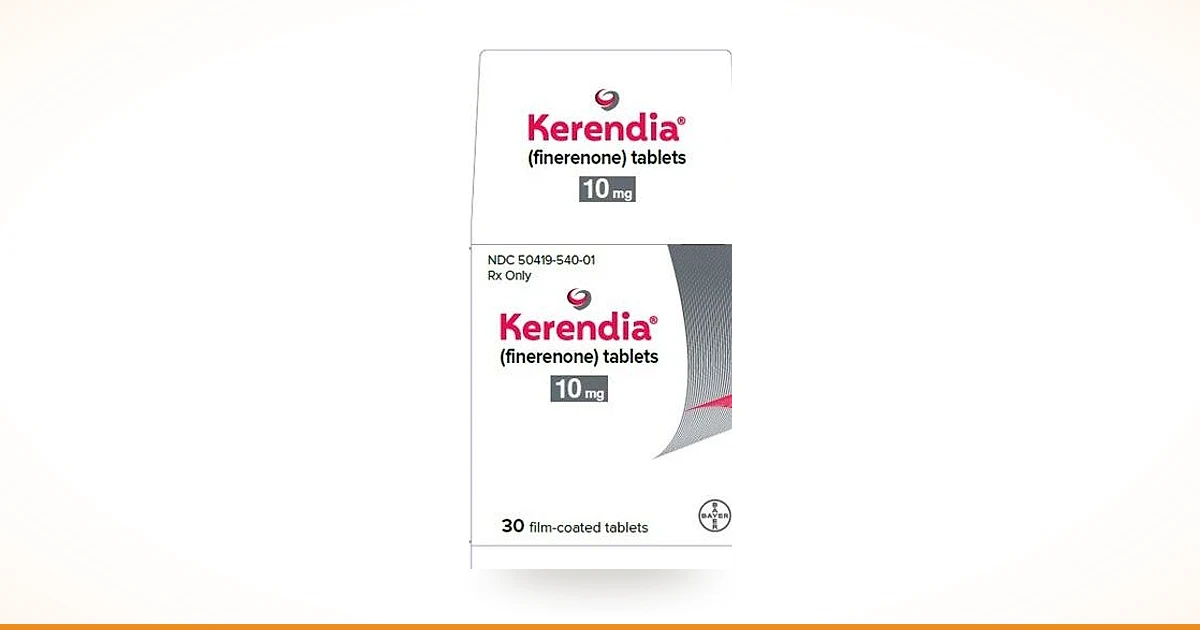
What it is. Finerenone (brand name Kerendia, Bayer) is a tablet that blocks the mineralocorticoid receptor. Not a hormone, not a diuretic, not a glucose-lowering drug.
What for. To slow kidney failure and reduce cardiovascular risk in chronic kidney disease associated with type 2 diabetes.
Where it sits. On top of an ACE inhibitor or ARB, alongside an SGLT2 inhibitor — not instead of them.
Why kidneys fail in diabetes
Years of high glucose damage the glomeruli, the kidney's filters. Protein begins to leak through them (albuminuria), and filtration then declines slowly. In parallel a second, less obvious mechanism switches on: aldosterone, the adrenal hormone, acts on the mineralocorticoid receptor in kidney tissue and drives inflammation and fibrosis — the replacement of working tissue with scar.
ACE inhibitors and ARBs partly suppress that path, but over time an escape phenomenon appears: aldosterone rises again. That is precisely the gap finerenone closes.
How it differs from spironolactone
| Spironolactone | Finerenone | |
|---|---|---|
| Structure | Steroidal | Non-steroidal |
| Hormonal side effects | Gynaecomastia, breast tenderness, cycle disturbance | Not characteristic |
| Distribution | More in the kidney | More even between kidney and heart |
| Potassium retention | Marked | Weaker, but monitoring required |
| Evidence in diabetic nephropathy | Limited | Two large outcome trials |
What the trials showed
▸ FIDELIO-DKD (NEJM, 2020; n=5,734) — kidney outcomes. Reduced risk of disease progression: sustained decline in filtration, progression to end-stage disease and renal death [1].
▸ FIGARO-DKD (NEJM, 2021; n=7,437) — cardiovascular outcomes. Reduced event rates in the same patient category [2].
▸ An individual-participant meta-analysis (Lancet, 2026) confirms the effect across both lines [3].
For nephrology this is an unusual situation: a drug that improves outcomes for both kidney and heart.
Who it is for
▸ adults with chronic kidney disease in type 2 diabetes;
▸ typically with albuminuria and reduced or declining filtration;
▸ on top of an ACE inhibitor or ARB at the maximally tolerated dose.
Who it is not for: patients with potassium above 5.0 mmol/L at baseline, an estimated GFR below 25 mL/min/1.73 m², adrenal insufficiency, or anyone seeking "kidney prevention" without documented renal involvement.
Dosing and monitoring
| Estimated GFR, mL/min/1.73 m² | Starting dose | Target |
|---|---|---|
| 60 and above | 20 mg/day | 20 mg/day |
| 25–60 | 10 mg/day | 20 mg/day if tolerated |
| Below 25 | Initiation not recommended | — |
Potassium monitoring is part of the therapy, not an optional extra:
▸ before starting — potassium, creatinine with eGFR, urine albumin-to-creatinine ratio;
▸ at 4 weeks — potassium and eGFR; the uptitration decision follows from these;
▸ at every dose change — repeat check;
▸ if potassium rises — reduce the dose or pause, resuming after it normalises.
How it fits with everything else
Modern management of diabetic kidney disease rests on several pillars, and they are not interchangeable:
| Class | What it works through |
|---|---|
| ACE inhibitors and ARBs | Glomerular pressure, reduction of urinary protein |
| SGLT2 inhibitors | Intraglomerular haemodynamics, metabolic effects |
| Finerenone | Suppression of inflammation and fibrosis in kidney tissue |
| GLP-1 receptor agonists | Metabolic control, weight, cardiovascular protection |
Finerenone is added to that structure rather than displacing parts of it.
What matters in practice
▸ The effect is not felt. The drug relieves no symptoms — it changes the trajectory of a disease visible only in laboratory results. Hence the familiar adherence problem.
▸ Potassium is not a formality. It is the one genuinely demanding element of this therapy, and an ordinary blood test settles it.
▸ It does not replace glucose and blood-pressure control. Without those, any nephroprotective drug works at half strength.
▸ It is prescription-only, started by a clinician after assessing filtration, albuminuria and potassium.
Prescribing can be discussed at a consultation; the product can be ordered here.
References
1. Bakris GL, et al. Effect of finerenone on chronic kidney disease outcomes in type 2 diabetes (FIDELIO-DKD). N Engl J Med. 2020;383(23):2219–2229. PMID 33264825
2. Pitt B, et al. Cardiovascular events with finerenone in kidney disease and type 2 diabetes (FIGARO-DKD). N Engl J Med. 2021;385(24):2252–2263. PMID 34449181
3. Neuen BL, et al. Efficacy and safety of finerenone in patients with chronic kidney disease: an individual participant data meta-analysis. Lancet. 2026. PMID 42248158
4. KERENDIA (finerenone) US Prescribing Information, Bayer HealthCare Pharmaceuticals.


