

The main points
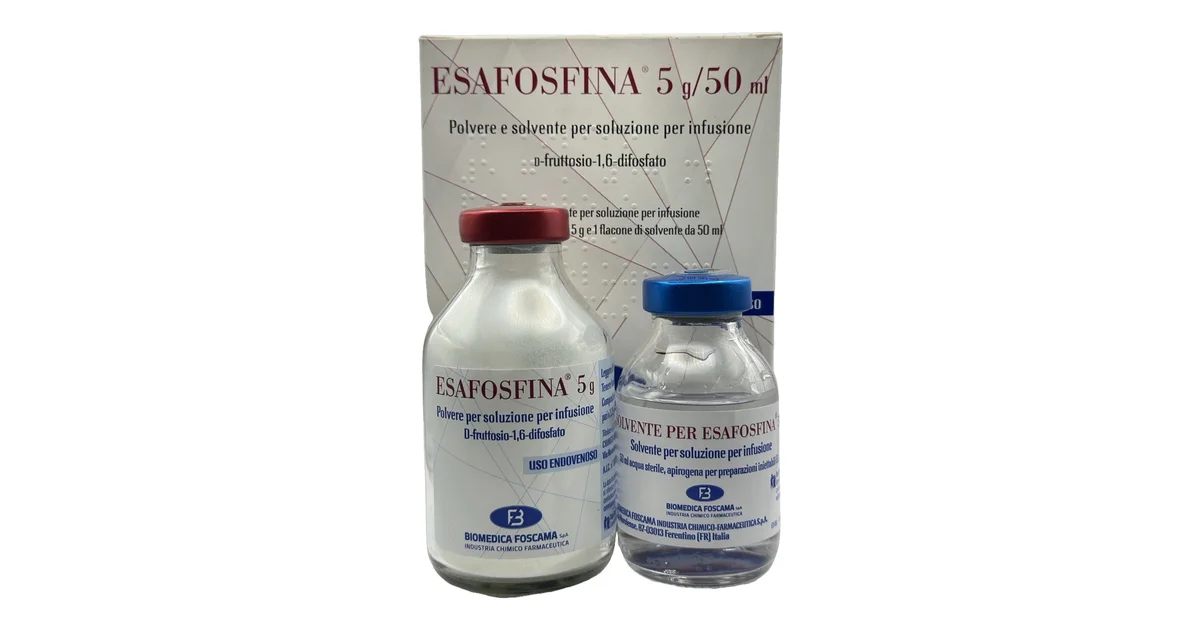
Recharges the cell. Esafosfina (Biomedica Foscama, Italy) is a drip of fructose-1,6-diphosphate (FDP). A single 5 g drip in 45 healthy adults raised blood phosphate and red-cell ATP (adenosine triphosphate, the cell’s «battery») and shifted metabolism towards burning carbohydrate (Markov AK Metabolism 2000. PMID 10877192).
Benefit shown when phosphate and oxygen run short. After large blood transfusions, in heart and lung surgery and in wasting in chronic lung disease — that is where its effect in patients has been studied best.
More work on an exercise bike. In a study of 12 healthy men, work after 15 g rose by 25 % (Ripari P Pharmatherapeutica 1988. PMID 3174724).
The substance itself is not banned. It is not on the WADA (World Anti-Doping Agency) 2026 Prohibited List; outside hospital only the volume is limited — 100 mL per 12 hours (WADA, 2026).
Only on a doctor’s prescription. It is a prescription intravenous drug; the official indication is low blood phosphorus.
Why it is an «energy drip»
Almost all of a cell’s energy passes through ATP (adenosine triphosphate), a «battery» with three phosphates. When a muscle contracts and the heart pumps blood, the battery runs down, and it can only be recharged with phosphate.
The cell turns glucose into energy along a chain of 10 steps. At the start it invests 2 ATP and gets fructose-1,6-diphosphate, a «semi-product» with two phosphates from which it then gets 4 ATP. Esafosfina delivers this semi-product directly: according to the Italian Medicines Agency (AIFA) label, half the dose leaves the blood for the tissues in 10–15 minutes (AIFA RCP, 2021).
The second target is red blood cells. From the same chain they make 2,3-DPG (2,3-diphosphoglycerate), which helps haemoglobin release oxygen to the muscles. So phosphate is needed not only to charge the muscle but also to supply it with oxygen.
Serie A footballers in the 1990s
Esafosfina’s best-known sports story is Italian. At Juventus in 1994–1998 players were given drips before matches; the Turin prosecutor’s consultants established that these were esafosfina and Neoton (phosphocreatine) (la Repubblica, 11.01.2001). In 2003 Gianluca Vialli confirmed in court that he had received esafosfina drips (la Repubblica, 29.10.2003).
Former Roma and Genoa sweeper Gianluca Signorini also said that esafosfina was given to him intravenously before matches (la Repubblica, 11.01.2001). An explicit ban on drips without a medical purpose entered the WADA rules only in 2005 (World Triathlon, 25.09.2004).
National-team track athletes: one in four of those on drips
In an anonymous survey of 138 elite national-team track athletes — race walking, middle- and long-distance running — 22 of the 93 athletes who listed their drips named esafosfina: 23.6 %, almost one in four. For comparison: Actovegin 77.4 %, phosphocreatine 64.5 %, L-carnitine 39.8 % (Bezuglov E Front Sports Act Living 2026. PMID 42440853).
WADA rules for drips
Fructose-1,6-diphosphate is not on the WADA 2026 Prohibited List. The method is limited: rule M2.2 bars athletes outside hospital from intravenous infusions totalling more than 100 mL per 12 hours (WADA, 2026).
- One 5 g/50 mL vial fits within the limit if nothing else went into a vein in those 12 hours.
- Two vials make exactly 100 mL: any line flush already takes you over the threshold.
- Italy’s rule is stricter: no more than 50 mL per 6 hours (Gazzetta Ufficiale, 2026).
What studies in people showed
| Where it was tested | Who took part | Result |
|---|---|---|
| Healthy adults, 2000 | 45 people | Blood phosphate and red-cell ATP rose |
| Healthy men, exercise bike, 1988 | 12 people | Work +25 %, maximal oxygen uptake +12 % |
| Massive blood transfusion, 1984 | 18 patients | 2,3-DPG rose faster than on ordinary phosphate |
| Heart valve replacement, 2024 | 40 patients | ST segment on the ECG (electrocardiogram) back to normal in 34.6 minutes vs 50.3 |
| Lung surgery, 2008 | 106 patients | Arrhythmia episodes 35 vs 67 |
| Wasting in chronic lung disease, 2000 | 45 patients | Breathing-in strength about +16 % |
In more detail. In heart valve replacement, in a double-blind study, markers of heart-muscle damage were lower after FDP (Xu H Eur J Cardiothorac Surg 2024. PMID 39120890). In lung surgery there were almost half as many arrhythmias (Xu XH Zhong Nan Da Xue Xue Bao Yi Xue Ban 2008. PMID 19001742). After transfusions 2,3-DPG rose faster (Iapichino G Int Surg 1984. PMID 6500874). In wasted patients with COPD (chronic obstructive pulmonary disease) breathing-in strength rose from 43.0 to 49.8 cmH2O (Marchesani F Respiration 2000. PMID 10773790).
In 10 trained men no difference from placebo was found (Myers J Med Sci Sports Exerc 1990. PMID 2406538). The takeaway is simple: esafosfina replaces what is missing, and it helps most when phosphate and oxygen are short.
The official indication: low blood phosphorus
The only official indication is confirmed hypophosphataemia: serum phosphorus below 0.8 mmol/L (2.5 mg/dL) (Liamis G QJM 2010. PMID 20356849; AIFA RCP, 2021). Phosphate shortage is common after blood transfusions, on cardiopulmonary bypass, in respiratory failure in chronic lung disease and in wasting. According to the Italian Society of Hospital Pharmacy (SIFO), in hospitals FDP also serves as a phosphate source for intravenous feeding (SIFO, 2022).
How it is given
Only as an intravenous drip and only on a doctor’s prescription. The powder is dissolved in 50 mL of solvent; the dose is 70–160 mg per kg of body weight a day, usually 1–2 vials for an adult. The rate is about 10 mL per minute, so a vial takes at least 5 minutes: when rushed, flushing, palpitations and tingling can occur (AIFA RCP, 2021).
What is checked before the drip: blood phosphorus, creatinine (kidney function), the absence of hereditary fructose intolerance and of allergy to the drug.
Who should not have it
According to the AIFA label, esafosfina is contraindicated in hereditary fructose intolerance, high blood phosphorus, kidney failure and allergy to the components. A vial contains 30 mmol of sodium — this matters on a salt-restricted diet. Allergic reactions are rare (AIFA RCP, 2021).
Bottom line
Esafosfina brings the cell a ready-made «semi-product» of energy and phosphate for its battery. Its benefit has been shown where phosphate and oxygen are short: after transfusions, in heart and lung surgery, in wasting. If you lack energy for no obvious reason, start with tests — see Stress axis: sleep, energy and which tests to discuss. How muscles themselves respond to exercise — in MOTS-c: a peptide from the mitochondrion’s own DNA.
This material is for information only and does not replace a consultation with a doctor. Esafosfina 5 g/50 mL is a prescription drug; the decision to prescribe it and the dose are made by a doctor based on test results.


