

In Brief
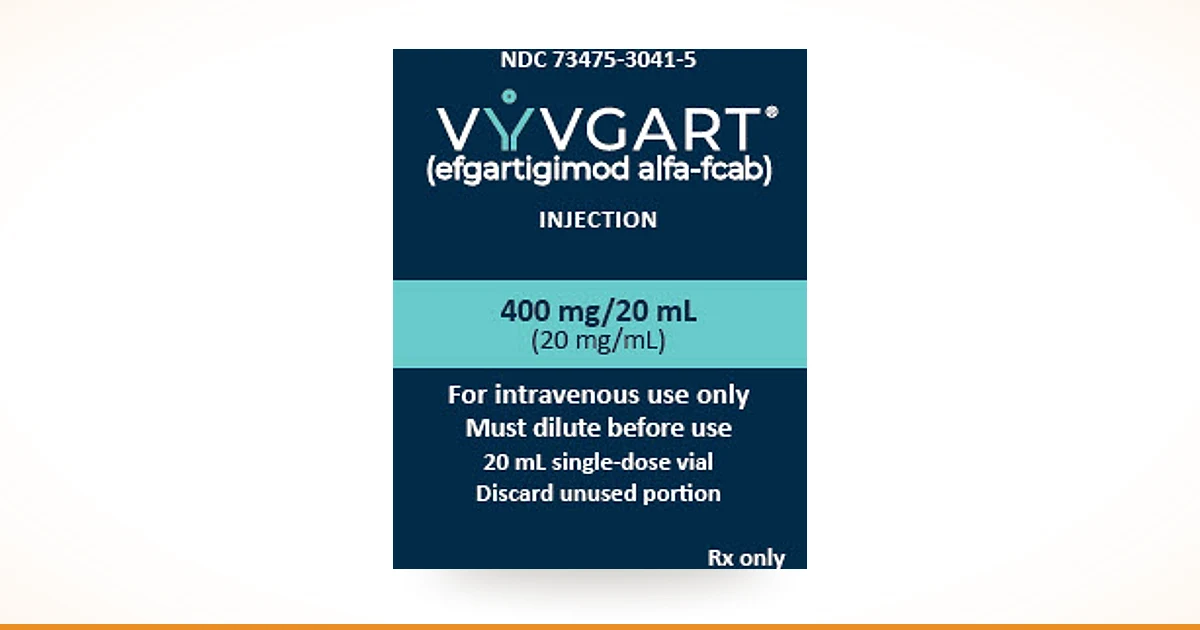
What it is. Efgartigimod (brand name Vyvgart) is the first drug to block the FcRn receptor. Approved by the FDA in December 2021.
Why it matters. It does not suppress immunity in general; it switches off the mechanism that rescues antibodies from destruction. Pathogenic antibodies are then disposed of.
Who it is for. Adults with generalised myasthenia gravis, primarily those with acetylcholine receptor antibodies; the indication was later extended to CIDP.
What Breaks in Myasthenia Gravis
A nerve commands a muscle chemically: it releases acetylcholine, and on the muscle the acetylcholine receptor — a kind of socket — receives it.
In myasthenia gravis the immune system makes antibodies against that socket. The nerve's command goes out, but there is nothing to receive it. Hence the characteristic picture: strength in the morning that fades by evening, a drooping eyelid, double vision, difficulty chewing and swallowing. In severe cases breathing is affected.
The key detail: the disease is sustained not by cells but by the antibodies themselves, circulating in the blood. So removing the antibodies helps — which is exactly the basis of plasma exchange, used in exacerbations for decades.
Why Antibodies Are So Long-Lived
An ordinary blood protein lasts hours. IgG antibodies last about three weeks. The reason is not molecular sturdiness but a separate rescue system.
Cells constantly take up whatever is in the blood, and captured proteins go for destruction. But IgG inside the cell binds the FcRn receptor, which carries it back out into the blood, past disposal.
Evolutionarily this is sensible: immune memory should last. But the system does not distinguish between an antibody protecting you from infection and one destroying your own muscle receptor. It rescues them all.
The Idea Behind the Drug
Efgartigimod is an antibody fragment altered to bind FcRn more tightly than ordinary IgG.
It occupies every rescue slot. The body's own antibodies can no longer return to the blood and are degraded by the usual route. IgG levels fall — and with them the quantity of pathogenic antibodies.
| Plasma exchange | Efgartigimod | |
|---|---|---|
| What it does | Mechanically removes antibodies from plasma | Switches off the mechanism that rescues them |
| Where it happens | In hospital, on a machine | An infusion, or an injection in subcutaneous form |
| Vascular access | Required | Not required |
| Selectivity | Removes everything | Lowers all IgG |
| Rhythm | By exacerbation | In cycles, as symptoms return |
What the Trials Showed
▸ ADAPT (Lancet Neurology, 2021) — 167 patients with generalised myasthenia gravis. Among those with acetylcholine receptor antibodies (77% of participants), a response on the MG-ADL activities-of-daily-living scale in the first cycle was achieved by 68% versus 30% on placebo; odds ratio 4.95 (95% CI 2.21–11.53; p<0.0001) [1].
Tolerability deserves separate attention: adverse events occurred in 77% on the drug versus 84% on placebo, serious ones in 5% versus 8%. Treatment was discontinued by 4% in each group. There were no deaths. For a drug that lowers the level of all antibodies, that is an unexpectedly calm picture.
▸ ADAPT-SC (Neurotherapeutics, 2024) — the subcutaneous form proved non-inferior to intravenous dosing for IgG reduction. The practical meaning: an infusion became an injection [2].
▸ ADHERE (Lancet Neurology, 2024) — the trial in chronic inflammatory demyelinating polyneuropathy on which the extension of the indication to that disease rests [3].
What It Looks Like for the Patient
| Parameter | Detail |
|---|---|
| Route | Intravenous infusion or subcutaneous injection |
| Schedule | A cycle of 4 weekly administrations, then a break |
| When the next cycle starts | On returning symptoms, not by the calendar |
| Monitoring | Symptoms, IgG level, signs of infection |
| Vaccination | Planned in advance, before treatment starts |
The cyclical schedule is not a compromise but a consequence of the mechanism: the drug lowers antibody levels temporarily, the body gradually restores them, and treatment is repeated as symptoms return.
What Cannot Be Claimed Yet
▸ That it is safer than classical immunosuppression over the long run — no head-to-head comparisons exist.
▸ That it works in every form of myasthenia gravis: the main evidence comes from patients with acetylcholine receptor antibodies.
▸ That other therapy can be stopped — in the trials efgartigimod was added to existing treatment, not substituted for it.
▸ What the long-range consequences are of repeatedly lowering IgG over many years — that has not been measured on such timescales.
Who It Is Not For
▸ Anyone with an active infection — treatment waits until it resolves.
▸ As emergency care in a myasthenic crisis: this is scheduled therapy, not a resuscitation measure.
▸ Anyone without a confirmed diagnosis and a defined antibody status: therapy is not chosen without them.
▸ As a patient-initiated replacement for baseline therapy.
Bottom Line
▸ A new point of attack: not suppressing immunity but switching off the system that prolongs antibody life.
▸ Efficacy demonstrated in patients with acetylcholine receptor antibodies: 68% response versus 30% on placebo.
▸ Tolerability in the trial was no worse than placebo, which is not obvious for such a mechanism.
▸ The subcutaneous form replaced the infusion with an injection without losing the effect on IgG.
▸ The main caveat: all IgG falls at once, so vaccination is planned in advance and infections are assessed more carefully.
Treatment can be discussed at a consultation; the drug can be ordered here.
References
1. Howard JF Jr, et al. Safety, efficacy, and tolerability of efgartigimod in patients with generalised myasthenia gravis (ADAPT): a multicentre, randomised, placebo-controlled, phase 3 trial. Lancet Neurol. 2021;20(7):526–536. PMID 34146511
2. Howard JF Jr, et al. Subcutaneous efgartigimod PH20 in generalized myasthenia gravis: A phase 3 randomized noninferiority study (ADAPT-SC). Neurotherapeutics. 2024;21(5):e00378. PMID 39227284
3. Allen JA, et al. Safety, tolerability, and efficacy of subcutaneous efgartigimod in patients with chronic inflammatory demyelinating polyneuropathy (ADHERE). Lancet Neurol. 2024;23(10):1013–1024. PMID 39304241
4. VYVGART (efgartigimod alfa) — US Prescribing Information, argenx.


