

In brief
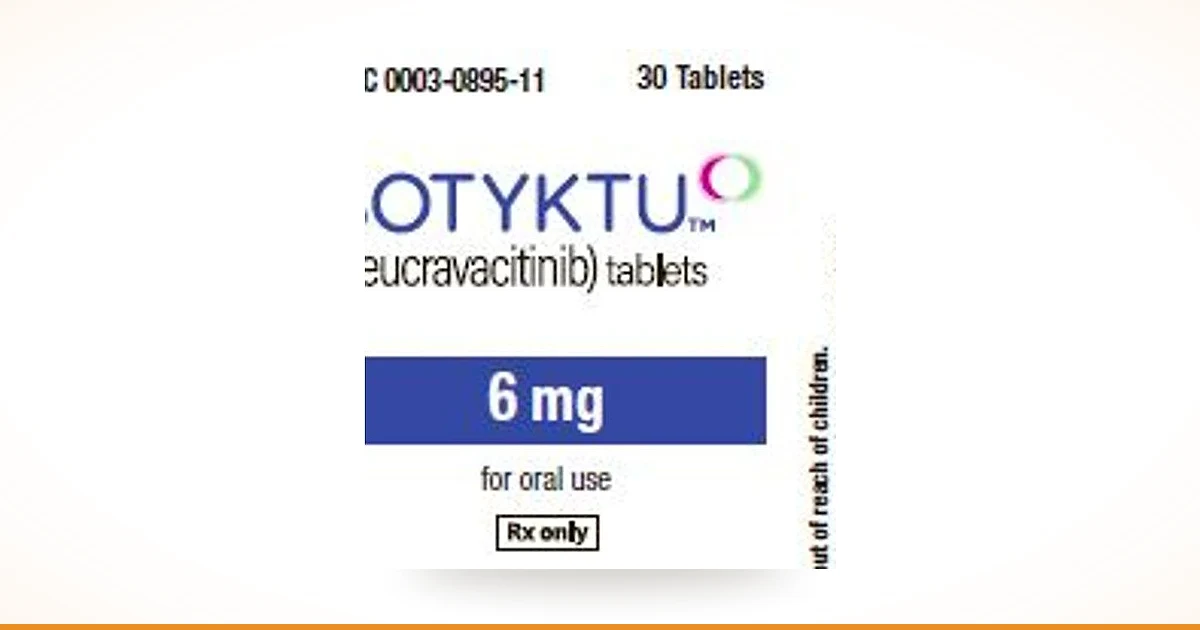
What it is. Deucravacitinib (brand name Sotyktu, Bristol Myers Squibb) is a psoriasis tablet — the first allosteric TYK2 inhibitor, approved by the FDA in September 2022.
Why it matters. It blocks the inflammatory signal without occupying the enzyme's active site, and therefore does not carry the boxed warning typical of JAK inhibitors.
For whom. Adults with moderate-to-severe plaque psoriasis who are candidates for systemic therapy.
What happens in psoriasis
Psoriasis is not "dry skin" or a cosmetic problem but chronic immune inflammation. The key players are the cytokines interleukin-23 and interleukin-12, along with type I interferons. They drive a cascade that makes skin cells divide many times faster than normal and sustains inflammation within the plaque.
The signal from those cytokines is carried into the cell by TYK2, a member of the Janus kinase family. Blocking it means switching off precisely the pathway on which psoriatic inflammation depends.
Why ordinary JAK inhibitors are a blunt instrument
Classic kinase inhibitors (tofacitinib, baricitinib, upadacitinib) bind the active site — where ATP docks to make the enzyme work.
The problem is that active sites are built similarly across related kinases. A drug that fits one inevitably engages its neighbours: JAK1, JAK2 and JAK3 govern haematopoiesis, immune surveillance and interferon signalling. Hence the FDA's class-wide boxed warning about serious infections, thrombosis, cardiovascular events and malignancy.
What was done differently
Besides its working domain, TYK2 has a regulatory (pseudokinase) domain — a part that normally holds the enzyme switched off.
Deucravacitinib binds precisely there. It does not occupy the keyhole; it fixes the adjacent lever in the "off" position.
| Classic JAK inhibitors | Deucravacitinib | |
|---|---|---|
| Binding site | Active site (ATP pocket) | Regulatory domain |
| Similarity of target across neighbouring kinases | High — hence cross-activity | Low — hence selectivity |
| Affects JAK1/2/3 | Yes | Essentially not at therapeutic doses |
| FDA boxed warning | Present | Absent |
| Formulation | Tablets | Tablets |
The design intent: obtain the anti-inflammatory effect along the required pathway without disturbing everything else.
What the trials showed
▸ POETYK PSO-1 and PSO-2 (JAAD, 2023) — two phase 3 trials. Deucravacitinib outperformed both placebo and apremilast on the proportion of patients achieving PASI 75 (at least 75% improvement in the psoriasis severity index) and clear or almost clear skin on sPGA [1].
▸ Five-year open-label extension (Am J Clin Dermatol, 2026) — efficacy and safety profile maintained with long-term use [2].
▸ A separate analysis showed improvement begins early and holds through the maintenance phase [3].
How it is taken
| Parameter | Detail |
|---|---|
| Dose | 6 mg once daily |
| Titration | Not required |
| Food | Irrelevant |
| Formulation | Tablet |
The absence of titration is a practical advantage: the patient starts at the working dose without a build-up period.
What to check before and during
▸ tuberculosis screening, including latent infection;
▸ hepatitis B and C markers;
▸ vaccination: live vaccines before starting, not during therapy;
▸ baseline blood counts and liver tests before initiation, thereafter at the clinician's discretion.
There is no rigid laboratory schedule of the kind classic JAK inhibitors demand — a direct consequence of the different selectivity.
Where it sits in psoriasis treatment
| Step | Treatment |
|---|---|
| Mild psoriasis | Topicals: corticosteroids, vitamin D analogues, calcineurin inhibitors |
| Moderate | Phototherapy, methotrexate, apremilast, deucravacitinib |
| Severe, with joint involvement | Injectable biologics: IL-17, IL-23 and TNF inhibitors |
Deucravacitinib occupies the oral systemic niche: stronger than apremilast on trial comparisons and simpler to take, though in severe disease and psoriatic arthritis injectable biologics remain the more powerful option.
Summary
▸ Allosteric mechanism: binding TYK2's regulatory domain rather than its active site.
▸ Hence selectivity and the absence of the boxed warning typical of JAK inhibitors.
▸ Efficacy above placebo and apremilast on PASI 75 and sPGA in phase 3 trials.
▸ Convenience: 6 mg once daily, no titration, food irrelevant.
▸ Monitoring lighter than for the JAK class, though tuberculosis and hepatitis screening is mandatory.
▸ Does not replace injectable biologics in severe psoriasis and arthritis.
Treatment can be discussed at a consultation; the product can be ordered here.
References
1. Armstrong AW, et al. Deucravacitinib versus placebo and apremilast in moderate to severe plaque psoriasis: efficacy and safety results from the 52-week, randomized, double-blinded, placebo-controlled phase 3 POETYK PSO-1 trial. J Am Acad Dermatol. 2023;88(1):29–39. PMID 35820547
2. Armstrong AW, et al. Deucravacitinib 5-year safety and efficacy results in plaque psoriasis: a phase 3 open-label extension. Am J Clin Dermatol. 2026. PMID 42563042
3. Korman NJ, et al. Deucravacitinib onset of action and maintenance of response in phase 3 plaque psoriasis trials. J Dermatolog Treat. 2024. PMID 38945549
4. SOTYKTU (deucravacitinib) US Prescribing Information, Bristol Myers Squibb.


