

In brief
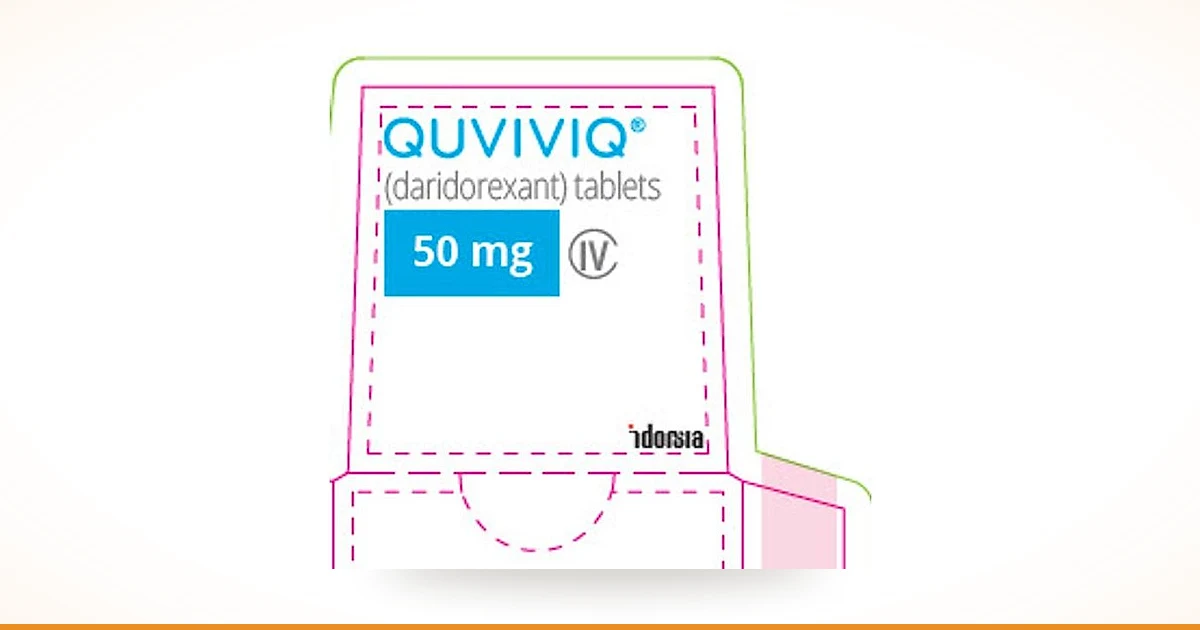
What it is. Daridorexant (brand name Quviviq, Idorsia) is a hypnotic of a new class: a dual orexin receptor antagonist.
The idea. Not to amplify the brain's inhibition but to remove the wakefulness signal. Not pressing the brake, but lifting the accelerator.
For whom. Adults with insomnia — difficulty falling asleep and/or staying asleep.
How the brain keeps itself awake
The hypothalamus contains a small group of neurons that produce orexin (also known as hypocretin). Its function is to keep the wakefulness system switched on, sustaining the centres responsible for attention and arousal.
What happens without orexin is precisely known: in narcolepsy those neurons die, people fall asleep in the middle of the day and lose muscle tone with emotion. Orexin is therefore not a hypothesis but a well-described switch.
Hence the idea: occupy orexin receptors temporarily and reversibly, the wakefulness signal weakens, and sleep arrives on its own — without suppressing the brain.
How this differs from familiar hypnotics
| Zolpidem, benzodiazepines | Daridorexant | |
|---|---|---|
| Target | GABA system (the brain's main brake) | Orexin receptors (the wakefulness system) |
| Principle | Amplify inhibition | Remove the wakefulness signal |
| Effect on the brain | General suppression of activity | Selective release of "hold" |
| Morning grogginess | Characteristic | Less |
| Coordination, falls | A significant problem, especially in older people | Less pronounced |
| Dependence and withdrawal | Marked | Milder, though the class is controlled |
About the half-life. Daridorexant's is around 8 hours — engineered so the drug covers the night and is largely gone by waking. That is a deliberate answer to the main complaint about hypnotics: "I sleep well but spend half the day in a fog."
What the trials showed
▸ Two randomised phase 3 trials (Lancet Neurology, 2022). Daridorexant improved objective polysomnographic measures — reducing latency to sleep onset and wake after sleep onset — and improved self-reported daytime functioning [1].
The second point matters more than it appears. Many hypnotics extend sleep in the laboratory without improving the day. It is the day — capacity, attention, wellbeing — that concerns the patient.
Dosing and rules
| Parameter | Detail |
|---|---|
| Dose | 25 mg or 50 mg |
| When | 30 minutes before bed |
| Frequency | Once per night; repeat dosing is not acceptable |
| Condition | At least 7 hours available for sleep |
| Food | Fatty meals delay onset |
Treatment usually starts at 25 mg, increasing if the response is insufficient at the clinician's discretion.
Safety
▸ Common: headache, daytime sleepiness.
▸ Rare but class-specific: sleep paralysis, vivid imagery on falling asleep or waking, brief muscle weakness with emotion. Reversible.
▸ Contraindication: narcolepsy.
▸ Caution: severe sleep apnoea, chronic lung disease, older age, any need to get up at night with intact coordination.
▸ Liver: not recommended in severe impairment.
▸ Alcohol and other CNS depressants — a dangerous combination.
▸ Status: controlled substance (Schedule IV in the US); abuse potential lower than classic hypnotics but not zero.
Where it belongs in treating insomnia
It is important not to be seduced by mechanistic novelty. In chronic insomnia, first line remains cognitive behavioural therapy: work on the sleep-wake schedule, restriction of time in bed, and breaking the learned association between bed and anxiety. Its effect persists after the course ends — something no hypnotic offers.
A sensible sequence looks like this:
▸ identify the cause: sleep apnoea, restless legs, depression and anxiety, pain, night work, caffeine and alcohol;
▸ begin cognitive behavioural work;
▸ use the drug as time-limited support while behaviour is rebuilt, or when insomnia is severe and relief is needed quickly;
▸ agree the duration in advance rather than extending it by default.
Summary
▸ A different mechanism: orexin blockade instead of amplified inhibition.
▸ Less morning grogginess thanks to a half-life of about 8 hours.
▸ Proven improvement in both objective sleep measures and daytime functioning.
▸ Dose 25 or 50 mg half an hour before bed, with at least 7 hours available.
▸ Not for narcolepsy; caution in apnoea and with alcohol.
▸ Does not replace cognitive behavioural therapy, which remains first line.
Insomnia and the right approach can be discussed at a consultation; the product can be ordered here.
References
1. Mignot E, et al. Safety and efficacy of daridorexant in patients with insomnia disorder: results from two multicentre, randomised, double-blind, placebo-controlled, phase 3 trials. Lancet Neurol. 2022;21(2):125–139. PMID 35065036
2. QUVIVIQ (daridorexant) US Prescribing Information, Idorsia Pharmaceuticals.


