

Key points
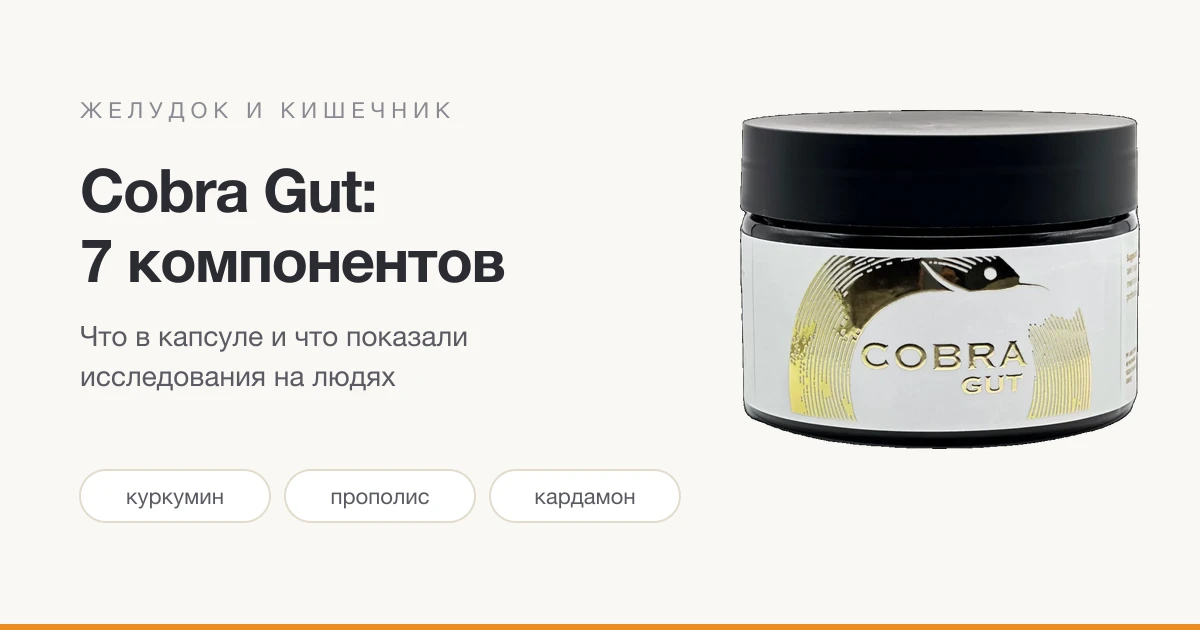
- One capsule, four jobs. The formula is built to work at the same time on the gastric mucosa (propolis, curcumin), digestion (bile acids, cardamom), the microbiome (Lactobacillus bulgaricus) and gut calm (quercetin).
- Curcumin for pain and heaviness in the stomach. In a double-blind trial of 132 people, pain fell 1.6 times more than on placebo (Yongwatana K, J Gastroenterol Hepatol 2022, PMID 34652861); in a trial of 206 people curcumin relieved symptoms over 4 weeks as well as omeprazole (Kongkam P, BMJ Evid Based Med 2023, PMID 37696679).
- Propolis for irritable bowel. 56 people, 6 weeks: improvement was 6.2 times more likely than on placebo (Miryan M, Food Sci Nutr 2022, PMID 35702280).
- Lactobacillus bulgaricus and Helicobacter. Among 200 people who took yoghurt with L. bulgaricus before anti-Helicobacter treatment, 89 % were cured (Tongtawee T, Asian Pac J Cancer Prev 2015, PMID 26163609).
- How to take it. One capsule a day with the largest meal; 50 capsules last 7 weeks; keep refrigerated. Not for pregnancy or breastfeeding; on anticoagulants or with chronic disease, talk to a doctor first.
What is in the capsule
| Ingredient | Dose | Role |
|---|---|---|
| Organic mountain propolis | 80 mg | mucosa, antimicrobial action |
| Dried cobra bile | 40 mg | fat digestion |
| Nepal cardamom | 40 mg | cramps, bloating |
| Turmeric extract (curcumin) | 40 mg | inflammation, bile flow |
| Japanese propolis | 40 mg | mucosa, protection |
| Quercetin | 40 mg | allergy, irritation |
| Lactobacillus bulgaricus | 20 mg (10 billion CFU) | microbiome, immunity |
Plant-based capsule (Plantgel), 50 per jar.
Curcumin: the most studied plant anti-inflammatory
A turmeric root extract standardised for curcumin. In the mucosa it inhibits the NF-κB pathway and the COX-2 enzyme — the main "switches" of inflammation — stimulates bile flow (choleretic) and quenches free radicals.
In humans. In functional dyspepsia — pain and heaviness without an ulcer — curcumin reduced symptoms better than placebo and as well as an acid-lowering drug in two randomised trials [1, 2]. In ulcerative colitis added to mesalamine, 54 % reached remission in a month versus 0 % on placebo (Lang A, Clin Gastroenterol Hepatol 2015, PMID 25724700); on maintenance, relapses over six months were 4.7 % versus 20.5 % (Hanai H, Clin Gastroenterol Hepatol 2006, PMID 17101300); a meta-analysis of 6 RCTs in 349 people gave a five-fold higher chance of remission (PMID 31696975). Across 9 RCTs curcumin lowered C-reactive protein by 3.67 mg/L on average (PMID 34586711). Doses up to 6 g a day for 4–7 weeks were tolerated without toxicity; abdominal discomfort is possible (PMID 29480523).
Propolis: bee resin from two origins
Mountain propolis is rich in flavonoids (galangin, chrysin, pinocembrin); Japanese propolis in bioflavonoids and caffeic acid esters (CAPE, artepillin C). Together they cover different parts of the spectrum: they disrupt bacterial membranes, including Helicobacter pylori (shown in the laboratory), inhibit NF-κB and protect mucosal cells from oxidative damage [3, 4].
In humans. In irritable bowel syndrome, 900 mg of propolis a day for 6 weeks made improvement 6.2 times more likely than placebo, with milder and less frequent pain [5]. During anti-Helicobacter treatment, a propolis complex reduced epigastric pain (p = 0.03) and improved tolerability (Mehri A, Biomed Res Int 2026, PMID 42411957). A meta-analysis of 16 RCTs: lower interleukin-6, C-reactive protein and tumour necrosis factor (PMID 39127756); a meta-analysis of 9 RCTs: higher glutathione and total antioxidant capacity (PMID 37317592). Mucosal healing in humans is confirmed with mouth rinses: severe mucositis is rarer (5 RCTs, 209 people, PMID 30022350) and aphthous ulcers heal faster (PMID 38248221).
Lactobacillus bulgaricus: the yoghurt starter that works in the gut
Lactobacillus delbrueckii subsp. bulgaricus was discovered by the Bulgarian student Stamen Grigorov in 1905. It produces lactic acid — the environment turns acidic and pathogens dislike it; it carries its own lactase, which survives the stomach, so lactose from yoghurt is absorbed three times better than from milk (Kolars JC, N Engl J Med 1984, PMID 6417539; review PMID 24695892); it releases bacteriocins and stimulates NK cells — the immune system's first line.
In humans. Yoghurt with L. bulgaricus and Streptococcus thermophilus before anti-Helicobacter treatment: 89 % cured, noticeably more than without yoghurt [6]. In the elderly, yoghurt with strain OLL1073R-1 cut the risk of colds 2.6-fold (Makino S, Br J Nutr 2010, PMID 20487575); capsules of strain 8481 for 6 months gave more NK cells and less inflammatory IL-8 (Moro-García MA, Age 2013, PMID 22645023). In 961 women with constipation — a small but significant improvement and better sleep (PMID 34030638).
Cardamom: the antispasmodic spice
A Himalayan spice from the ginger family; its main compounds are 1,8-cineole and α-terpinyl acetate (PMID 36245491). It relaxes intestinal smooth muscle as a calcium blocker — shown in the laboratory (PMID 18037596) — and stimulates digestive juices and bile. In traditional medicine it is a remedy for nausea, diarrhoea and indigestion (PMID 31541721).
In humans. 87 people with fatty liver disease, 3 g a day for 3 months: less liver fat, lower insulin and triglycerides, higher "good" cholesterol (Daneshi-Maskooni M, BMC Complement Altern Med 2019, PMID 30871514). A meta-analysis of 8 trials in 595 people: glycated haemoglobin lower by 0.4 %, C-reactive protein by 1.2 mg/L, interleukin-6 by 2.4 ng/L (Izadi B, Phytother Res 2023, PMID 36181264; Aghasi M, J Sci Food Agric 2019, PMID 30701554). Inhaling cardamom oil after caesarean section: nausea in 37 % versus 66 % (PMID 35581106). There are no direct human trials of cardamom for bloating or dyspepsia — here the case rests on biochemistry and tradition.
Quercetin: the immune cells' "calmer"
A flavonoid from onions, apples and buckwheat. It stabilises mast-cell membranes — less histamine, swelling and itching; it is a strong antioxidant and lowers C-reactive protein. From onions it is absorbed twice as well as pure powder (Hollman PC, Am J Clin Nutr 1995, PMID 7491892); doses up to 1 g a day are safe, with rare and mild side effects (BfR, PMID 29127724).
In humans. 66 people with seasonal allergy, 200 mg a day for 4 weeks: less eye itching, sneezing and runny nose, better sleep from the first week (Yamada S, Eur Rev Med Pharmacol Sci 2022, PMID 35776034). A meta-analysis of 7 trials: C-reactive protein lower by 0.33 mg/L (Mohammadi-Sartang M, Eur J Clin Nutr 2017, PMID 28537580); in women with rheumatoid arthritis over 8 weeks — less morning stiffness and pain, lower TNF-α (Javadi F, J Am Coll Nutr 2017, PMID 27710596). Blood pressure in a meta-analysis of 7 RCTs: lower by 3.0/2.6 mm Hg (PMID 27405810). In cyclists, 1 g a day for 5 weeks: upper respiratory infections after heavy training in 1 of 20 versus 9 of 20 (Nieman DC, Med Sci Sports Exerc 2007, PMID 17805089).
Cobra bile: tradition and biochemistry
Dried snake bile has been part of Eastern medicine for centuries: in Chinese patent medicines "Shedan" it is the first ingredient (PMID 34738383). Modern analysis shows it is a set of bile acids — up to 57, dominated by taurocholic acid (Zhang J, J Chromatogr B 2016, PMID 27760405; PMID 33645062; PMID 31535572).
What bile acids do. They emulsify fats and switch on lipase — fatty food is broken down instead of "sitting like a stone"; they help trypsin digest proteins; they restrain bacterial growth in the small intestine; through the FXR and TGR5 receptors they take part in metabolic regulation and the gut barrier (Hofmann AF, Hagey LR, Cell Mol Life Sci 2008, PMID 18488143; PMID 1619357; PMID 16102595; PMID 40692955). Taurine conjugates stay soluble in acid, glycine conjugates do not, so they get to work faster.
Honestly. There are no clinical trials of snake bile itself in humans; the benefit is explained by the action of bile acids, which physiology knows well. Oral bile acids in people with short bowel syndrome increased fat absorption (PMID 9869597; PMID 15248106).
How to take it
- One capsule a day with food, ideally with the largest meal. Swallow with water.
- One jar lasts 7 weeks. A repeat course — after a break, as decided by a doctor.
- Keep refrigerated, tightly closed — the capsule contains live bacteria.
- Assess the effect after 4 weeks. Cramps and bloating respond first (days), the stomach in about a month, the microbiome and cold frequency by the end of the course.
Who should not take it
- Pregnancy and breastfeeding — do not take: safety in these periods has not been studied.
- Anticoagulants — curcumin and quercetin may enhance their effect; discuss with the prescribing doctor.
- Gallstones, liver and pancreatic disease — bile acids and curcumin increase bile flow, so see a doctor first.
- Allergy to bee products — propolis is contraindicated.
Bottom line
Cobra Gut is not one active ingredient but seven, each with its own job. Best studied in humans are curcumin (dyspepsia, ulcerative colitis), propolis (irritable bowel, mucosa), Lactobacillus bulgaricus (Helicobacter, immunity in the elderly) and quercetin (allergy, inflammation). Cardamom and cobra bile rest on biochemistry and tradition: they have no direct clinical trials in bloating or dyspepsia. This material is educational and does not replace a medical consultation.
References
1. Yongwatana K, et al. Curcuma longa versus omeprazole in functional dyspepsia: randomized trial. J Gastroenterol Hepatol. 2022. PMID 34652861.
2. Kongkam P, et al. Curcumin and proton pump inhibitors for functional dyspepsia: randomised, double blind controlled trial. BMJ Evid Based Med. 2023. PMID 37696679.
3. Propolis reviews: PMID 40858917; PMID 36144852; PMID 28755848.
4. Propolis and inflammation, meta-analysis of 16 RCTs. 2024. PMID 39127756; antioxidants (9 RCTs). 2023. PMID 37317592.
5. Miryan M, et al. Effects of propolis supplementation on irritable bowel syndrome. Food Sci Nutr. 2022. PMID 35702280.
6. Tongtawee T, et al. Pretreatment with Lactobacillus delbrueckii and Streptococcus thermophilus and tailored triple therapy for H. pylori. Asian Pac J Cancer Prev. 2015. PMID 26163609.
7. Lang A, et al. Curcumin in combination with mesalamine induces remission in mild-to-moderate ulcerative colitis. Clin Gastroenterol Hepatol. 2015. PMID 25724700.
8. Hanai H, et al. Curcumin maintenance therapy for ulcerative colitis. Clin Gastroenterol Hepatol. 2006. PMID 17101300. Meta-analysis: PMID 31696975.
9. Curcumin and C-reactive protein, meta-analysis of 9 RCTs. 2022. PMID 34586711. Safety: PMID 29480523.
10. Mehri A, et al. Enhanced H. pylori treatment using a β-cyclodextrin–propolis complex. Biomed Res Int. 2026. PMID 42411957.
11. Mucositis: PMID 30022350. Aphthous stomatitis: PMID 38248221.
12. Makino S, et al. Yoghurt fermented with L. bulgaricus OLL1073R-1 and infection risk in the elderly. Br J Nutr. 2010. PMID 20487575.
13. Moro-García MA, et al. L. delbrueckii subsp. bulgaricus 8481 and immune profile in the elderly. Age (Dordr). 2013. PMID 22645023.
14. Kolars JC, et al. Yogurt — an autodigesting source of lactose. N Engl J Med. 1984. PMID 6417539. Yoghurt lactase review: PMID 24695892. Constipation: PMID 34030638.
15. Daneshi-Maskooni M, et al. Green cardamom in NAFLD: randomized trial. BMC Complement Altern Med. 2019. PMID 30871514.
16. Izadi B, et al. Green cardamom, blood pressure and inflammatory markers: meta-analysis. Phytother Res. 2023. PMID 36181264. Aghasi M, et al. J Sci Food Agric. 2019. PMID 30701554.
17. Cardamom: nausea after caesarean PMID 35581106; active compounds PMID 36245491; antispasmodic (laboratory) PMID 18037596; tradition PMID 31541721.
18. Yamada S, et al. Quercetin-containing supplement and allergic reaction: randomized trial. Eur Rev Med Pharmacol Sci. 2022. PMID 35776034.
19. Mohammadi-Sartang M, et al. Quercetin and C-reactive protein: meta-analysis. Eur J Clin Nutr. 2017. PMID 28537580. Javadi F, et al. J Am Coll Nutr. 2017. PMID 27710596.
20. Quercetin and blood pressure, meta-analysis of 7 RCTs. 2016. PMID 27405810. Nieman DC, et al. Med Sci Sports Exerc. 2007. PMID 17805089. Hollman PC, et al. 1995. PMID 7491892. BfR, 2018. PMID 29127724.
21. Hofmann AF, Hagey LR. Bile acids: chemistry, pathochemistry, biology, pathobiology, and therapeutics. Cell Mol Life Sci. 2008. PMID 18488143. Hofmann AF. 1992. PMID 1619357. Bile and microbes: PMID 16102595. FXR/TGR5: PMID 40692955.
22. Bile acids in short bowel syndrome: PMID 9869597; PMID 15248106.
23. Zhang J, et al. Rapid identification of bile acids in snake bile by UPLC-QTOF-MS. J Chromatogr B. 2016. PMID 27760405. Snake bile composition: PMID 33645062; PMID 31535572. Tradition: PMID 34738383.
Draft prepared with a language model from verified sources; reviewed and edited by Vladimir Pereligyn, MD, endocrinologist. Educational material; it does not replace a medical consultation.


