

Key points
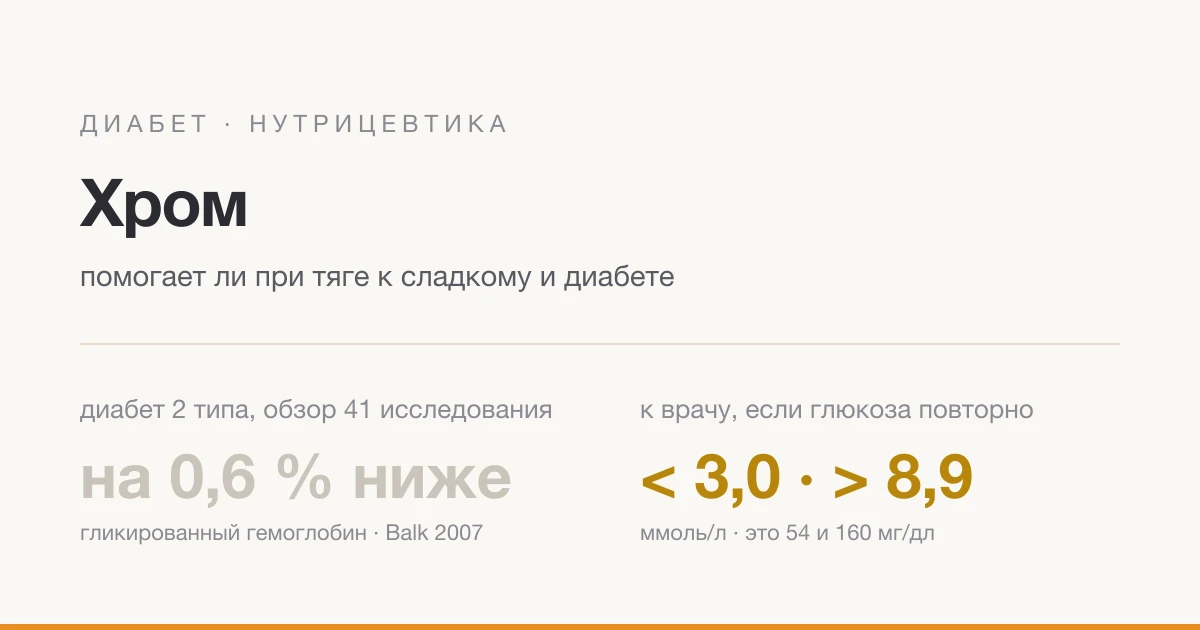
In type 2 diabetes, a small benefit. In a review of 41 studies (some in people without diabetes), participants with type 2 diabetes saw glycated hemoglobin (HbA1c, the average blood sugar over 2–3 months) fall by 0.6% (about 7 mmol/mol) and fasting glucose by 1.0 mmol/L (18 mg/dL) (Balk EM Diabetes Care 2007. PMID 17519436).
Usual doses are well tolerated. In a meta-analysis of 25 randomized studies, the risk of adverse events on chromium did not differ from placebo (dummy pills), but long-term safety has not been studied (Suksomboon N J Clin Pharm Ther 2014. PMID 24635480).
Food cravings: early signals. In small studies of 42 and 113 participants, chromium reduced hunger and the amount eaten, and carbohydrate craving on a separate item of the scale (Anton SD Diabetes Technol Ther 2008. PMID 18715218; Docherty JP J Psychiatr Pract 2005. PMID 16184071).
Barely noticeable effect on weight. In a meta-analysis of 11 studies, people on chromium lost 0.5 kg more than on placebo (Onakpoya I Obes Rev 2013. PMID 23495911).
Not a substitute for diabetes treatment. Authors from the NIH Office of Dietary Supplements (US National Institutes of Health) reviewed 20 studies and rated the effectiveness of chromium as limited (Costello RB Nutr Rev 2016. PMID 27261273).
What chromium does in the body
In food and supplements, chromium is trivalent. The Burgerstein handbook describes it as part of the “glucose tolerance factor”, which enhances the action of insulin (Burgerstein, Handbuch Nährstoffe 2015, p. 123–124). The reference values given there are 30–100 mcg a day under the 2000 German, Austrian and Swiss (DACH) reference values and 20–35 mcg under the 2001 US “adequate intake”; the handbook’s own doses are higher, and current assessments are more cautious (Burgerstein, Handbuch Nährstoffe 2015, p. 125). Chromium is poorly absorbed, 0.4–2%, and vitamin C improves absorption (Burgerstein, Handbuch Nährstoffe 2015, p. 125–126). Hexavalent chromium is an industrial carcinogen and is not used in medicine (Burgerstein, Handbuch Nährstoffe 2015, p. 127; Henriksen C Food Nutr Res 2023. PMID 38084146).
In 2014 the European Food Safety Authority (EFSA) considered the essential role of chromium unproven: even from data on intravenous feeding, EFSA could not determine a requirement, chose not to set an “adequate intake”, and found no evidence of benefit from chromium in healthy people (EFSA NDA Panel EFSA J 2014. PMID 42087961). The 2023 Nordic Nutrition Recommendations also give no reference value: there is no reliable test for chromium stores, and its essentiality is disputed (Henriksen C Food Nutr Res 2023. PMID 38084146).
Chromium in food
Chromium is found in many foods, for example meat and whole grains. But the doses from supplement studies, 200–1000 mcg a day (Burgerstein, Handbuch Nährstoffe 2015, p. 125), cannot be obtained from food (Henriksen C Food Nutr Res 2023. PMID 38084146).
Chromium in type 2 diabetes
2007 review. In a review of 41 studies (some in people without diabetes; almost half of low quality), participants with type 2 diabetes saw HbA1c fall by 0.6% (about 7 mmol/mol) and fasting glucose by 1.0 mmol/L (18 mg/dL). Stronger effects were more often found in low-quality studies (Balk EM Diabetes Care 2007. PMID 17519436).
2014 meta-analysis. In 25 studies in people with diabetes (in three studies, together with biotin or vitamins C and E), HbA1c fell by 0.55% (about 6 mmol/mol) and fasting glucose by 1.15 mmol/L (21 mg/dL). Improvement was more likely at doses above 200 mcg a day, especially with chromium picolinate (Suksomboon N J Clin Pharm Ther 2014. PMID 24635480).
2020 meta-analysis. In 28 studies, fasting glucose fell by 1.1 mmol/L (19 mg/dL) and HbA1c by 0.71% (about 8 mmol/mol). But for glucose the studies barely agreed: heterogeneity (I², the share of differences not explained by chance) was 99.8% (Asbaghi O Pharmacol Res 2020. PMID 32730903).
2016 review. Authors from the NIH Office of Dietary Supplements reviewed 20 studies and found that the treatment target, fasting glucose no higher than 7.2 mmol/L (130 mg/dL) or HbA1c no higher than 7% (53 mmol/mol), was rarely reached on chromium: for glucose in 5 of 20 studies, for HbA1c in 3 of 14. In their conclusion, there is little basis for recommending chromium for glucose control (Costello RB Nutr Rev 2016. PMID 27261273). What else is discussed for insulin resistance: see the article PCOS and insulin resistance: what helps.
Sugar cravings
This has been tested only in small studies.
42 women, 8 weeks. Overweight women with carbohydrate cravings received chromium picolinate or placebo. On chromium they ate less, and their hunger and cravings for fatty food were weaker; their weight went down, but the difference from placebo was not statistically significant (Anton SD Diabetes Technol Ther 2008. PMID 18715218).
113 adults, 8 weeks. People with atypical depression (in which appetite is often increased) received 600 mcg of chromium a day or placebo. On the main depression scale, the groups did not differ. Among the 75 who followed the protocol (50 on chromium, 25 on placebo), carbohydrate craving and increased appetite decreased more than on placebo; in an additional analysis of 41 people with strong cravings, the response on the depression scale was 65% versus 33% (Docherty JP J Psychiatr Pract 2005. PMID 16184071).
The handbook also mentions a regimen of 600 mcg a day for 2 months for sugar cravings (Burgerstein, Handbuch Nährstoffe 2015, p. 127). How to smooth out glucose swings with food: see the article No sugar swings.
Chromium and weight
In a meta-analysis of 11 studies, overweight people on chromium lost 0.5 kg more than on placebo, with a wide spread of results. The authors call the effect small and its clinical relevance unclear; adverse events included loose stools, dizziness, headache and hives (Onakpoya I Obes Rev 2013. PMID 23495911).
What the studies showed
| What was tested | Who took part | Result |
|---|---|---|
| Type 2 diabetes, 2007 review | 41 studies (some in people without diabetes), almost half of low quality | In participants with type 2 diabetes HbA1c −0.6% (7 mmol/mol), fasting glucose −1.0 mmol/L (18 mg/dL) |
| Diabetes, 2014 meta-analysis | 25 randomized studies | HbA1c −0.55% (6 mmol/mol), glucose −1.15 mmol/L (21 mg/dL); side effects as on placebo |
| Type 2 diabetes, 2020 meta-analysis | 28 studies | Glucose −1.1 mmol/L (19 mg/dL), HbA1c −0.71% (8 mmol/mol); heterogeneity for glucose 99.8% |
| Treatment targets, NIH Office of Dietary Supplements review 2016 | 20 studies | Glucose target reached in 5 of 20, HbA1c target in 3 of 14 |
| Weight, 2013 meta-analysis | 11 studies | −0.5 kg versus placebo, clinical relevance unclear |
| Food cravings, 2008 | 42 women, 8 weeks | Less food, hunger and craving for fatty food |
| Atypical depression, 2005 | 113 adults, 8 weeks | No difference on the main scale; less carbohydrate craving in those who followed the protocol |
There is a null result too: in people without diabetes, the 2007 review found no effect of chromium on glucose or lipids (Balk EM Diabetes Care 2007. PMID 17519436).
Who should be careful
- People who exceed the doses: a case has been described in which a woman took 1200–2400 mcg of chromium picolinate a day for 4–5 months to lose weight and was hospitalized with kidney failure and liver damage; after treatment, including dialysis, she recovered (Cerulli J Ann Pharmacother 1998. PMID 9562138).
- People with kidney or liver disease: start a chromium supplement only after talking to a doctor.
- People taking glucose-lowering drugs or insulin: if you start chromium, check your glucose more often and see a doctor if it is repeatedly below 3.0 mmol/L (54 mg/dL) or above 8.9 mmol/L (160 mg/dL).
- Pregnant and breastfeeding women: a supplement during this period is chosen by a doctor.
- At very high doses, trivalent chromium may damage DNA; this has been studied only in animals (Burgerstein, Handbuch Nährstoffe 2015, p. 127).
Bottom line
Chromium is not a magic remedy: the effect is small, and the studies are not of sufficient quality for firm conclusions. In type 2 diabetes, HbA1c and glucose fall slightly, and the effect on weight is barely noticeable. Diabetes treatment rests on diet, physical activity and medication, and chromium can be discussed as an add-on. You can find out whether you need it at a consultation.
This material is for information only and does not replace a consultation with a doctor. Do not change the doses of glucose-lowering drugs without a doctor.


