

Key points
First pill for severe alopecia. In 2022, baricitinib became the first pill approved in the US for severe alopecia areata in adults (FDA, 2022).
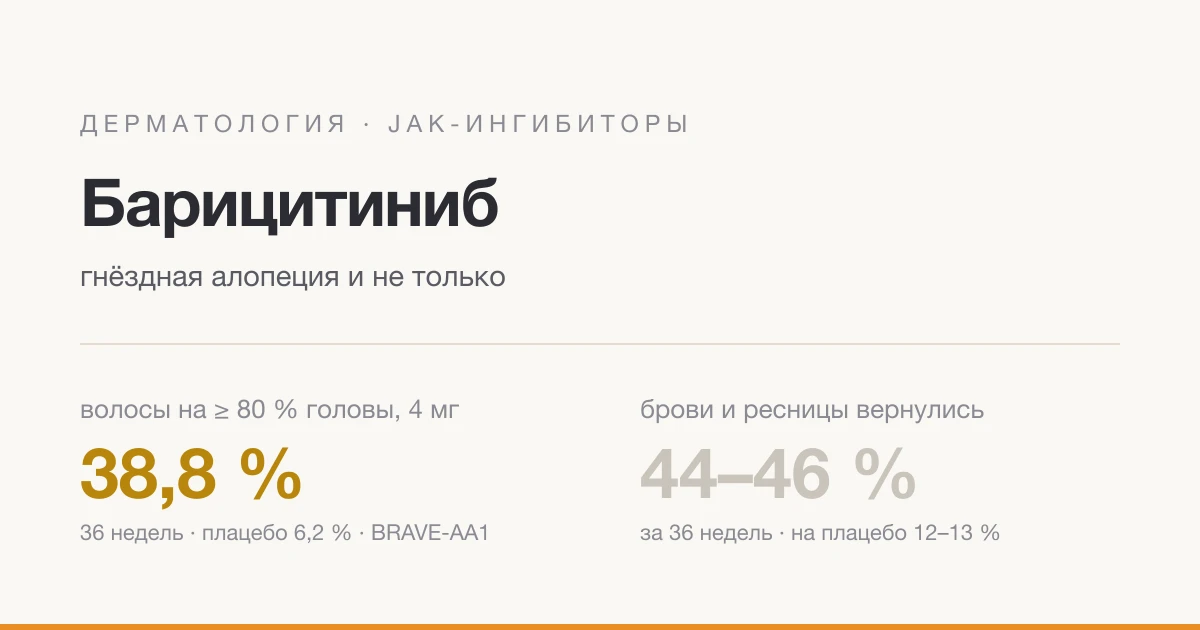
Hair returned in almost 4 in 10. Over 36 weeks on 4 mg a day, hair again covered at least 80% of the scalp in 38.8% and 35.9% of adults versus 6.2% and 3.3% on placebo (King B N Engl J Med 2022. PMID 35334197).
Eyebrows and eyelashes — in almost half. Over 36 weeks on 4 mg they regrew fully or almost fully in 44–46% of those with noticeable gaps versus 12–13% on placebo (Mostaghimi A Br J Dermatol 2025. PMID 40179237).
The result lasts for years. Among those who responded by the first year, with continued treatment 89% on 4 mg and 84% on 2 mg kept it at 3 years (Senna M J Am Acad Dermatol 2026. PMID 41314424).
Not just hair. Baricitinib is used in rheumatoid arthritis and severe COVID, in the European Union and Japan also in atopic dermatitis, and in type 1 diabetes it showed an interesting result in a trial.
Alopecia areata: the immune system attacks hair
Alopecia areata (patchy hair loss) occurs at least once in a lifetime in about 1 person in 50: in a large UK study the lifetime incidence was 2.1% (Thompson AR Br J Dermatol 2024. PMID 39104082). Hair falls out in round patches, sometimes almost all the hair on the head goes, and with it the eyebrows and eyelashes.
The cause lies in the body's own immune system: its cells mistakenly attack the hair follicle. No scar is left, so the hair can grow back if the attack is stopped (Mateos-Haro M Cochrane Database Syst Rev 2023. PMID 37870096).
Alopecia affects more than appearance. Among those who had signs of anxiety on the HADS (Hospital Anxiety and Depression Scale) at baseline, these resolved in 47% with good hair regrowth versus 26% without regrowth (Piraccini BM J Dermatolog Treat 2023. PMID 37381691). This is an association with regrowth, not a direct effect of the pill on the mind.
How baricitinib works
Inside an immune cell, inflammatory signals are relayed by enzymes called Janus kinases (JAK). Baricitinib inhibits two of them — JAK1 and JAK2 (King B N Engl J Med 2022. PMID 35334197). Inflammatory signals weaken, and the immune attack on the follicle can subside. It is taken as one tablet a day: 2 or 4 mg.
Scalp hair: what the trials showed
Two large trials. BRAVE-AA1 and BRAVE-AA2 enrolled 1200 adults who at baseline were missing half of the hair on their head or more. The goal was hair covering at least 80% of the scalp again — a score of 20 or less on the SALT (Severity of Alopecia Tool) scale (King B N Engl J Med 2022. PMID 35334197).
36 weeks. On 4 mg the goal was reached by 38.8% and 35.9%, on 2 mg by 22.8% and 19.4%, on placebo by 6.2% and 3.3% (King B N Engl J Med 2022. PMID 35334197). Almost 4 in 10 on the higher dose versus about 1 in 20 on placebo.
The share grows by one year. Hair grows back slowly and the result builds up over months: by week 52 on 4 mg the goal was reached by 40.9% and 36.8% (Kwon O Am J Clin Dermatol 2023. PMID 36855020).
If 2 mg is not enough. Those who had not responded to 2 mg over a year had their dose raised to 4 mg: another one in four achieved good regrowth, and the share with restored eyebrows rose from 19 to 38%, eyelashes from 24 to 41%. There was no control group at this stage (Ko JM JAMA Dermatol 2023. PMID 37556146).
Cochrane review. Its authors analyzed 63 trials of 47 treatments. Based on the two BRAVE trials, baricitinib was 7.5 times more likely than placebo to produce regrowth of at least 75% of hair over 12–26 weeks — this is high-certainty evidence; for most other treatments the result remains unclear (Mateos-Haro M Cochrane Database Syst Rev 2023. PMID 37870096).
Everyday practice. In 27 hospitals in Italy, of 253 adults on 4 mg almost two thirds had reduced their hair loss to 20% or less by week 48, and anxiety and low mood scores decreased; there was no control group (Piraccini BM J Eur Acad Dermatol Venereol 2026. PMID 40985491).
Children — observations so far. In a Chinese clinic, among 33 children aged 2–18, almost half had the area of hair loss halved in about six months, and there were no serious adverse events. In children with alopecia the drug is used outside its approved indications, and the study is small and uncontrolled (Wei D Dermatology 2025. PMID 40774240).
Eyebrows and eyelashes
Over 36 weeks on 4 mg, eyebrows regrew fully or almost fully in 44.3% and eyelashes in 46.4% of those with noticeable gaps; on placebo, in 12.6% and 12.4% (Mostaghimi A Br J Dermatol 2025. PMID 40179237).
By week 52 on 4 mg, among those whose scalp hair regrew, eyebrows recovered in 78.5% and eyelashes in 82.6%. And even when the scalp did not respond, eyebrows and eyelashes came back in almost half (Mostaghimi A Br J Dermatol 2025. PMID 40179237).
How long the result lasts
The data here are good — provided treatment continues, and they apply to those who responded by the first year. At 2 years about 9 in 10 on 4 mg kept the result (Senna M J Eur Acad Dermatol Venereol 2024. PMID 38391212), at 3 years 89% on 4 mg and 84% on 2 mg (Senna M J Am Acad Dermatol 2026. PMID 41314424), and at almost 4 years about 85% (Vleugels RA Dermatol Ther (Heidelb) 2026. PMID 42825995). Dropouts were not counted in these calculations, and in the 4-year analysis missing data were filled in by a statistical estimate, so the estimate may be slightly inflated.
What happens after stopping. In the BRAVE-AA1 trial, some of the responders at one year (40 of 154) were randomly switched to placebo: by week 152, 80% of them had lost the result versus 7% of those who continued treatment. After restarting 4 mg, 21 of 24 regained the result (King B JAMA Dermatol 2024. PMID 39141364). Alopecia areata is a chronic condition, and treatment is meant to be long-term.
Rheumatoid arthritis
Baricitinib was first approved for joints, in rheumatoid arthritis: in the European Union since 2017 (EMA, 2017), and in the US since 2018 at a dose of 2 mg (FDA, 2018). The trials below studied the 4 mg dose:
- together with methotrexate, improvement on the ACR20 scale (at least 20%) over 12 weeks occurred in 70% versus 40% on placebo, and more often than with the biologic drug adalimumab (Taylor PC N Engl J Med 2017. PMID 28199814);
- even when biologic drugs had not helped, improvement occurred twice as often: 55% versus 27% (Genovese MC N Engl J Med 2016. PMID 27028914);
- in those just starting treatment, baricitinib on its own helped more often than the standard first drug, methotrexate: 77% versus 62% over 24 weeks (Fleischmann R Arthritis Rheumatol 2017. PMID 27723271);
- at 5 years, joint damage on X-rays had not progressed in 60–66% of those who started on baricitinib versus 41% of those who started on methotrexate (van der Heijde D J Rheumatol 2022. PMID 34526397).
Atopic dermatitis: itch eases quickly
Itch began to ease as early as the day after the first tablet, and falling asleep became easier from the second day (Buhl T Dermatol Ther (Heidelb) 2021. PMID 33899152). Together with steroid creams, on 4 mg clear or almost clear skin at 16 weeks was twice as common: 31% versus 15% (Reich K JAMA Dermatol 2020. PMID 33001140).
The drug has also been studied in children. In atopic dermatitis in 2–17-year-olds, the high dose together with creams outperformed placebo on all main measures (Torrelo A Br J Dermatol 2023. PMID 36999560), and in juvenile arthritis three quarters of children responded in the open-label part of the trial, and with continued treatment flares occurred less often than after switching to placebo; there were twice as many infections in this trial, and one case of PE (pulmonary embolism) was judged to be related to the drug (Ramanan AV Lancet 2023. PMID 37423231).
Severe COVID
In the largest trial of patients hospitalized with COVID, 12% died within 28 days on baricitinib versus 14% on usual care; together with similar drugs, data from nine trials show a reduction in mortality of about one fifth (RECOVERY Collaborative Group Lancet 2022. PMID 35908569). In a double-blind trial the main goal — fewer cases of deterioration — was not met, while 28-day mortality, a secondary goal, was 8% versus 13% (Marconi VC Lancet Respir Med 2021. PMID 34480861). Together with an antiviral drug, recovery was on average one day faster (Kalil AC N Engl J Med 2021. PMID 33306283). The World Health Organization gave baricitinib a strong recommendation together with corticosteroids (WHO, 2022).
Type 1 diabetes: an unexpected trial
In type 1 diabetes, the immune system destroys the cells that make insulin. In the BANDIT trial, 91 people whose diabetes had been diagnosed no more than 100 days earlier took baricitinib or placebo. After 48 weeks, more of their own insulin was being produced on baricitinib: stimulated C-peptide was 0.65 vs 0.43 nmol/L per minute (2.0 vs 1.3 ng/mL per minute). The insulin dose was lower on average — 0.41 vs 0.52 U/kg per day, glucose fluctuated less, and glycated hemoglobin did not differ between the groups (Waibel M N Engl J Med 2023. PMID 38055252).
Six months after stopping, the difference was still present, but after a year it was no longer significant: the benefit probably requires continuous treatment (So M Diabetes Care 2026. PMID 42627334). For now these are trials, not treatment: the drug is not approved for diabetes. In a small trial in type 2 diabetes with kidney damage, baricitinib reduced albumin loss in the urine over 24 weeks by 41% compared with placebo, but a third of those on 4 mg developed anemia, and the drug has no such indication (Tuttle KR Nephrol Dial Transplant 2018. PMID 29481660).
What the trials showed: in brief
| Where it was tested | Who took part | Result on 4 mg |
|---|---|---|
| Alopecia areata, 36 weeks | 1200 adults | Hair on ≥ 80% of the scalp in 38.8% and 35.9% vs 6.2% and 3.3% |
| Eyebrows and eyelashes, 36 weeks | Pooled data from two trials | Regrew fully or almost fully in 44–46% vs 12–13% |
| Keeping the result, 3 years | Responders by the first year | Kept by 89% on 4 mg and 84% on 2 mg |
| Rheumatoid arthritis, 12 weeks | 1307 adults | Improvement in 70% vs 40% |
| Atopic dermatitis with creams, 16 weeks | 329 adults | Clear skin in 31% vs 15% |
| Severe COVID, 28 days | 8156 people | Mortality 12% vs 14% |
| Type 1 diabetes, 48 weeks | 91 people | C-peptide 0.65 vs 0.43 nmol/L per minute |
Not everything was confirmed: in lupus the first trial met its main goal (57% vs 46%), but the second did not repeat the result — 47% vs 46% (Morand EF Lancet 2023. PMID 36848918; Petri M Lancet 2023. PMID 36848919); in vitiligo, together with phototherapy, the prespecified goal was not met (Seneschal J JAMA Dermatol 2025. PMID 39841460).
Safety: what matters
What is more common. Colds and upper respiratory tract infections, headache; in alopecia also acne and a rise in CPK (creatine phosphokinase) in blood tests (Kwon O Am J Clin Dermatol 2023. PMID 36855020). Among specific risks is shingles (Taylor PC Ann Rheum Dis 2022. PMID 34706874). Both “bad” LDL and “good” HDL cholesterol rise, their ratio does not change, the rise stops by about week 12, and statins bring LDL back to baseline (Taylor PC Ann Rheum Dis 2018. PMID 29463520).
Alopecia: serious complications are rare. In 1303 adults, serious infections occurred at a rate of 0.8 per 100 person-years, and over the whole period there was one heart attack, one PE (pulmonary embolism), three cases of cancer not counting non-melanoma skin cancer, and no deaths (King B Br J Dermatol 2023. PMID 36763878). Over an additional year of follow-up (treatment up to 4 years, 2.3 years on average) there were no new serious infections, cardiovascular events or thromboses (King B Am J Clin Dermatol 2025. PMID 40214720).
Risk depends on the person. In people under 65 without risk factors, serious complications were extremely rare. Extra caution is needed after age 65 and with smoking, diabetes, hypertension, atherosclerosis, obesity (a body mass index of 30 or higher), low physical activity and a history of cancer (Taylor PC Adv Ther 2023. PMID 36802049).
Where the warnings come from. The US labeling of JAK inhibitors used for inflammatory diseases carries a warning about serious infections, mortality, blood clots, the heart and tumors. The warnings about the heart and tumors came from a trial of another drug in the class, tofacitinib, in people aged 50 and over with risk factors (Ytterberg SR N Engl J Med 2022. PMID 35081280). For blood clots there is a signal for baricitinib itself: in the placebo-controlled phase, deep vein thrombosis or PE occurred in 6 of 997 people on 4 mg and in no one on placebo (Taylor PC Arthritis Rheumatol 2019. PMID 30663869). In a German registry, tumors on JAK inhibitors occurred slightly more often than on biologic drugs when treatment lasted longer than 16 months (Schaefer M Ann Rheum Dis 2025. PMID 40571478).
How it is taken
- One tablet a day — 2 or 4 mg.
- Lab tests are done before starting and during treatment: the doctor decides which ones.
- In alopecia the result builds up over months and is assessed after about a year.
- Treatment is meant to be long-term: after stopping, hair usually falls out.
Bottom line
Baricitinib is the first pill approved in the US for severe alopecia areata in adults. Hair, eyebrows and eyelashes come back in many people, and in those who respond the result lasts for years with continued treatment. It is also used in rheumatoid arthritis and severe COVID, in the European Union and Japan in atopic dermatitis, and in type 1 diabetes it is still being studied. The decision about treatment is made together with a doctor after lab tests. Another JAK inhibitor for alopecia is covered in the article Alopecia areata and ritlecitinib; you can discuss your own treatment at a consultation.
This material is for information only and does not replace a consultation with a doctor. Baricitinib is a prescription drug; the decision on prescribing, dose and monitoring is made by a doctor based on examination results.


