

Key points
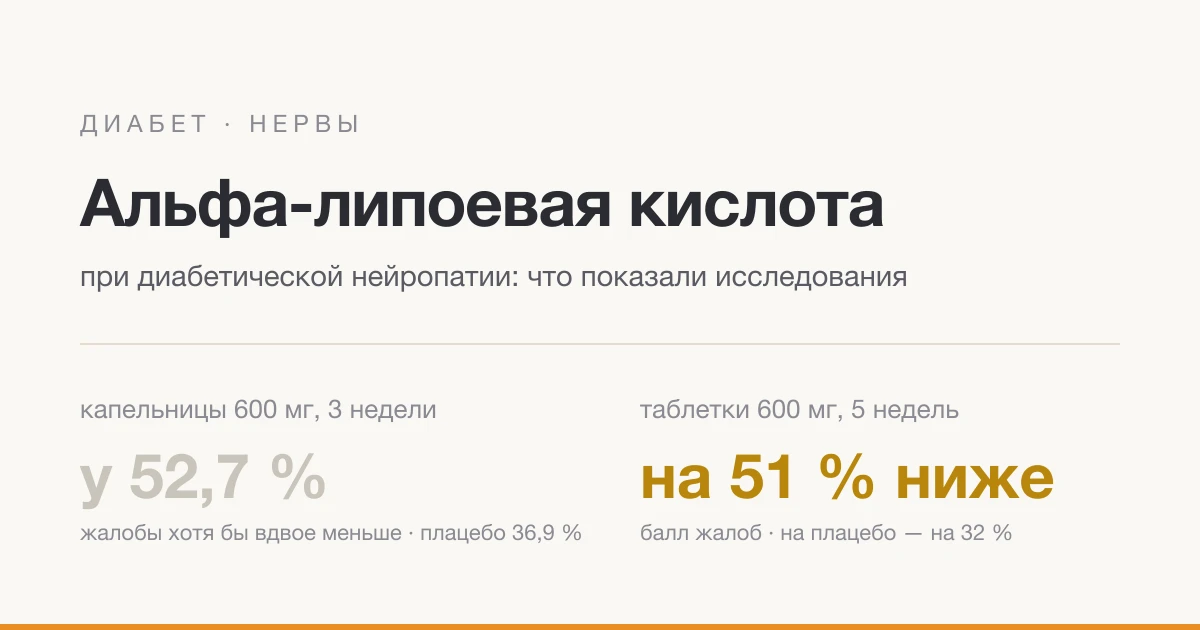
Alpha-lipoic acid (ALA) has been studied best at 600 mg a day — in drips and in tablets. The table shows the results in diabetic neuropathy.
| What for | How it helps | What human studies showed |
|---|---|---|
| Pain, burning and numbness in the feet: 600 mg drips, 3 weeks | reduce foot symptoms more than placebo | ALADIN, 328 people with type 2 diabetes: symptom score −63.5% versus −38.4% on placebo (Ziegler D Diabetologia 1995. PMID 8786016); SYDNEY, 120 people, 14 drips: −5.7 versus −1.8 points, each of the symptoms decreased (Ametov AS Diabetes Care 2003. PMID 12610036); meta-analysis of 4 studies, 1258 people: symptom score 24% better, symptoms decreased at least by half in 52.7% versus 36.9%, the difference noticeable from day 8 (Ziegler D Diabet Med 2004. PMID 14984445) |
| The same symptoms: 600 mg tablets once a day, 5 weeks | reduce symptoms when taken by mouth | SYDNEY 2, 181 people, 45 in the 600 mg group versus 43 on placebo: symptom score −51% versus −32% (Ziegler D Diabetes Care 2006. PMID 17065669) |
| Doctor’s assessment of the nerves: 600 mg a day for 4 years | more people had a clear improvement and fewer had a worsening | NATHAN 1, 460 people with mild to moderate neuropathy: this result was on a secondary measure, the Neuropathy Impairment Score (Ziegler D Diabetes Care 2011. PMID 21775755) |
How it helps
What alpha-lipoic acid is
Alpha-lipoic (thioctic) acid works in mitochondria, the cell’s “power stations”: it is needed by the enzymes pyruvate dehydrogenase and alpha-ketoglutarate dehydrogenase, which take part in getting energy from food. It is also an antioxidant that acts both in membranes and in the fluids of the cell and serves as a “go-between” for vitamins E and C (Burgerstein, Handbuch Nährstoffe 2015, p. 170–171). Nerve damage in diabetes is linked, among other things, to oxidative stress — hence the idea of using an antioxidant for neuropathy.
Drips: 600 mg for 3 weeks
ALADIN. In the ALADIN study (Alpha-Lipoic Acid in Diabetic Neuropathy), 328 people with type 2 diabetes received drips of 1200, 600 or 100 mg of ALA or placebo for 3 weeks. At 600 mg the foot symptom score fell by 63.5%, on placebo by 38.4%. Adverse events occurred in 18.2% at 600 mg, in 20.7% on placebo and in 32.6% at 1200 mg (Ziegler D Diabetologia 1995. PMID 8786016).
SYDNEY. In the SYDNEY study of 120 people, after 14 drips of 600 mg the symptom score fell by an average of 5.7 points versus 1.8 on placebo, and each of the symptoms decreased (Ametov AS Diabetes Care 2003. PMID 12610036).
Pooled data. In a meta-analysis — a pooling of results — of 4 drip studies (1258 people), after 3 weeks the symptom score was 24% better than on placebo, and the difference became noticeable from day 8; symptoms decreased at least by half in 52.7% on ALA versus 36.9% on placebo (Ziegler D Diabet Med 2004. PMID 14984445). A meta-analysis by another group of authors also called this course a clinically significant way to reduce neuropathic pain (Mijnhout GS Int J Endocrinol 2012. PMID 22331979).
Tablets: 600 mg a day
In the SYDNEY 2 study, 181 people took 600, 1200 or 1800 mg of ALA once a day or placebo for 5 weeks. The symptom score fell by 51, 48 and 52% versus 32% on placebo. Nausea, vomiting and dizziness became more frequent with dose, so the authors consider 600 mg the optimal dose (Ziegler D Diabetes Care 2006. PMID 17065669).
Long-term use: 600 mg a day for 4 years
NATHAN 1. In the NATHAN 1 study, 460 people with mild to moderate neuropathy took 600 mg of ALA once a day or placebo for 4 years. On secondary measures, on the Neuropathy Impairment Score (NIS), results on ALA were better: more people had a clear improvement and fewer had a worsening (Ziegler D Diabetes Care 2011. PMID 21775755). The main measure is covered under “Caveats”.
How to take it
The best-studied dose is 600 mg a day — as a 3-week course of drips or as tablets once a day for 5 weeks; in tablets, 1200 and 1800 mg a day added no benefit. The form — drips or tablets — is chosen together with a doctor.
Burgerstein’s handbook gives the usual dose of 0.2–1.0 g a day (Burgerstein, Handbuch Nährstoffe 2015, p. 171).
Who should see a doctor first
Short courses were well tolerated: in the meta-analysis of drips, adverse events were no more frequent than on placebo (Ziegler D Diabet Med 2004. PMID 14984445). With oral intake, nausea and vomiting became more frequent with dose (Ziegler D Diabetes Care 2006. PMID 17065669), and over 4 years serious adverse events — any severe health events, not necessarily caused by the drug — occurred in 38.1% on ALA versus 28.0% on placebo, with similar tolerability (Ziegler D Diabetes Care 2011. PMID 21775755).
Hirata disease. Insulin autoimmune syndrome (Hirata disease) is rare: the immune system makes antibodies to the person’s own insulin, and blood sugar falls in someone who has never injected insulin. Six Europeans (median age 63) have been described in whom episodes of low blood sugar began 30–120 days into taking 600 mg of ALA a day; after ALA was stopped, the episodes became fewer (Gullo D Clin Endocrinol 2014. PMID 24111525).
Who is prone to it. Susceptibility is linked to the genes for human leukocyte antigens (HLA) — tissue-compatibility proteins used to match donors. In a review of 68 cases with genetic testing, the HLA-DRB104:06 variant predominated in people of East Asian origin and DRB104:03 in Europeans, and in Europeans lipoic acid was a common trigger (Yao D Diabetes Metab Syndr Obes 2024. PMID 39309309).
- If you develop weakness, sweating, trembling or confusion while taking ALA, check your glucose. Repeated readings below 3.0 mmol/L (54 mg/dL) or above 8.9 mmol/L (160 mg/dL) are a reason to see a doctor and mention that you take ALA.
- If you are on insulin or glucose-lowering tablets, low blood sugar is easy to blame on them — tell your doctor about the supplement.
- Hirata disease has been described in Europeans and in people of East Asian origin; in Europeans, ALA is a common trigger (Yao D Diabetes Metab Syndr Obes 2024. PMID 39309309). Anyone taking ALA should know about it.
- If ALA makes you nauseous, do not increase the dose: 1200 and 1800 mg a day gave no more benefit than 600 mg.
Bottom line
Short courses of alpha-lipoic acid — 600 mg drips for 3 weeks and 600 mg tablets for 5 weeks — reduced burning, pain and numbness in the feet in diabetes. A rare risk worth knowing in advance is Hirata disease with episodes of low blood sugar; how to avoid glucose dips is covered in the article No Sugar Swings. Whether ALA is right for you can be decided at a consultation.
Source: Alpha-Lipoic Acid for Diabetic Neuropathy: What the Studies Showed — universum.earth. Dr. Pereligyn.


