

In brief
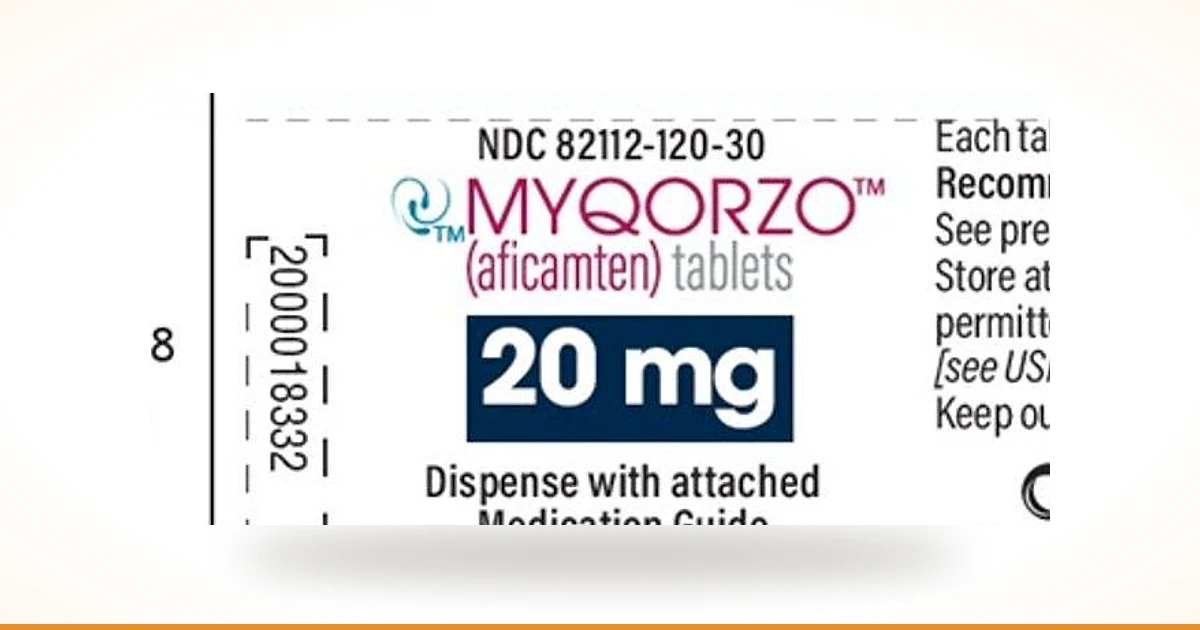
What it is. Aficamten (brand name Myqorzo, Cytokinetics) is the second cardiac myosin inhibitor of its class, approved by the FDA on 19 December 2025.
What for. Symptomatic obstructive hypertrophic cardiomyopathy in adults.
How it differs from its predecessor. The same mechanism with more manageable pharmacokinetics.
The mechanism is mavacamten's
In hypertrophic cardiomyopathy the heart muscle contracts excessively: the fraction of myosin ready to engage actin is increased. The thickened septum together with the mitral valve blocks outflow into the aorta — obstruction follows, and with it breathlessness, chest pain and syncope.
Cardiac myosin inhibitors reduce the number of those couplings. The heart contracts more moderately, relaxes better and the outlet obstruction eases.
The mechanics are covered in the mavacamten guide; here we focus on what the second generation changes.
What the second generation changed
| Mavacamten | Aficamten | |
|---|---|---|
| FDA approval | April 2022 | December 2025 |
| Half-life | Long | Shorter |
| Time to steady state | Slower | Faster |
| Titration steps | Less frequent | More frequent, more flexible |
| Reversibility if over-suppressed | Slower | Faster |
| Pivotal trial | EXPLORER-HCM | SEQUOIA-HCM |
The practical meaning of these differences is one word: controllability. When a drug lowers cardiac contractility, being able to correct course quickly matters. A shorter half-life means both faster dose finding and faster resolution of an unwanted drop in ejection fraction.
This does not make aficamten "better" — no head-to-head trials have been conducted between the two, and such claims would not be supportable.
What SEQUOIA-HCM showed
▸ SEQUOIA-HCM (New England Journal of Medicine, 2024) — a phase 3 trial in patients with the symptomatic obstructive form. Aficamten improved peak oxygen uptake during exercise compared with placebo [1].
Peak oxygen uptake is an objective measure of capacity obtained during exercise testing. It does not depend on how the patient rates their own wellbeing, which is what makes it a valuable endpoint.
▸ A secondary analysis (JACC: Heart Failure, 2026) showed the effect held regardless of prior beta blocker treatment [2].
Monitoring and safety
The requirements match the class:
▸ echocardiography before starting, during titration and regularly thereafter — ejection fraction is the parameter watched;
▸ if ejection fraction falls below threshold, the dose is reduced or treatment paused;
▸ pregnancy is a contraindication;
▸ hepatic enzyme interactions require a review of current therapy before prescribing;
▸ intercurrent illness (infection, arrhythmia) can temporarily lower contractility — therapy is reassessed.
Where it belongs in treatment
A myosin inhibitor is not first line. The usual sequence:
▸ beta blockers or verapamil as baseline therapy;
▸ with persistent symptoms and obstruction — discussion of a myosin inhibitor;
▸ where drugs fail and obstruction is severe — septal myectomy or alcohol ablation in an experienced centre.
The choice between mavacamten and aficamten rests with the cardiologist: availability, convenience of monitoring and the clinical picture.
Summary
▸ The second drug of the class, approved in December 2025.
▸ Mechanism identical to mavacamten: fewer actin-myosin bridges, less obstruction.
▸ The difference is controllability: shorter half-life, more flexible titration, faster reversibility.
▸ SEQUOIA-HCM: improved peak oxygen uptake versus placebo.
▸ Echocardiography is mandatory — the class risk has not gone away.
▸ No head-to-head comparison with mavacamten — "better" cannot be claimed, "easier to titrate" can.
The diagnosis and management can be discussed at a consultation; the product can be ordered here.
References
1. Maron MS, et al. Aficamten for symptomatic obstructive hypertrophic cardiomyopathy (SEQUOIA-HCM). N Engl J Med. 2024;390(20):1849–1861. PMID 38739079
2. Dominguez F, et al. Efficacy of aficamten vs metoprolol according to pretrial beta-blocker treatment in obstructive hypertrophic cardiomyopathy. JACC Heart Fail. 2026. PMID 42667283
3. Olivotto I, et al. Mavacamten for treatment of symptomatic obstructive hypertrophic cardiomyopathy (EXPLORER-HCM). Lancet. 2020;396(10253):759–769. PMID 32871100
4. MYQORZO (aficamten) US Prescribing Information, Cytokinetics.


