

Key points
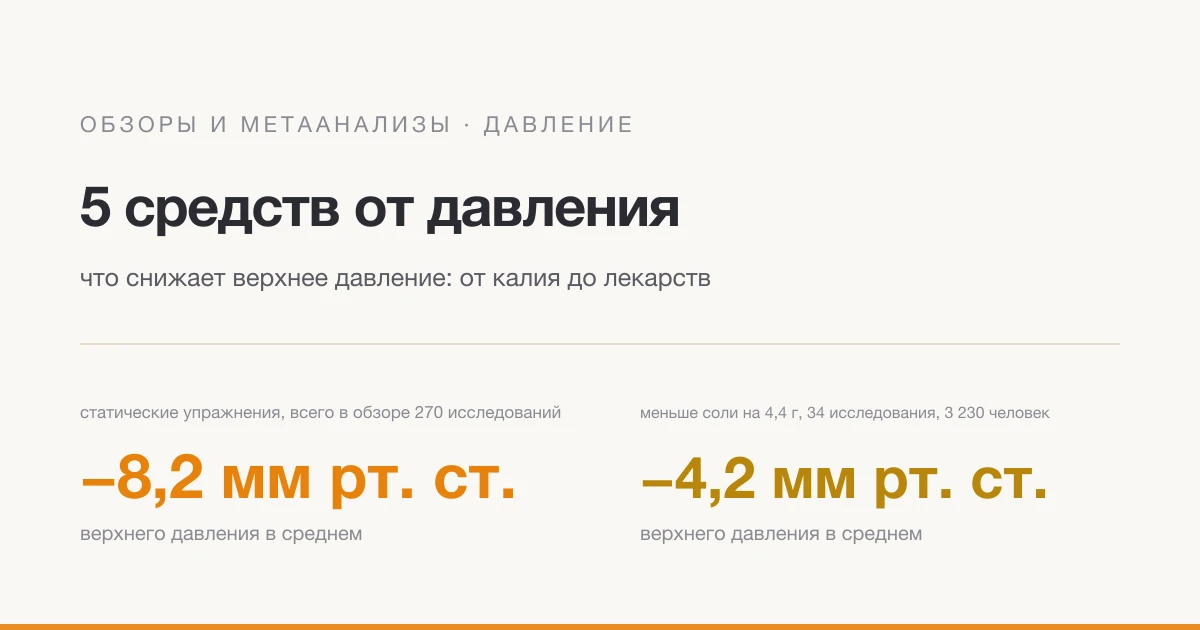
Systolic (upper) blood pressure can be lowered not only with pills. Meta-analyses and a Cochrane review tested simple measures, and when their results are put side by side, the five, from more modest to strongest, are: potassium from food, weight loss, less salt, static exercise and medicines prescribed by a doctor. By the average figures, the strongest of the non-drug measures is static exercise such as a wall squat: systolic pressure lower by 8.2 mm Hg on average (270 trials and 15,827 people in the review in total). In third place is less salt: 4.2 mm Hg lower (34 trials, 3,230 people). You can start today with one habit, and the choice of medicines, if needed, is made only by a doctor.
| What | How much | Why it helps | What studies showed |
|---|---|---|---|
| 5. Potassium from food | beans, potatoes, bananas, greens; in some trials 90-120 mmol of potassium a day (about 3.5-4.7 g) | Lower systolic pressure in people with hypertension | 22 trials, 1,606 people: 3.5 mm Hg lower; with hypertension 5.3 mm Hg lower (16 trials, 818 people) |
| 4. Weight loss | 4 kg lost over 6-36 months | Lower pressure; in one trial fewer returns to pills or serious complications | Cochrane: systolic pressure 4.5 mm Hg lower (calculated from 3 of 8 trials; 2,100 people with hypertension in the review in total) |
| 3. Less salt | 4.4 g less salt a day (about three quarters of a teaspoon) | Lower systolic pressure with and without hypertension | 34 trials, 3,230 people: 4.2 mm Hg lower; with hypertension 5.4 mm Hg lower (subgroup) |
| 2. Static exercise | wall squat and other held positions | The largest fall in pressure among types of training | 8.2 mm Hg lower (270 trials and 15,827 people in the review in total) |
| 1. Medicines prescribed by a doctor | the doctor chooses the plan and dose | Pressure can be brought to target | chosen individually, on a doctor's prescription |
How to read this list
The list runs as in the video: from the more modest measure to the strongest. All numbers are averages for groups of people: in some pressure falls more, in others less. The measures do not compete, they can be combined, and the doctor decides whether medicines are needed on top.
Place 5. Potassium from food
Potassium is a mineral found in ordinary food. In a meta-analysis of 22 trials (1,606 people), more potassium lowered systolic pressure by 3.5 mm Hg and diastolic by 2.0. The effect was seen in people with hypertension: their systolic pressure fell by 5.3 mm Hg (16 trials, 818 people); in people without hypertension no fall was shown (3 trials, 757 people). Potassium was mostly given as tablets, but in three trials where people were advised to eat more potassium-rich food (244 people), systolic pressure also fell, by 4.2 mm Hg. In a subgroup of 5 trials (286 people) where potassium intake was 90-120 mmol a day (about 3.5-4.7 g), pressure fell by 7.2 mm Hg; the authors found no clear dependence on dose (Aburto NJ BMJ 2013. PMID 23558164).
Two more facts for potassium. In observational studies (9 cohorts), more potassium in food was associated with a 24% lower risk of stroke (RR 0.76; 95% CI 0.66-0.89). And the trials showed no harm to kidney function, cholesterol or stress hormones in adults (Aburto NJ BMJ 2013. PMID 23558164). A simple day: a banana for breakfast, bean soup with dill for lunch, a baked potato with a vegetable salad for dinner.
Place 4. Weight loss
A Cochrane review pooled 8 trials of weight-loss diets in 2,100 people with hypertension, lasting from 6 to 36 months. Weight in the diet groups was 4.0 kg lower (5 trials), and systolic pressure was 4.5 mm Hg lower (95% CI 1.8-7.2) and diastolic 3.2 mm Hg lower (3 trials). Cochrane graded the evidence for pressure as low quality (Semlitsch T Cochrane Database Syst Rev 2016. PMID 26934541).
There is also something that matters in life: in one trial a weight-loss diet made it less likely that a person had to go back to pills or had a serious complication (HR 0.70; 95% CI 0.57-0.87, that is, a 30% lower risk) (Semlitsch T Cochrane Database Syst Rev 2016. PMID 26934541).
Place 3. Less salt
In a meta-analysis of 34 trials (3,230 people), salt in food was cut by 4.4 g a day on average, and systolic pressure fell by 4.2 mm Hg (95% CI 3.2-5.2) and diastolic by 2.1. In people with hypertension the fall was larger, 5.4 mm Hg, and in people with normal pressure 2.4 mm Hg. The more salt removed, the larger the fall: by the authors' calculation, 6 g less salt a day corresponds to a fall of 5.8 mm Hg (He FJ BMJ 2013. PMID 23558162).
What it looks like in the kitchen: 4.4 g is about three quarters of a teaspoon of salt. Most salt comes not from the shaker but from sausages, cheese, bread, sauces, canned food and ready meals. A good first step: do not add salt on the plate, pick products with less salt and add flavour with herbs, lemon and spices. More on a week-long experiment with less salt: A week without salt: what happens to blood pressure.
Place 2. Static exercise
These are exercises in which you hold a position without moving: a wall squat (as if sitting on an invisible chair), holding in place. A network meta-analysis of 270 trials (15,827 people in total) compared all kinds of training. Isometric, that is static, exercise gave the largest fall in pressure: systolic by 8.2 mm Hg, diastolic by 4.0. Next came combined training (6.0 mm Hg lower), dynamic strength training (4.6), aerobic exercise such as running and walking (4.5) and interval training (4.1). The best option for systolic pressure was the wall squat (Edwards JJ Br J Sports Med 2023. PMID 37491419).
For diastolic pressure the best submode was running (Edwards JJ Br J Sports Med 2023. PMID 37491419). So walking and running keep their place in the week, and static exercise is added on top. Ask a doctor or trainer how many seconds to hold and how many sets; breathe evenly, without holding your breath.
Place 1. Medicines prescribed by a doctor
Blood pressure medicines are chosen and prescribed only by a doctor: the plan and dose are not started, stopped or changed on your own.
Why alcohol is not on the list
Drinking less alcohol also lowers pressure, but not in everyone. In a meta-analysis of 36 trials (2,865 people in total), a fall in pressure was shown in people who drank more than 2 drinks a day, the largest, 5.5 mm Hg, in those who drank 6 drinks a day or more and cut alcohol by about half. In those who drank 2 drinks a day or less, no significant fall was shown (Roerecke M Lancet Public Health 2017. PMID 29253389). That is why it did not make the list for everyone.
Where to start
- Measure pressure at home by the rules and write down the results so that you come to the doctor with numbers. How to measure correctly on both arms: Blood pressure on both arms: why measure the difference.
- Cut out extra salt: do not add salt on the plate and read labels.
- Add potassium as food: beans, potatoes, a banana, greens every day.
- Make static exercise a habit 2-3 times a week, agreed with your doctor, and keep walking as it is.
- If you are overweight, aim for 4 kg less: that is how much was lost on average in the trials.
Who should see a doctor first
Pressure above 135/85 mm Hg on repeated home measurements is a reason to see a doctor. If you have been prescribed medicines, keep taking them and discuss changes of lifestyle at the visit. With kidney disease and with medicines that affect potassium, increase potassium in food only with a doctor: the studies showed benefit in people with normal kidney function. Potassium tablets are taken only on a doctor's prescription. Static exercise with high pressure and heart disease is also started in agreement with a doctor.
Bottom line
Four habits are backed by reviews and meta-analyses: more potassium, weight loss, less salt and static exercise; on average they lower systolic pressure by 3.5-8.2 mm Hg, and they can be combined. The fifth measure, medicines, is chosen by a doctor if pressure stays high.
Source: 5 strongest ways to lower blood pressure: reviews and meta-analyses — universum.earth. Dr. Pereligyn.


