

Key points
Steady blood sugar is not about strict bans but about a plate that is simple and tasty to choose from. The five-day menu is built from ordinary foods without grains or bread: eggs, fish, poultry, legumes, vegetables, berries, nuts, avocado and olive oil. Three dishes a day, no weighing. Three habits complement the menu: the protein part of the dish first, 25-29 g of fibre a day and a short walk after eating. What exactly human studies tested is explained below, and the menu is easy to adapt to your taste.
| Day | Breakfast | Lunch | Dinner |
|---|---|---|---|
| 1 | Omelette with vegetables | Lentil soup | Fish with broccoli |
| 2 | Yogurt with berries | Chicken with salad and avocado | Vegetables with beans |
| 3 | Eggs with herbs | Turkey with vegetables and nuts | Tuna salad with chickpeas |
| 4 | Cottage cheese with berries | Soup and a bread-free turkey patty | Salmon with vegetables |
| 5 | Yogurt with nuts and seeds | Chicken with vegetables and avocado | Omelette with spinach |
The plate rule
A simple rule helps you build any dish without scales: half the plate vegetables, a quarter protein, a quarter healthy fats. Vegetables give volume and fibre: salads, broccoli, spinach, herbs, courgette, cabbage. Protein is eggs, fish, poultry, cottage cheese, yogurt, legumes. Healthy fats are nuts, avocado and olive oil. There are no grains or bread in the menu: vegetables and legumes take their place. The rule is a convenient guide for building a plate and is not the result of a separate study.
Here is how it looks through the day. Breakfast: an omelette with vegetables, topped with tomato and herbs. Lunch: lentil soup with a spoon of olive oil. Dinner: baked fish with broccoli. Portions follow hunger: once you feel full, that is enough. If you need a snack, a handful of nuts, half an avocado or a hard-boiled egg work well. Swap dishes around and repeat favourites: steady sugar rests on principles, not one recipe. For variety, cook in different ways: bake, stew, steam, make a puréed soup or an egg bake. Herbs, garlic and lemon juice add flavour without sugar and without extra effort. In the evening a simple principle works well: a light dinner of fish or eggs with a large portion of vegetables, so you do not go to bed feeling heavy.
Protein at the start of a meal
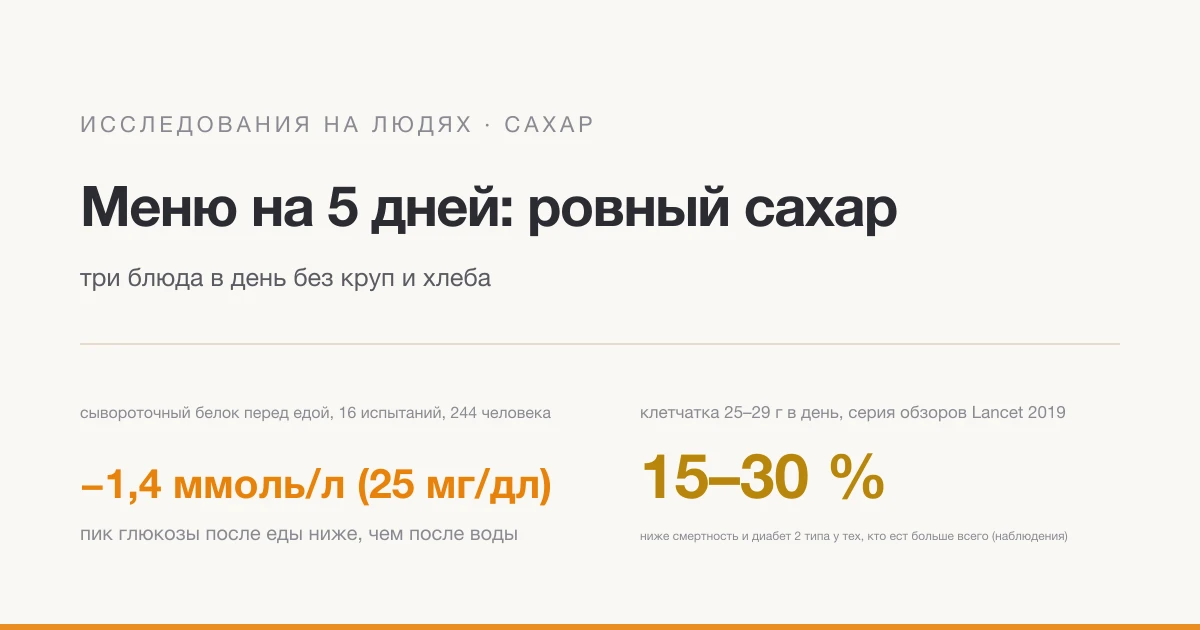
The most visible trick in the menu is starting a meal with protein. A systematic review of 16 randomised crossover trials with 244 people (lean, with obesity and with type 2 diabetes) showed that a serving of whey protein before a meal lowered the post-meal glucose peak by 1.4 mmol/L (25 mg/dL) compared with water, with high certainty (Smedegaard S Am J Clin Nutr 2023. PMID 37536867). The total glucose load after the meal was also lower.
In plain words: in these trials whey protein before a meal slowed stomach emptying and raised peak insulin, and sugar rose more gently after eating. The review noted that the effect was more pronounced and lasted longer in people with type 2 diabetes, and the protein dose in the trials ranged from 4 to 55 g: the larger the dose, the stronger the reduction. The trials studied whey protein specifically, so by the same principle the protein part of the dish comes first in the menu: egg, fish or poultry first, then vegetables.
Fibre: 25-29 grams a day
Fibre is what vegetables, legumes, berries, nuts and seeds are made of, and this menu has plenty. In a series of systematic reviews, comparing people who ate the most fibre with those who ate the least, all-cause mortality and mortality from heart disease, coronary heart disease, stroke, type 2 diabetes and colorectal cancer were 15-30% lower (observational). The risk reduction was greatest at 25-29 g of fibre a day (Reynolds A Lancet 2019. PMID 30638909).
What it means for your day. In clinical trials from the same review, higher fibre intake was associated with lower body weight, systolic blood pressure and total cholesterol. Lentil soup, beans with vegetables, chickpeas in a tuna salad, berries with yogurt, a handful of nuts and seeds help you reach this amount without bread or grains. Add fibre gradually and drink enough water so that your gut adapts without discomfort.
A walk after eating
Light walking instead of long sitting works as a free helper for blood sugar. A systematic review pooled seven one-day randomised crossover trials in adults, mostly with overweight or obesity: frequent short light-walking breaks in prolonged sitting significantly lowered glucose and insulin after eating compared with continuous sitting, while simply standing helped less (Buffey AJ Sports Med 2022. PMID 35147898).
In the trials walking broke up sitting through the day, and ten minutes after a meal is a practical tip based on the same principle. Walk calmly, without a sporty pace: so that you can still talk. Ten minutes around the house after lunch or dinner, a phone call on the move, the walk to the shop. The trials in the review lasted one day, so they show the effect on the day of the walk. If you take diabetes medication, discuss how you feel and your readings during walks with your doctor.
How to use the menu
The menu is designed for five days, then it can go round again, swapping dishes within one category: fish for poultry, lentils for chickpeas, berries in yogurt for berries in cottage cheese. A few simple rules: choose what you like, cook for two meals at once, keep eggs, tinned legumes and frozen vegetables at home for days when you have no time. If you need a menu for your own tests and medicines, it is built at a consultation. With allergies and intolerances, swap dishes within the same group. Make a short shopping list for the week: a few protein foods, five or six kinds of vegetables, fresh or frozen berries, nuts, avocado, olive oil and a tin of chickpeas or beans. Once a week spend an hour on preparation: boil eggs, bake fish or poultry, chop vegetables, cook lentils. Then the menu comes together in minutes, and the decision about what to eat is made in advance, not on an empty stomach.
Who should see a doctor first
See a doctor if results are repeatedly below 3.0 mmol/L (54 mg/dL) or above 8.9 mmol/L (160 mg/dL); in diabetes targets are individual per the doctor's plan, below 3.0 mmol/L (54 mg/dL) always means a doctor. People treated for diabetes, pregnant women and those with kidney or liver disease should discuss the menu and walks with a doctor first. Prescribed treatment continues; the menu complements it.
Bottom line
Steady blood sugar is built from simple decisions: protein at the start of a meal, vegetables on half the plate, 25-29 g of fibre a day and ten calm minutes of walking after eating. Five days of a menu without grains or bread show how this looks in practice and work as a base for your own variations. Protein before a meal, fibre and light walking instead of long sitting have been studied in people, and the menu is easy to adapt to taste and routine. For a plan built around your tests, see a doctor.
Source: 5-day menu for steady blood sugar — universum.earth. Dr. Pereligyn.


