

Key points
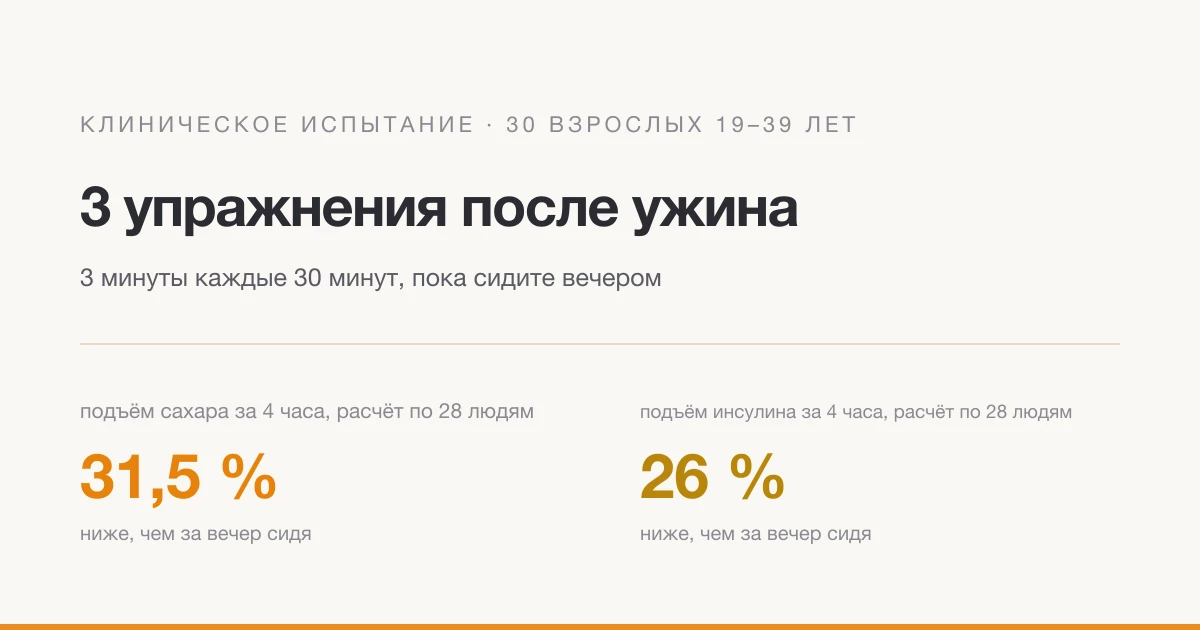
Three simple exercises beside a chair fit into an ordinary evening at home. In a clinical trial, 30 healthy adults aged 19–39 spent two evenings in a laboratory: dinner at the start, dessert two hours later. On one evening they sat without breaks; on the other they did 3 minutes of exercises every 30 minutes. With the exercise breaks, the rise in blood sugar after dinner over 4 hours was almost a third lower than on the sitting evening. Below are the exercises step by step, then what the studies showed.
| What | How much | Why it helps | What the studies showed |
|---|---|---|---|
| Three exercises beside a chair: chair squats, calf raises, standing knee raises | 20 seconds each, 3 rounds in a row = 3 minutes, every 30 minutes | Lower rise in blood sugar after dinner | A laboratory trial, 30 healthy adults aged 19–39, analysis of 28 people: rise in blood sugar over 4 hours 31.5% lower than on the sitting evening |
| Same | Same | Lower rise in insulin after dinner | Analysis of 28 people: rise in insulin over 4 hours 26% lower than on the sitting evening |
| Short movement breaks, walking showed the clearest effect | Various protocols | Lower rise in blood sugar after a meal | Review, 38 trials in the blood sugar rise analysis: lower than with uninterrupted sitting |
The three exercises step by step
Setup. Take a stable chair without wheels and put its back against a wall, or push it against a table so it cannot slide. Set a timer on your phone: each exercise lasts 20 seconds. Wear non-slip shoes and loose clothes. Do all three exercises at one calm pace, ideally counting aloud or to music.
Step 1. Chair squats, 20 seconds. Stand in front of the chair with your back to it, feet shoulder-width apart. Lower slowly, sending your hips back, until you touch the seat, then stand up right away. Keep your back straight and your knees pointing the same way as your toes. If it is hard, do not go all the way down, or lightly hold a support.
Step 2. Calf raises, 20 seconds. Stand beside the chair with a hand on the back for support. Rise onto your toes, pause for a second at the top, then lower smoothly onto the whole foot. Keep the rhythm even, without jerking.
Step 3. Standing knee raises, then lift the straight leg back, 20 seconds. Holding the chair back, lift one knee forward to a comfortable height and put the foot down. Then lift the straight leg back without arching your lower back, and return. Alternate legs.
Putting it together. Do each exercise for 20 seconds in a row: squats, calf raises, knee raises. That is one round, about a minute. Repeat for 3 rounds without stopping, which makes 3 minutes. Then sit down again; about half an hour passes until the next set.
Common mistakes. Do not rush: fast jerks are not needed, an even pace and full control of the movement matter more. Do not hold your breath; breathe freely, counting aloud. Do not arch your lower back or drop onto the chair when squatting. If you feel pain rather than just muscles working, stop and see a doctor.
How to fit it into your evening
Set a repeating 30-minute timer on your phone. While watching a series, do the set during the ad break, between episodes or while the kettle boils. Over the 4 hours of the trial evening that added up to 8 sets of 3 minutes, which is 24 minutes of movement in total. It helps to leave the chair and support in place beforehand, so you stand up at the signal without any preparation. A habit anchor works well: dinner is over, the dishes are cleared, the chair is against the wall and the timer is running. Start the timer when dinner is over, then simply follow the signal. If an evening goes badly and you skip a couple of sets, do not catch up all at once; carry on from the next scheduled time. The value is in regular movement, not in a perfect schedule.
How do you know the pace is right? You can still talk, but your breathing quickens slightly. If you are so out of breath that a sentence is hard, slow down. If squatting is uncomfortable, do a partial squat with support or simply walk around the room: in the review of 38 trials, walking gave the most noticeable result. What matters is that the evening is not one long stretch of sitting, but includes movement you can manage.
An example evening. You finish dinner at 7 p.m. and sit down to a film. At 7:30 the timer goes: three rounds, three minutes, and back to the sofa. At 8:00 the same, in the ad break. By 10 p.m. that adds up to 5 sets, on an ordinary evening with no sportswear and no separate time set aside. If you enjoy the gym or the treadmill, keep them: the chair routine simply fills the hours when you would be sitting anyway.
If you are planning dinner, vegetables, fish, eggs, nuts, avocado and olive oil suit steady blood sugar, without grains or bread. In the trial the dinner was a substantial meal with carbohydrates, followed by dessert; the trial menu is not a recommendation: it was a standard meal, the same on both evenings.
What the studies showed
The trial was a randomized crossover: each participant served as their own control. It included 30 healthy adults aged 19–39, 10 each with normal weight, overweight and obesity; none had diabetes. Each spent two evenings of 4 hours, starting around 5 p.m.: dinner at the start, dessert 2 hours later. On one evening they sat without breaks, on the other they did 3 minutes of exercises every 30 minutes, following a video at one pace (Gale JT Med Sci Sports Exerc 2023. PMID 36921112).
In the analysis of 28 people, the rise in blood sugar over 4 hours (the increase above the starting level) was on average 31.5% lower than on the sitting evening, and the rise in insulin was 26% lower (Gale JT Med Sci Sports Exerc 2023. PMID 36921112). Blood sugar over the whole evening, not the rise but the entire curve, was 7.4% lower in the same 28 people: the figure is smaller because it counts the whole time, including the starting level. The benefit was seen in all three weight groups.
The likely reason: working muscles take sugar out of the blood by a route that does not depend on insulin; the trial itself did not measure the mechanism. A 2026 review pooled studies of short movement breaks: the blood sugar rise analysis included 38 trials, and the breaks lowered the rise in blood sugar after a meal compared with uninterrupted sitting, walking showed the clearest effect (Gale JT Obes Rev 2026. PMID 42070794). This was two evenings in a laboratory in healthy adults, so there are no figures for weeks or months of this routine.
Who should see a doctor first
Talk to your doctor first if you have pain in the knees, hips or back; if you feel dizzy on standing or are at risk of falling (hold the back of the chair); if you recently had surgery or an injury; or if you are pregnant and advised to limit exercise. With diabetes under a treatment plan, blood sugar can fall further during exercise, so discuss this with your doctor.
If you do not have diabetes, see a doctor if your blood sugar is repeatedly below 3.0 mmol/L (54 mg/dL) or above 8.9 mmol/L (160 mg/dL); with diabetes, targets are individual under your doctor's plan, and below 3.0 mmol/L (54 mg/dL) always means seeing a doctor.
Bottom line
Three exercises beside a chair, 20 seconds each, 3 rounds in a row every 30 minutes of the evening, lowered the rise in blood sugar after dinner over 4 hours by 31.5% on average (analysis of 28 people) and the rise in insulin by 26% compared with a sitting evening in healthy adults in a laboratory. Start with one evening and your usual chair. You can check your insulin sensitivity with the HOMA-IR calculator or the insulin resistance test, and tailor exercise and meals to your test results at a consultation.
Source: 3 exercises that lower the rise in blood sugar after dinner: what the trial showed — universum.earth. Dr. Pereligyn.


