

The main point
Good news: to live longer you do not need exactly 10,000 steps. Benefit starts at 3–4 thousand steps a day and for many people levels off at 6–8 thousand. Any addition to what you walk now works for your heart, blood vessels, brain and mood.
| Goal | Steps | Why it helps | What studies showed |
|---|---|---|---|
| Easy start | about 3,800 a day | Lower risk of dementia | 78,430 adults aged 40–79, 6.9 years on average: at 3,826 steps dementia risk was 25% lower |
| Realistic target | 7,000 a day | Lower risk of death, heart and vascular disease, type 2 diabetes, depression | Review of 14 studies: versus 2,000 steps, risk of death 47% lower; 6 studies: heart and vascular disease 25% lower |
| After age 60 | 6,000–8,000 a day | Benefit levels off | 15 studies, 47,471 adults: risk barely falls further |
| Under age 60 | 8,000–10,000 a day | Benefit levels off later | The same 15 studies |
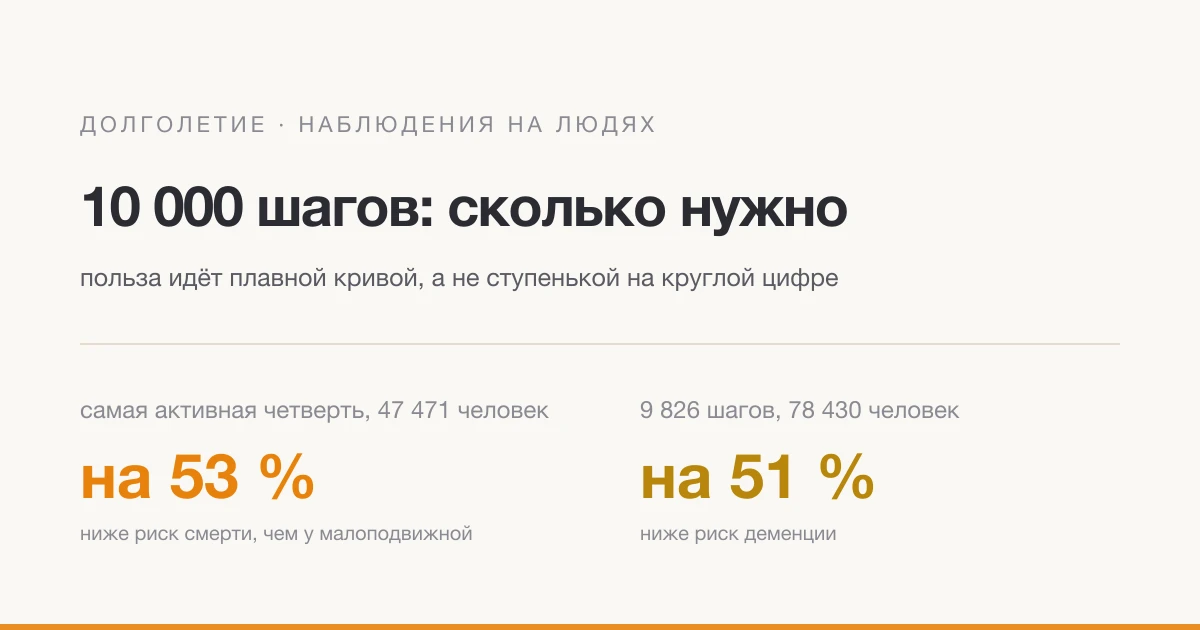
| About 10,000 | 9,826 a day | Most benefit for the brain | 78,430 adults: dementia risk 51% lower |
| Most active quarter | 10,901 a day on average | Lower risk of death | 47,471 adults, 3,013 deaths: 53% lower than the quarter taking 3,553 steps |
Where 10,000 came from
The number 10,000 has long been treated as a required minimum, although, as the authors of a large study put it, it has limited scientific basis (Lee I M JAMA Intern Med 2019. PMID 31141585). Current data paint a gentler picture: benefit does not jump at 10,000 but follows a smooth curve that for many people levels off earlier.
What studies of tens of thousands of people showed
A pooled analysis included 15 studies: 47,471 adults, 3,013 deaths, 7.1 years of follow-up on average. People were split into four equal groups by daily steps. The groups averaged 3,553, 5,801, 7,842 and 10,901 steps. Compared with the least active group, the risk of death was 40% lower in the second group, 45% lower in the third and 53% lower in the fourth (Paluch A E Lancet Public Health 2022. PMID 35247352).
A useful detail for anyone who dislikes records: the second group, about 5,800 steps, already got most of the benefit. After age 60 the curve levelled off at 6,000–8,000 steps, under 60 at 8,000–10,000.
A real-life example. If you walk 3,000–4,000 steps now, going to 6,000 gives noticeably more than a push from 8,000 to 10,000. Start small: get off a stop earlier, walk during a phone call, take the stairs.
Steps and the brain
In 78,430 adults aged 40–79, dementia developed in 866 people over 6.9 years. At 9,826 steps a day the risk was 51% lower, and at 3,826 steps already 25% lower (Del Pozo Cruz B JAMA Neurol 2022. PMID 36066874).
What else walking gives
In a 2025 review, compared with 2,000 steps a day, 7,000 steps were linked to a lower risk of death by 47% (14 studies), heart and vascular disease by 25% (6 studies), type 2 diabetes by 14% (4 studies), depressive symptoms by 22% (3 studies) and dementia by 38% (2 studies). For most of these outcomes the certainty of evidence was moderate (Ding D Lancet Public Health 2025. PMID 40713949).
Does pace matter
Among 16,741 women averaging 72 years, the number of steps mattered more than pace. Women with 4,363 steps a day had a 41% lower risk of death than those with 2,718; with 8,442 steps 58% lower, and beyond about 7,500 steps the curve levelled off. Once steps were accounted for, the link with faster pace weakened and mostly lost significance (Lee I M JAMA Intern Med 2019. PMID 31141585). So walk at a comfortable pace; speeding up is optional.
How to add steps
First learn your usual number: take the average of 3–4 days on your phone counter. Add one thousand steps and hold for a week. Then add another. Split walking into parts: the way to work, a lunch walk, an evening loop. Walking with someone is easier than alone.
Who should see a doctor first
See a doctor before increasing activity if you have chest pain, breathlessness at rest or with light effort, dizziness or fainting, after a heart attack or heart surgery, or strong joint or leg pain when walking. The doctor will suggest a safe pace.
Bottom line
Do not chase a round number. Add one or two thousand steps to your usual count and take 7,000 steps a day as a guide: that is enough to get most of the benefit. If you reach 10,000, that is good too.
Source: 10,000 steps a day: how many you really need — universum.earth. Dr. Pereligyn.


