
Information about medicinal products published on this website is provided for informational purposes only and does not constitute advertising, a public offer, an offer for sale, or instructions for use.
The use of medicinal products is permitted only upon a doctor’s prescription. Consultations are provided by clinic specialists in person or online in accordance with applicable law.
The use of medicinal products is permitted only upon a doctor’s prescription. Consultations are provided by clinic specialists in person or online in accordance with applicable law.
CHECK-UP OF THE THYROID GLAND
A comprehensive check-up allows for the assessment of hormonal status, the detection of autoimmune diseases, nodular formations, and hidden thyroid dysfunctions at early stages.
350у.е.
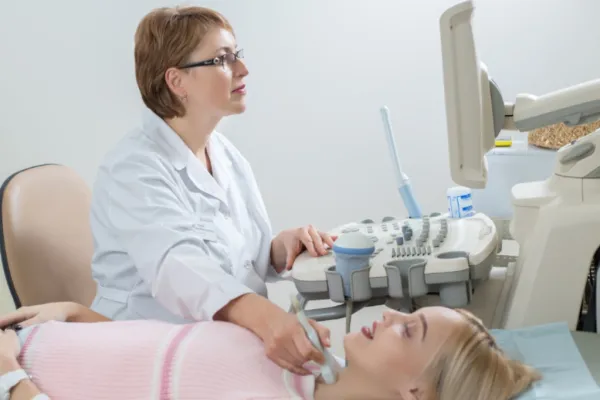
The thyroid gland regulates metabolism, heart function, the nervous system, weight, energy levels, and overall well-being.
Check-up “Thyroid Gland”
Laboratory tests:
Thyroid hormones and antibodies:
- TSH (thyroid-stimulating hormone)
- Free T4
- Free T3
- Anti-thyroglobulin antibodies (Anti-TG)
- Anti-thyroid peroxidase antibodies (Anti-TPO)
Specific markers (if indicated):
- Calcitonin
- Anti-TSH receptor antibodies (Anti-TSHR)
Associated metabolic markers:
- Cholesterol
- Low-density lipoproteins (LDL)
- Ionized calcium (free calcium)
- Vitamin D (25-hydroxyvitamin D, 25(OH)D)
Ultrasound diagnostics
Thyroid ultrasound:
- Anatomical size and volume of the gland
- Structural characteristics of the tissue
- Presence of focal changes (nodules)
- Assessment of regional lymph nodes
Endocrinologist consultation
Medical support
- Analysis and interpretation of test results
- Development of individualized recommendations for further monitoring, diagnostics, or treatment
Guidelines for blood test preparation
1. Fasting (mandatory)
Blood must be drawn in the morning strictly on an empty stomach after 8–12 hours of overnight fasting.
Before the test, do not:
- Eat food
- Drink tea, coffee, or juices
- Chew gum
Drinking one glass of plain still water is allowed and recommended. This reduces blood viscosity and facilitates blood collection.
2. 24 hours before the test
- Completely avoid alcohol
- Avoid overeating
- Refrain from fatty, fried, and spicy foods. Fatty foods may cause lipemia (cloudiness of blood serum), which can make the test impossible to perform.
- Avoid intense physical activity (workouts, heavy physical labor)
- If possible, avoid stress and emotional overstrain
3. On the morning of the test
- Do not smoke for at least 1–2 hours before blood collection
- Arrive at the laboratory 15 minutes before the procedure
- Sit calmly, rest, and normalize your breathing before the blood draw
- It is not recommended to give blood immediately after brisk walking or climbing stairs
Check-up “Thyroid Gland”
Laboratory tests:
Thyroid hormones and antibodies:
- TSH (thyroid-stimulating hormone)
- Free T4
- Free T3
- Anti-thyroglobulin antibodies (Anti-TG)
- Anti-thyroid peroxidase antibodies (Anti-TPO)
Specific markers (if indicated):
- Calcitonin
- Anti-TSH receptor antibodies (Anti-TSHR)
Associated metabolic markers:
- Cholesterol
- Low-density lipoproteins (LDL)
- Ionized calcium (free calcium)
- Vitamin D (25-hydroxyvitamin D, 25(OH)D)
Ultrasound diagnostics
Thyroid ultrasound:
- Anatomical size and volume of the gland
- Structural characteristics of the tissue
- Presence of focal changes (nodules)
- Assessment of regional lymph nodes
Endocrinologist consultation
Medical support
- Analysis and interpretation of test results
- Development of individualized recommendations for further monitoring, diagnostics, or treatment
Guidelines for blood test preparation
1. Fasting (mandatory)
Blood must be drawn in the morning strictly on an empty stomach after 8–12 hours of overnight fasting.
Before the test, do not:
- Eat food
- Drink tea, coffee, or juices
- Chew gum
Drinking one glass of plain still water is allowed and recommended. This reduces blood viscosity and facilitates blood collection.
2. 24 hours before the test
- Completely avoid alcohol
- Avoid overeating
- Refrain from fatty, fried, and spicy foods. Fatty foods may cause lipemia (cloudiness of blood serum), which can make the test impossible to perform.
- Avoid intense physical activity (workouts, heavy physical labor)
- If possible, avoid stress and emotional overstrain
3. On the morning of the test
- Do not smoke for at least 1–2 hours before blood collection
- Arrive at the laboratory 15 minutes before the procedure
- Sit calmly, rest, and normalize your breathing before the blood draw
- It is not recommended to give blood immediately after brisk walking or climbing stairs


